Email drip campaigns for user activation are the back-channel that turns a fresh signup into an engaged user when the in-app onboarding alone is not enough. For most vibe coded SaaS products, the activation drip is one of the highest-leverage growth investments, often lifting first-week retention by 25 to 40 percent. The catch is that most drip campaigns are designed by marketers without input from the product, the result feels generic, the emails get ignored, and the campaign damages sender reputation more than it helps activation.
This piece walks through the seven email sequence that consistently works for SaaS activation, the timing that respects user attention, the personalization that lifts open rates, and the pitfalls that kill the campaign before it gets started.
Why Activation Drips Matter More Than Marketing Emails
The conventional view of drip campaigns is that they are marketing tools, used to nurture cold leads toward a purchase. For SaaS products that sell self-serve, the more important use is activation, the work of moving paying or trial signups from "I just installed this" to "I cannot live without this." The two use cases require completely different content, timing, and metrics.
Activation drips are read by people who have already chosen to use your product, which makes them a fundamentally different audience from cold leads. The emails should treat them as insiders, not prospects. Done well, the campaign feels like personalized concierge guidance. Done poorly, it feels like spam from a service the user thought they could trust.
A 2024 ProfitWell analysis of 600 SaaS activation campaigns found that the median app gained a 23 percent lift in first-week retention from a well-designed drip, and that the lift correlated more strongly with email content quality than with email volume. The teams that wrote 7 thoughtful emails outperformed those that wrote 14 generic ones.
The pattern to copy is the way a good hotel concierge follows up with arriving guests. A polite check-in on day one, a recommendation on day two, a question about how everything is going on day three. Each touch is brief, useful, and clearly tied to the guest's actual experience. Your activation drip should aim for the same posture.
The Seven Email Sequence
After studying activation campaigns at hundreds of SaaS companies, the same seven email skeleton consistently produces good results. The order, timing, and content of each are specific.
Email 1, the welcome. Sent immediately after signup. Short, warm, and specific to the product. Confirms the signup, sets expectations for what they will see next, and includes one direct call to action (usually "complete your first task"). This email gets the highest open rate of the sequence, often 60 to 80 percent.
Email 2, the first action prompt. Sent 24 hours later if the user has not yet completed the activation moment. The content is a focused walkthrough of the single most important first action, with a screenshot or short loom-style video. Skip this email if the user already activated.
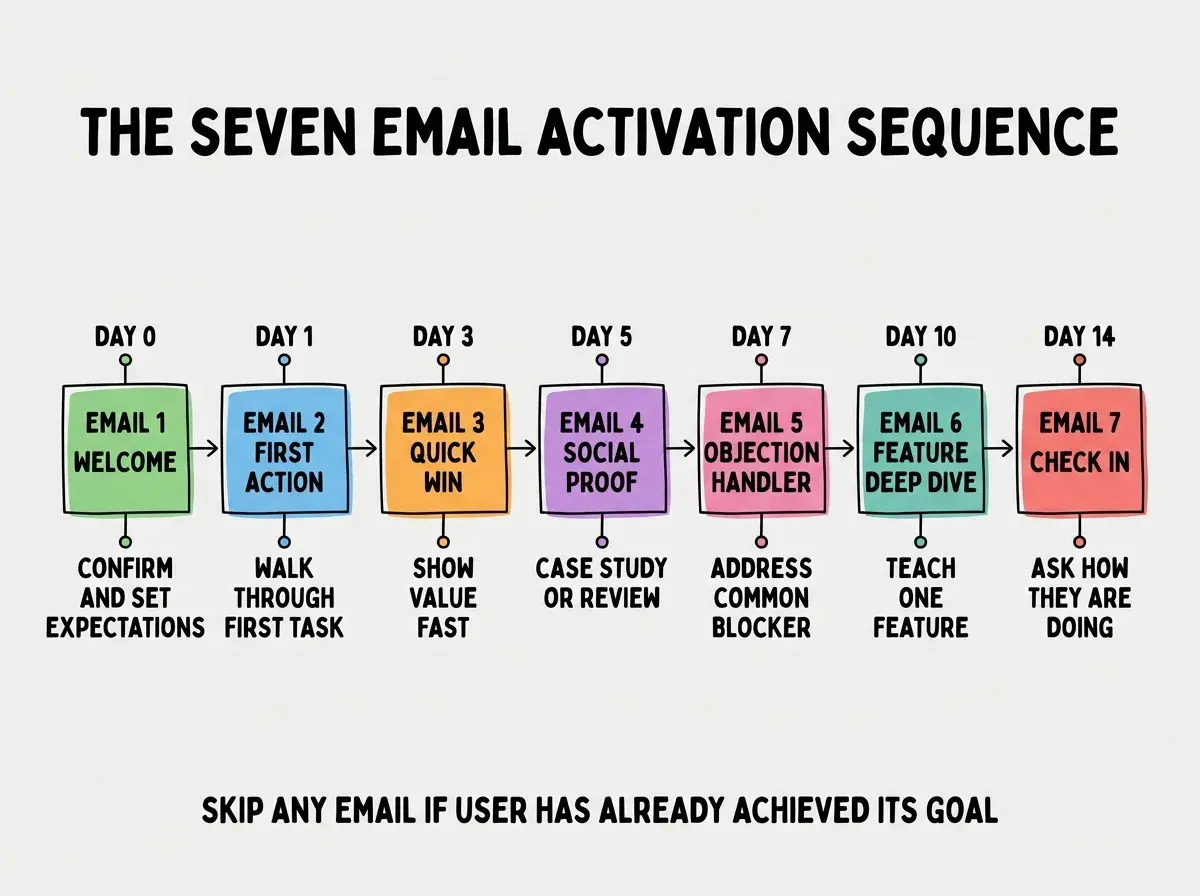
Email 3, the quick win. Sent on day three. Highlights one specific small thing they can do that produces immediate value, distinct from the activation moment. The goal is to give them a second reason to engage, deepening the habit.
Email 4, the social proof. Sent on day five. A short customer story or testimonial relevant to their use case (if you can segment) showing what is possible with the product. This email shifts the message from "here is what to do" to "here is what others have built."
Email 5, the objection handler. Sent on day seven. Addresses the most common reason users churn at this point in the funnel. For developer tools it might be "is this fast enough." For marketing tools it might be "does this integrate with our stack." Each industry has different objections, learn yours and address them directly.
Read more user growth and retention guides
Browse the grow categoryEmail 6, the feature deep dive. Sent on day ten. Teaches one powerful feature the user probably has not discovered yet. The goal is to deepen engagement by showing the product has more depth than the surface.
Email 7, the check-in. Sent on day fourteen. A short, personal email asking how things are going and inviting reply. This email recovers users who have stopped engaging and produces useful qualitative feedback. Founders often answer this email personally for the first 100 or so signups.
The Timing That Respects Attention
The timing matters as much as the content. Three rules cover most cases.
Rule 1, send when they are likely to read. Tuesday through Thursday, 9am to 11am in the user's local time zone, produces the best open rates for B2B. Saturday and Sunday produce the worst. Use the email service's scheduling features to send by time zone.
Rule 2, never two emails in 24 hours. Even if you want to send a cross-sell or a promotion, do not stack it on top of an activation email. The deluge feels desperate and damages sender reputation.
Rule 3, stop sending if they engage strongly. A user who has actively used the product for 7 days does not need email 6 or 7. The drip should taper as engagement increases, not run on a fixed schedule regardless.
The Personalization That Lifts Open Rates
Generic mass emails produce 15 to 25 percent open rates. Personalized emails produce 35 to 55 percent. The personalization that matters is small but specific.
The from name should be a real human. "Pranay from Vibe Coder Blog" outperforms "Vibe Coder Blog Team" by 10 to 20 percent. Use the founder's real name when possible.
The subject line should reference something they did. "Welcome, you just signed up for X" is fine. "Your first task is waiting" is better. "Question about the dashboard you just opened" is better still.
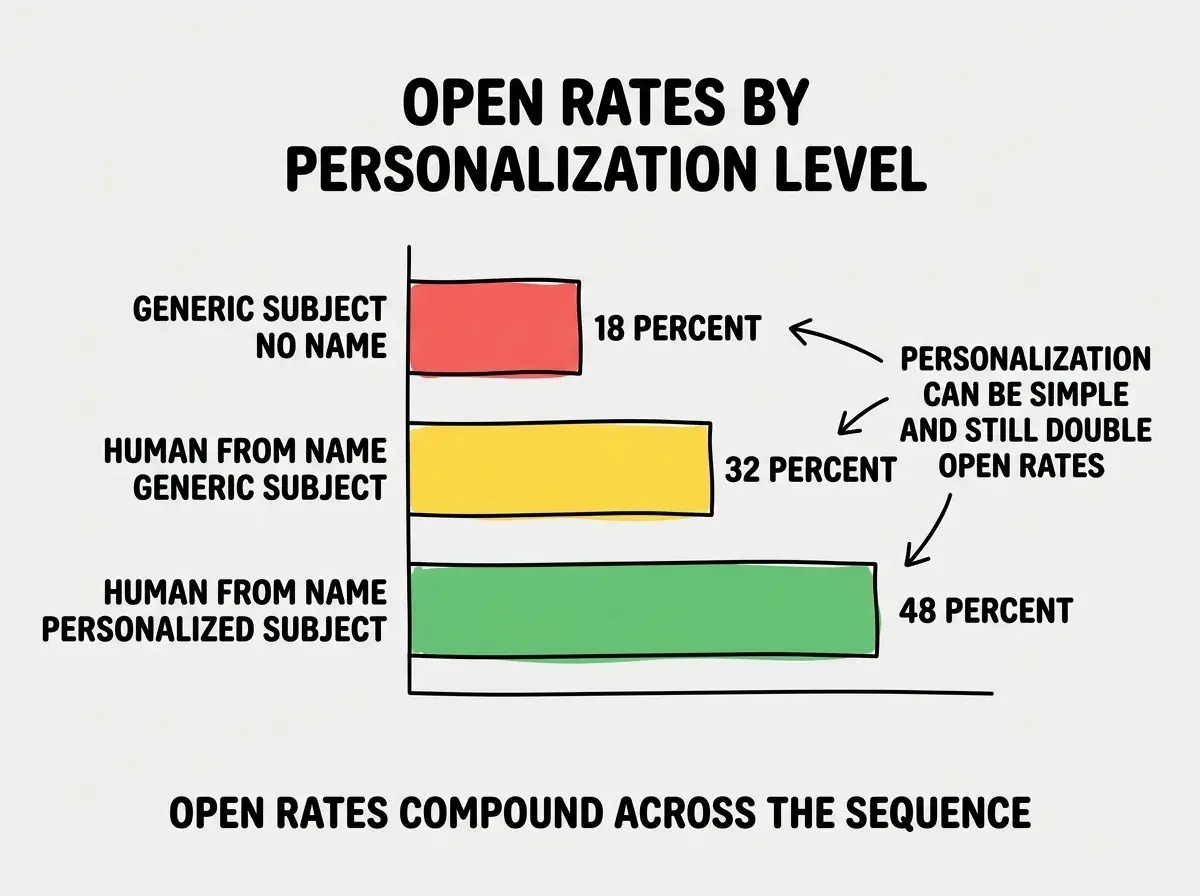
The body should reference their actual usage. "I noticed you imported your first contacts" is much better than "We hope you enjoy the product." Use the data your app already has to make the email feel written for them.
The most expensive activation drip mistake is including a sales pitch in every email. A user who signed up for a free trial and then receives 7 emails pushing the upgrade feels harassed, not nurtured. The drip should be 80 percent value, 20 percent gentle product education, and 0 percent direct sales until the user has actually activated. Sales emails belong in a separate sequence later.
The corollary is that the activation drip is not a marketing campaign. It is a customer success conversation conducted by email. The emotional register should be helpful, not promotional, and the writing should sound like a real person, not corporate marketing.
Dig deeper
A few hand-picked sources if you want to go further.
What This Means For You
The activation drip is one of the cheapest and most leveraged growth investments you can make. Two days of writing and a small implementation effort produce a campaign that lifts retention for every future signup.
- If you're a founder: Write the seven emails this week. Even before you have automation, sending them manually to your first 50 signups produces meaningful retention lift and teaches you what works.
- If you're changing careers: Email drip design is a high-leverage skill that translates across product, marketing, and customer success roles.
- If you're a student: Reverse-engineer the activation drips from products you actually love. Save the emails, note the timing, and analyze what makes them work. The pattern is teachable.
Browse more growth and email guides
Read more grow guides