To navigate the stigma as a designer who codes in 2026, recognize that the stigma flows in both directions (designers who think coders lack taste, coders who think designers lack rigor), build credibility signals that prove your competence in both worlds (a portfolio with shipped products, public technical writing, contributions to open-source design systems), and position yourself as a design engineer or product engineer rather than as either pure designer or pure developer. The hybrid role is increasingly valued in 2026 and the stigma is fading faster than most designers realize.
This piece walks through the stigma in both directions, the credibility signals that work, the positioning patterns, and the four mistakes that keep hybrid designers undervalued.
Why the Stigma Persists Despite Being Outdated
The stigma against designers who code is rooted in old assumptions that no longer hold. Designers were once thought to lack the patience and rigor for code; coders were once thought to lack the visual taste and user empathy for design. Both stereotypes were wrong even when they were common, and AI assistance has made them increasingly indefensible.
What remains is a residual cultural stigma in some communities. Pure designers sometimes view designers who code as having "given up" on design; pure engineers sometimes view designers who code as dilettantes producing low-quality output. Both views are increasingly minority positions but still affect how hybrid designers experience the workplace.
A 2025 Figma survey of 2,000 designers found that designers who could code shipped 2.4x more design ideas to production than designers who could not. The hiring data backed this up: in 2025, "design engineer" job postings grew 230 percent year-over-year while pure designer postings grew 12 percent. The market has decided; the stigma is a lagging cultural artifact.
The pattern to copy is the way bilingual professionals navigate two cultures. They do not pick one side; they move fluently between both, gaining advantages from belonging to neither pure camp. Designers who code follow the same playbook: not pure designers, not pure engineers, but more valuable than either alone.
The Stigma in Both Directions
Understanding the stigma from both sides helps designers who code respond to it appropriately.
From pure designers. "You are not a real designer if you spend time coding." The implicit assumption is that design is a finite skill that competes with coding for attention. The reality is that design and code are complementary; the time you spend coding teaches you what is buildable.
From pure engineers. "Designers who code produce sloppy code." The implicit assumption is that design judgment and code rigor cannot coexist. The reality is that designers who learn to code rigorously produce code that is both functional and well-designed, often with better UX than pure-engineer code.
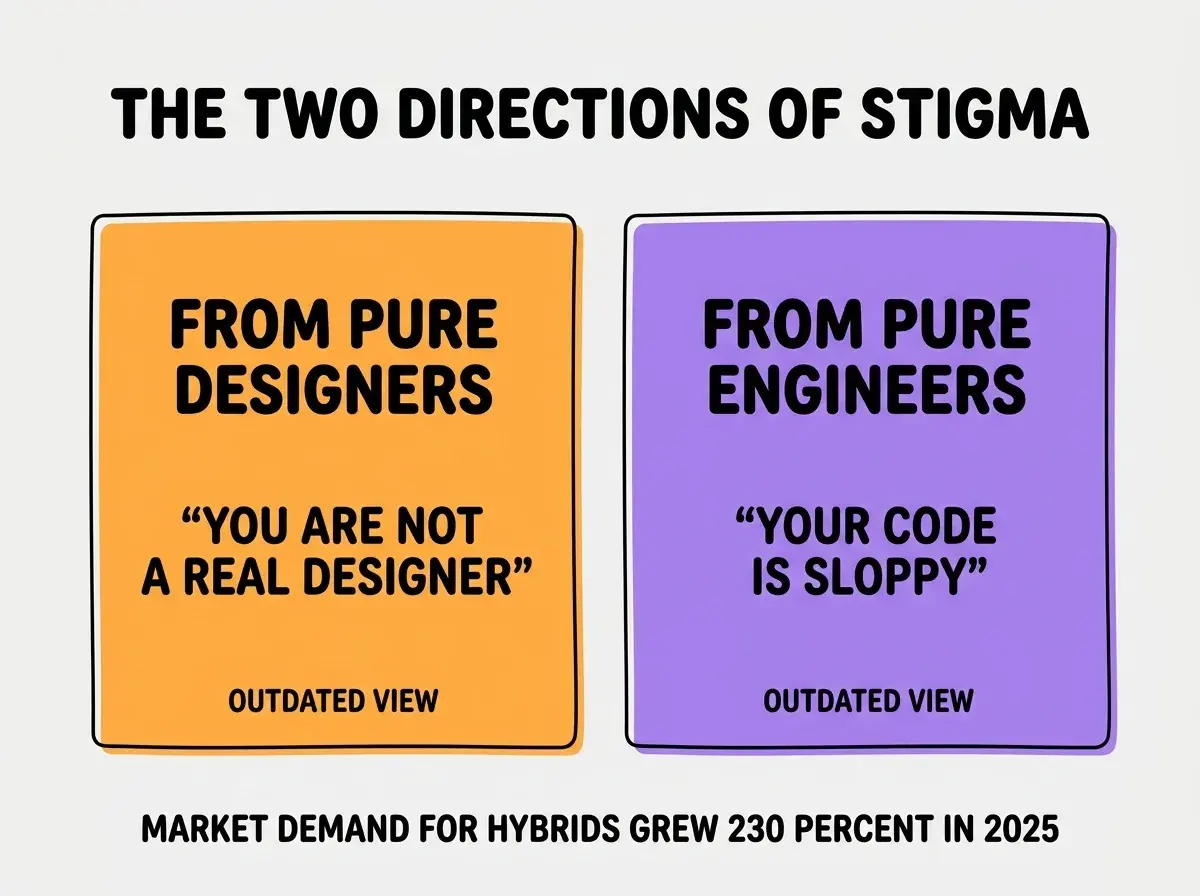
The right response to both is to demonstrate competence rather than argue. Showing the work beats explaining the philosophy.
The Four Credibility Signals That Work
Demonstrating competence requires specific signals that both communities recognize. Four signals carry the most weight.
Signal 1, shipped products. A portfolio of products you both designed AND coded, in production, with real users. The single strongest signal. Demonstrates you can take ideas all the way to working software.
Signal 2, public technical writing. Writing about technical decisions in your design work signals rigor to engineers and depth to designers. Substack, personal blog, Medium all work.
Browse more designer career guides
Read more tools articlesSignal 3, design system contributions. Open-source contributions to design system tools (Radix, shadcn/ui, design token tools) demonstrate competence at the intersection of design and code. Visible in your GitHub.
Signal 4, conference talks or workshops. Speaking publicly about your hybrid practice signals expertise. Local meetups are an easy starting point; conference talks come later.
How to Position Yourself
Positioning is what determines how you are perceived. Three patterns work for designers who code.
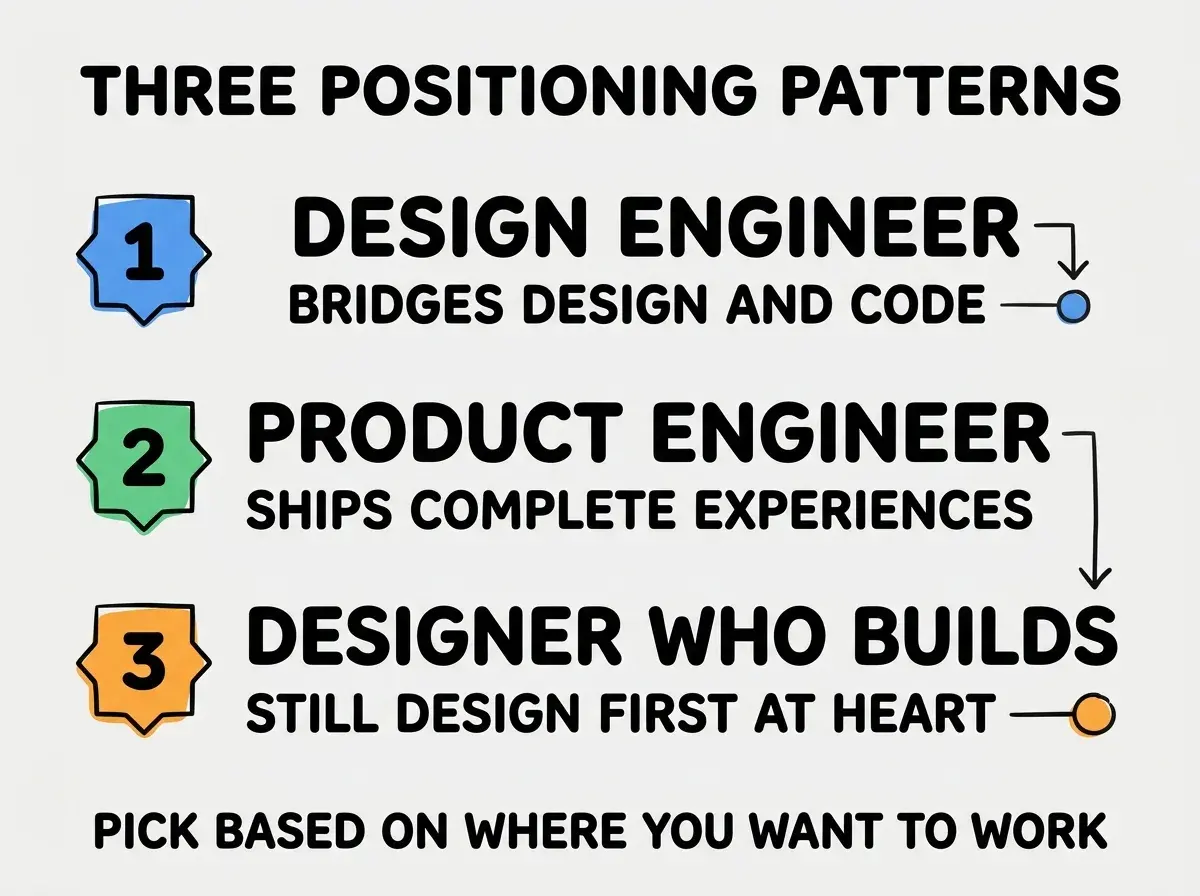
Pattern 1, design engineer. Explicit hybrid role. Common at companies like Vercel, Linear, Stripe, Figma. Carries clear meaning in the industry as of 2026. Often pays better than either pure role.
Pattern 2, product engineer. Emphasizes shipping complete experiences over either pure design or pure engineering. Common at startups where everyone wears multiple hats.
Pattern 3, designer who builds. Still design-first but with shipping ability. Right for designers who want to stay primarily in the design world but with code as a power tool.
The right positioning depends on where you want to work. Design engineer roles pay best at tech-forward companies; designer-who-builds works better at design-led agencies and consultancies.
Practical Steps to Build Credibility
Beyond signals and positioning, four practical steps significantly accelerate the credibility build.
Step 1, ship one project end-to-end. Pick a personal project, design it, code it, deploy it, get real users. The completeness matters more than the polish. One shipped product beats five Figma mockups.
Step 2, document your process publicly. Write about decisions you made, trade-offs you faced, things you learned. Even if no one reads it initially, the act of writing clarifies your thinking and creates a portfolio of intellectual work.
Step 3, contribute to open source consistently. One PR a month to projects you use builds visible expertise over a year. Pick projects at the intersection of design and code (Tailwind, Radix, Tokens Studio, design system libraries).
Step 4, network across both communities. Attend design meetups AND engineering meetups. Be visibly present in both. The visibility is what makes the hybrid identity legible to others.
The four steps compound over time. None of them produces visible credibility in the first month; together they produce a body of evidence that becomes hard to ignore by month twelve. The discipline is doing them consistently rather than perfectly.
Compensation Patterns for Hybrid Designers
Compensation for designers who code is often higher than for either pure designers or pure engineers, but the negotiation requires specific framing. Three patterns work well in 2026.
Pattern A, design engineer salary band. Many companies have a dedicated design engineer band that pays at the intersection of design and engineering bands. Often 15 to 30 percent above pure design at the same level.
Pattern B, stock-heavy compensation. Hybrid designers at startups often get higher equity allocations because they ship more product directly. Reflects the leverage the hybrid role has on company outcomes.
Pattern C, contractor premium. Hybrid designers contracting independently can charge above pure-design and above pure-engineering rates because they reduce coordination costs for clients. Premium of 25 to 50 percent over comparable specialist rates is common.
The right compensation pattern depends on your career stage and risk tolerance. Salary band works at established companies; equity-heavy works at startups; contracting works for independent operators. All three are credible options in 2026.
The most damaging positioning mistake for designers who code is hiding the hybrid nature on resumes and portfolios. Designers sometimes downplay coding skills because they fear it makes them look "less designer"; engineers sometimes downplay design skills because they fear it makes them look "less engineer." The right approach is to lead with the hybrid identity prominently. The companies that value the combination will recognize you immediately; the companies that do not are not where you want to work anyway. Positioning yourself as the hybrid is the filter that finds the right opportunities.
The other mistake is over-optimizing for one community's approval. Designers who code who spend all their time in design Twitter being defensive about coding are using energy that would be better spent shipping. Designers who code who spend all their time in engineering communities trying to prove rigor are doing the same. The healthiest path is to focus on the work, ship products, write publicly, and let the credibility build itself.
What This Means For You
Designers who code are increasingly valued in 2026, and the stigma against them is fading faster than the stigma's holders realize.
- If you're a founder: Hire designers who code if you can. They ship more design ideas to production than pure designers and produce better UX than pure engineers.
- If you're changing careers into design: Learn to code from the start. The hybrid path is increasingly the better path even if it feels less pure.
- If you're a student: Take both design and code seriously. The combination compounds across your entire career.
Browse more designer career guides
Read more tools articles