To implement connection pooling for database performance, follow the four phase approach (size pools based on database connection limits and application concurrency, configure pool behavior for application traffic patterns, monitor pool health to prevent connection exhaustion, and use pooler middleware for serverless or containerized deployments), recognize what makes connection pooling effective versus problematic, and apply the patterns that prevent the connection exhaustion incidents that destroy production reliability. The connection pooling capability matters because database connections are scarce resources that determine application capacity.
This piece walks through the four pooling phases, what makes pools effective, the specific tooling, and the four mistakes that produce connection exhaustion incidents.
Why Connection Pooling Matters
Connection pooling matters because database connections are expensive to establish and limited in supply. The expense matters; without pooling, each request establishes new connection that adds latency and exhausts database connection limits.
The 2026 reality is that AI tools generate database code without considering connection pooling, producing applications that work in development but exhaust connections in production. Without explicit pooling consideration, AI built apps often hit connection exhaustion incidents.
A 2025 production database incident analysis of 500 incidents found that 41 percent traced to connection pooling misconfiguration or absence. Connection exhaustion remains one of the most common production database incidents despite being preventable through proper pooling.
The pattern to copy is the way taxis pool capacity at airports. Taxi pools have limited cars; cars get used efficiently through pooling rather than dedicated assignment. Database connections follow similar pattern; pooling enables efficient use of limited resources where dedicated assignment would exhaust them.
The Four Pooling Phase Approach
Four phases produce effective connection pooling.
Phase 1, size pools based on database limits and concurrency. Pool size matches expected concurrent queries within database connection limits. Sizing matters dramatically.
Phase 2, configure pool behavior for traffic patterns. Idle timeout, max lifetime, health checks. Configuration matches application patterns.
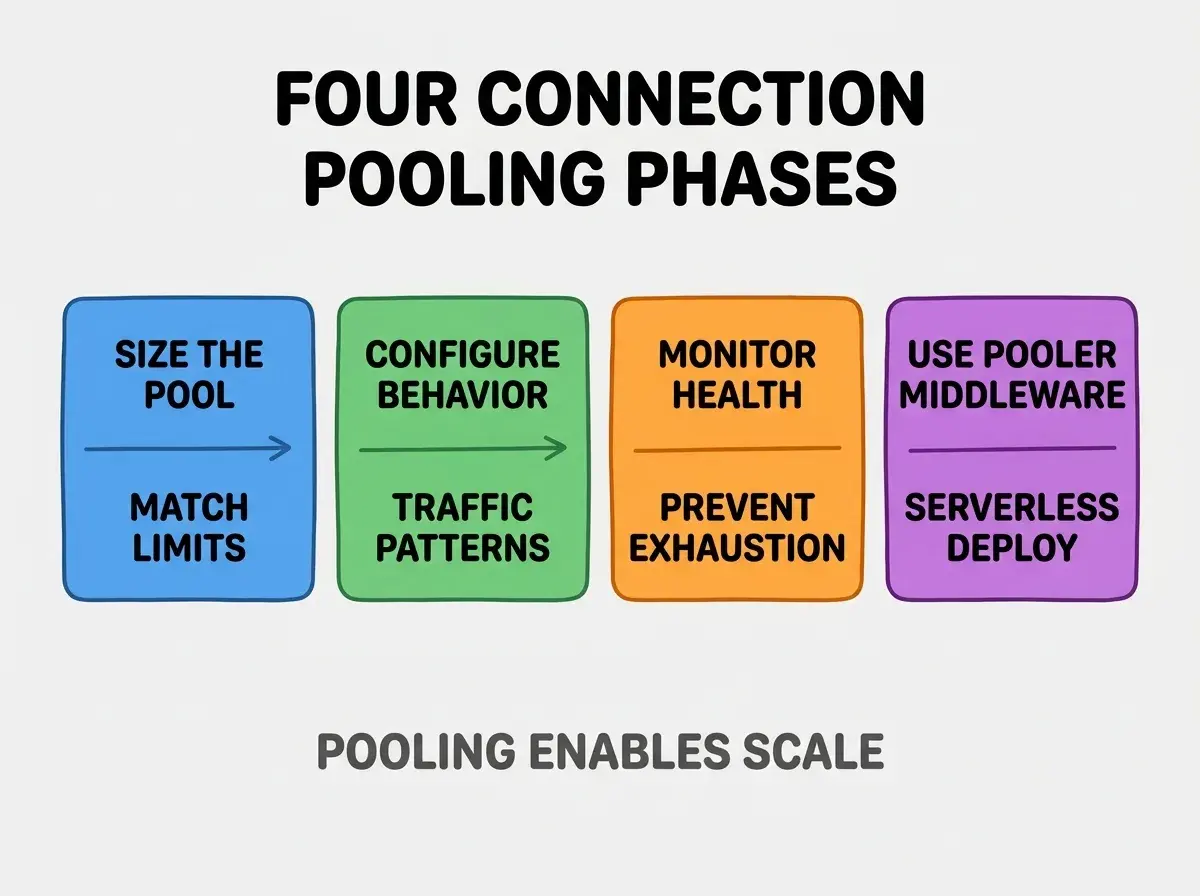
Phase 3, monitor pool health to prevent exhaustion. Active connections, waiting queries, timeout rates. Without monitoring, exhaustion strikes without warning.
Phase 4, use pooler middleware for serverless deployments. PgBouncer, RDS Proxy, Supabase pooler. Middleware handles pooling that serverless cannot handle directly.
What Makes Connection Pools Effective
Three patterns characterize effective connection pools.
Pattern 1, pool size matches concurrent query capacity. Too small produces queueing; too large exhausts database connections. Right size depends on application patterns.
Browse more ship articles
Read more ship articlesPattern 2, idle connections recycled appropriately. Long idle connections waste resources; recycling reclaims them. Recycling balance matters.
Pattern 3, connection health validated before use. Stale connections fail unpredictably; validation prevents using broken connections. Validation overhead trades against reliability.
The Specific Tooling That Works
Three tool categories handle different pooling needs.
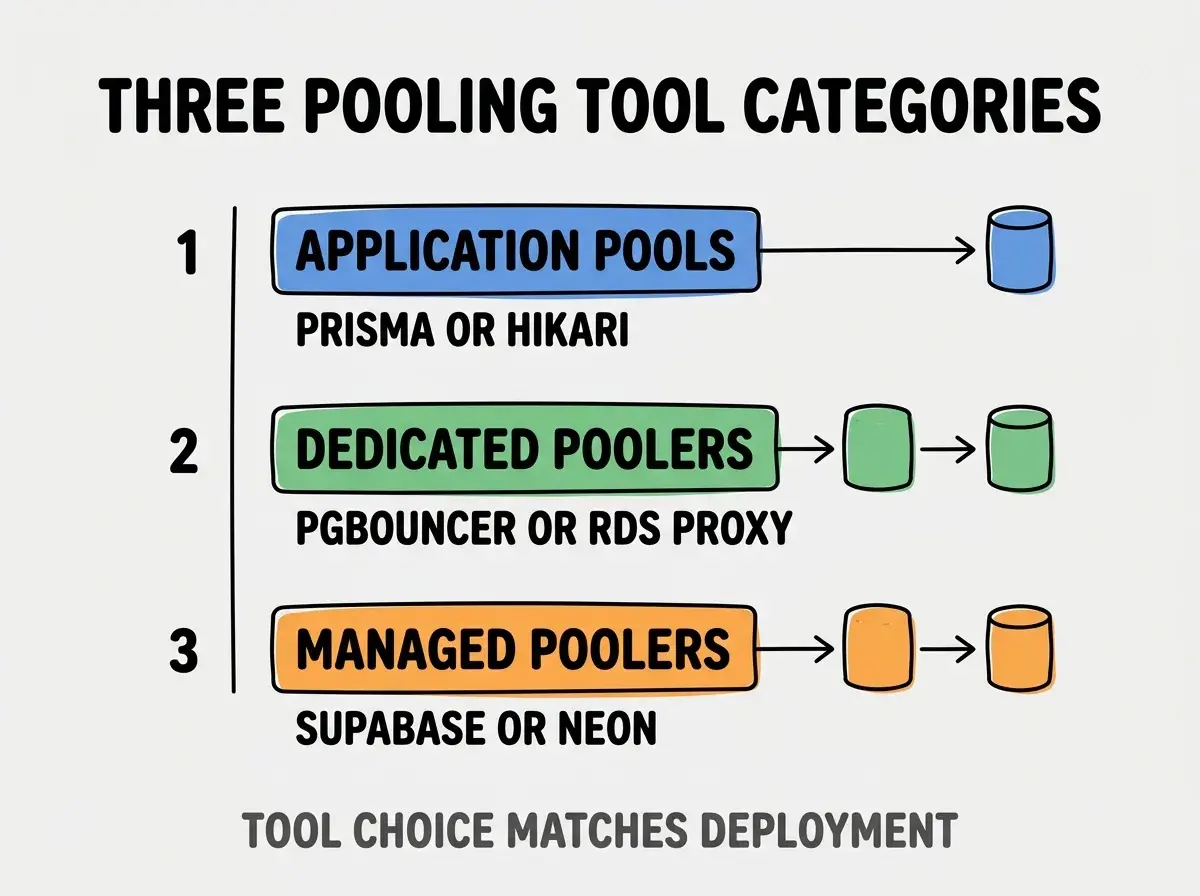
Tool 1, application level pools like Prisma or HikariCP. Pool lives in application; effective for traditional server deployments. Application pools work for stable server counts.
Tool 2, dedicated poolers like PgBouncer or RDS Proxy. Pool lives in dedicated middleware; effective for high concurrency. Dedicated poolers handle thousands of application connections.
Tool 3, managed poolers in services like Supabase or Neon. Pool managed by database service; effective for serverless. Managed poolers reduce operational burden.
What Makes Pooling Sustainable In Production
Three patterns separate sustainable pooling from problematic pooling.
Pattern 1, monitoring with alerting on pool exhaustion. Exhaustion alerts enable response before incidents. Without alerts, exhaustion strikes without preparation.
Pattern 2, capacity planning matching pool sizing. Database capacity must support pool sizes across all clients. Without planning, multiple applications exhaust shared databases.
Pattern 3, graceful degradation when pools saturate. Pool saturation should produce slower responses not failures. Without graceful handling, saturation cascades into incidents.
The combination produces pooling that handles production reality. Without these patterns, pooling configurations work initially but fail under realistic conditions.
How To Configure Pools For Specific Scenarios
Three scenarios deserve specific configurations.
Scenario A, traditional server deployment. Application level pool, sized to expected concurrent queries, idle timeout matching traffic patterns. Standard configuration works.
Scenario B, serverless function deployment. Dedicated pooler middleware, application uses pooler connections. Without middleware, serverless exhausts database connections.
Scenario C, high concurrency real time application. Multiple pool layers, dedicated pooler with application pool, careful capacity planning. High concurrency requires layered approach.
The combination produces configurations matched to deployment patterns. Without scenario specific configuration, generic pools fail at deployment specific challenges.
The most damaging connection pooling mistake is sizing pools larger than database can support. Larger pools feel safer but exhaust database connection limits when multiple application instances open pools simultaneously. The fix is to calculate total connections across all instances and ensure total stays within database limits with headroom; pool size times instance count should not exceed database capacity. Teams that ignore this math produce exhaustion incidents that proper math prevents.
The other mistake is missing pooler middleware for serverless. Serverless functions cannot share connections; without middleware, each function exhausts connections quickly. The fix is to add pooler middleware for serverless deployments.
A third mistake is not monitoring pool metrics. Pool issues happen silently until they cause incidents. The fix is to monitor active connections, waiting queries, and exhaustion events.
A fourth mistake is treating pooling as one time setup. Application patterns change; pool sizing requires periodic review. The fix is to review pool configuration alongside other infrastructure.
How To Diagnose Pooling Problems
Three diagnostic patterns help identify pooling issues.
Diagnostic 1, database connection count compared to pool sizes. Discrepancy reveals leak or misconfiguration. Comparison catches issues before exhaustion.
Diagnostic 2, query latency distribution analysis. Connection wait time appears as elevated query latency. Analysis distinguishes connection issues from query issues.
Diagnostic 3, connection establishment rate monitoring. High establishment rate signals pool too small or connection leaks. Monitoring reveals sizing issues.
The combination produces diagnostic capability for pooling issues. Without diagnostics, pooling issues misattribute to other causes.
How Connection Pooling Will Likely Evolve
Connection pooling will likely continue evolving with deployment patterns.
The first likely evolution is serverless pooling becoming more standard. Managed services for serverless pooling will mature. Maturity reduces serverless pooling complexity.
The second likely evolution is observability tooling improving. Better visibility into pool behavior across deployment patterns. Improvement enables earlier issue detection.
The third likely evolution is AI assisted pool tuning emerging. AI for pool sizing recommendations based on observed patterns. Assistance reduces manual tuning burden.
The combination suggests connection pooling will remain critical but become more tooled. Engineers learning pooling now build skills that remain valuable as tooling improves.
Common Questions About Connection Pooling
Connection pooling raises questions worth addressing directly.
The first question is what pool size to use as starting point. Common starting point is concurrent CPU count times 2; adjust based on observed waiting queries. Sizing matters less than monitoring and adjustment over time.
The second question is whether ORMs handle pooling well. Most ORMs include pool implementations; quality varies. Verify ORM pool behavior matches application patterns rather than assuming default works.
The third question is how to handle pool exhaustion when it happens. Graceful degradation through queueing or fast failure both work; choice depends on application patterns. Without explicit handling, exhaustion produces unpredictable behavior.
What This Means For You
Connection pooling determines database performance and capacity. The four phases, configurations, and monitoring patterns produce framework for effective pooling.
- If you're a senior dev: Connection pooling configuration affects production reliability dramatically. Investment in pooling pays back through avoided incidents.
- If you're an indie hacker: Solo deployments hit pooling issues at modest scale. Plan pooling from start rather than adding after incidents.
- If you're a founder: Help engineering team prioritize pooling configuration. Pooling issues produce visible incidents that erode user trust during growth.
Browse more ship articles
Read more ship articles