To build a Wordle clone with AI in a weekend, copy the four core mechanics that make the original work (5-letter daily word, 6 guesses, color-coded feedback, shared puzzle for everyone), use AI to generate the game logic in JavaScript with React or vanilla DOM, add a small twist that makes your version distinctive (longer words, themed dictionaries, different scoring), and deploy to a free static host. The build takes 4 to 8 hours total and produces a real game your friends can play in their browser.
This piece walks through the four mechanics, the implementation that ships, the twist patterns that work, and the four mistakes that turn Wordle clones into broken puzzles.
Why Wordle Is the Perfect Clone Project
Wordle is the perfect game to clone because the design is mechanically simple but algorithmically interesting. The whole game is letter comparison, color feedback, and guess tracking, which means you can implement the core mechanics in 100 lines of code. The remaining work (UI polish, daily puzzle distribution, sharing) is also small.
The clone exercise teaches you data structures (the dictionary), algorithms (the letter matching), state management (guess history), and frontend basics (the keyboard, the grid, the animations). Few beginner projects pack so many fundamental concepts into so small a codebase.
A 2025 freeCodeCamp survey of 8,000 beginner programmers found that those who built a Wordle clone had a 67 percent higher rate of completing follow-up projects compared to those who built a static landing page as their first project. The combination of clear mechanics, satisfying interactivity, and shareable result creates strong momentum for continued learning. Wordle clones are ideal second-week beginner projects.
The pattern to copy is the way music students learn by transcribing songs they love. Transcribing forces you to understand the structure of music in a way that listening alone does not. Cloning Wordle does the same for game programming: you understand the structure of a puzzle game in a way that playing alone does not.
The Four Core Mechanics
Wordle works because of four specific mechanics. Cloning all four produces a game that feels right; skipping any of them produces a game that feels off.
Mechanic 1, the 5-letter daily word. A single word, the same for everyone in the world, that resets at midnight. The shared experience is core to the social loop.
Mechanic 2, the 6-guess limit. Six tries to guess the word. Tight enough to be challenging, generous enough to be solvable. Changing the limit changes the whole feel.
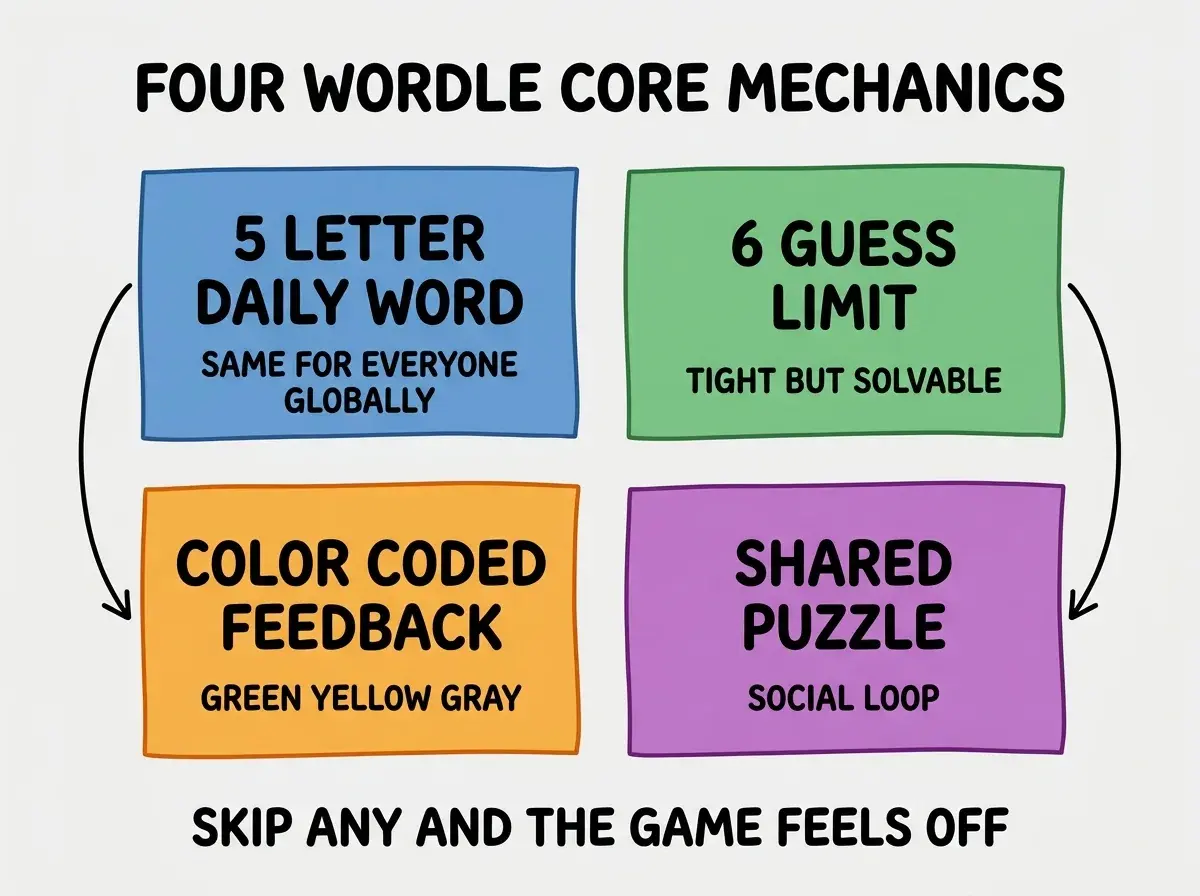
Mechanic 3, color-coded feedback. Green for right letter in right position, yellow for right letter in wrong position, gray for not in word. The visual feedback is the puzzle's core information.
Mechanic 4, shared puzzle. Everyone playing today plays the same word. The shared experience drives the social conversation that made Wordle viral.
The Implementation That Ships
Building Wordle takes about 4 hours of focused work. Three pieces handle most of it.
Piece 1, the dictionary. A list of 5-letter words, both for the daily puzzle and for validating guesses. About 2,000 common words for puzzles, 12,000 valid guesses. JSON file works fine.
Browse more game build guides
Read more build articlesPiece 2, the matching algorithm. Take the player's guess, compare to the answer, return the color for each letter. Subtle edge cases (duplicate letters) require careful logic; AI handles them well if you ask explicitly.
Piece 3, the UI. The grid of guess rows, the keyboard with color-coded keys, the game-end states (win, lose, share). React works well; vanilla JS works too.
The whole thing fits in 300-400 lines of code. The main complexity is the matching algorithm with duplicate letters, which trips up most beginner implementations.
The Twist That Makes It Yours
A pure Wordle clone is fine; a Wordle clone with one distinctive twist is better. Three twist patterns work well.
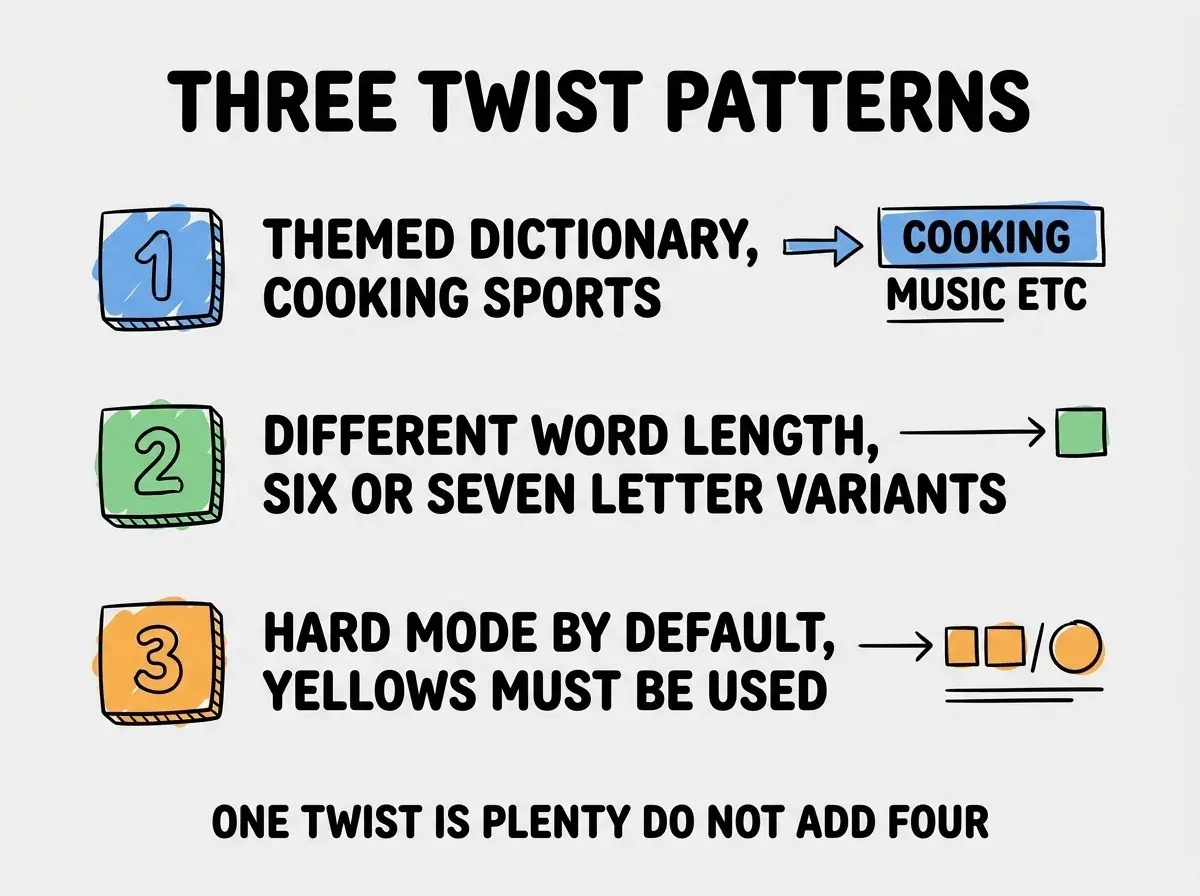
Twist 1, themed dictionary. Cooking words, sports terms, music vocabulary, programming jargon. Same mechanics, themed corpus. Easy to build, fun for niche audiences.
Twist 2, different word length. 6-letter Wordle, 7-letter Wordle, variable-length Wordle. Slightly harder mechanically; significantly different feel.
Twist 3, hard mode by default. Yellow letters must be used in subsequent guesses. Increases challenge without adding complexity. Good for word game enthusiasts.
The right twist depends on your audience. Pick one that you would enjoy playing yourself. If you would not play your own twist, neither will anyone else.
How to Distribute the Daily Puzzle
The "same puzzle for everyone today" is a small but important detail. Two patterns work for the distribution.
Pattern A, deterministic from date. The puzzle for any given date is determined by a hash of the date. No server needed; everyone on the same date sees the same puzzle. Simplest approach.
Pattern B, server-issued. A simple API returns today's word. Lets you curate the puzzles, swap them mid-day if needed, and track stats. More complex but more controllable.
For a hobby project, pattern A wins. For a production game with users, pattern B starts being worth the complexity around 100 daily players. Most beginner builds should use pattern A.
The important constraint is that everyone playing on the same day sees the same word. Without this, the social conversation breaks (you cannot compare results because you played different puzzles), and the shared experience that drives Wordle's appeal disappears.
Sharing Results and Social Loops
Wordle's viral spread came from the share button that copies a spoiler-free emoji grid. Replicating this is what turns a clone from a personal game into a social one.
Step 1, generate the emoji grid. After the game ends, build a string with one emoji per guess (green/yellow/black squares) representing the result. Format with the puzzle number and your guess count.
Step 2, copy to clipboard. Use the navigator.clipboard API to put the share text on the user's clipboard with one click. Show a "copied" confirmation.
Step 3, encourage sharing. A simple message like "share your result" with the share button below makes the social loop explicit. Without prompting, most players forget to share.
The share feature takes 30 minutes to add and dramatically changes the game's reach. A Wordle clone with no share feature is a personal puzzle; a Wordle clone with the share feature is a social game that friends compare results on.
The most damaging Wordle clone mistake is getting the duplicate letter logic wrong. The naive implementation marks both Es in "EERIE" as yellow if the answer is "ELITE," but the correct behavior depends on which Es are in the right position and how many Es the answer has total. The rule (each letter in your guess gets matched at most once against the answer's letters, prioritizing exact position matches) is subtle and trips up most beginner implementations. The fix is to ask the AI explicitly to handle duplicates correctly and test with words that share letters. Get this right and your clone feels right; get it wrong and players notice immediately.
The other mistake is over-investing in animations and polish before the core game works. Beautiful keyboard animations on a Wordle clone with broken matching logic is unshippable. Get the core game playable first, polish second. The polish takes 30 minutes when the game is solid; on a buggy game it never gets done because the bugs always come first.
What This Means For You
A Wordle clone is one of the best beginner projects in 2026. The mechanics teach fundamental skills, the result is shareable, and the build fits in a weekend.
- If you're a founder: Build a Wordle clone as your first weekend project before tackling your business idea. The mechanics teach state and feedback patterns you will use everywhere.
- If you're changing careers: A working Wordle clone is portfolio-ready and demonstrates that you can ship interactive code.
- If you're a student: Wordle clones are the perfect second-week project. Easy enough to finish, hard enough to feel like real programming.
Browse more game tutorials
Read more build articles