To build a text-based adventure game with AI in 2026, structure your game around a node graph where each location is a node with text and choices, store the entire game as a JSON file you can edit without touching code, use AI to generate both the room descriptions and the game engine, and add small touches (inventory, save state, simple combat) only after the basic exploration loop is fun. The build takes 3 to 5 hours for someone new to game programming, and produces a real game you can iterate on for weeks.
This piece walks through the data structure, the four narrative patterns that work, the AI prompts that produce engaging writing, and the four mistakes that turn text adventures into dry exposition.
Why Text Adventures Are an Underrated Beginner Project
Text-based adventure games sound old-fashioned, and that is exactly why they are perfect for beginners. There are no graphics to design, no animation loops to debug, no input timing to handle. The entire game is a series of text screens where the player picks a choice and the next screen appears. The simplicity exposes you to the core programming concepts (state, conditionals, data structures) without burying them under complexity.
The 2026 advantage is that AI is exceptionally good at both generating the engine code AND generating the room descriptions and dialogue. A text adventure that previously required either deep programming OR deep writing now requires neither. AI handles both, and you direct the experience.
A 2025 itch.io study of 10,000 first-time game developers found that text-based games had the highest completion rate (78 percent reached a playable state) compared to platformers (34 percent) and 3D games (12 percent). Completion is a better predictor of skill development than ambition; finishing five small text adventures teaches more than abandoning one ambitious 3D game. Text adventures are the highest-finishing-rate game genre, period.
The pattern to copy is the way novelists write short stories before novels. The constraints of the short form force you to make every word count, which is exactly the skill set you need before tackling longer work. Text adventures are the short stories of game development.
The Four Narrative Patterns That Work
Different text adventures use different narrative patterns. Knowing which pattern fits your game upfront prevents the most common structural problems.
Pattern 1, exploration map. Player wanders a world (rooms connected by directions: north, south, east, west). Pick up items, solve puzzles, find the goal. Classic Zork structure. Highest replayability.
Pattern 2, branching narrative. Player makes choices that change the story. Each choice leads to a different branch. Closer to a Choose Your Own Adventure book. Highest emotional impact.
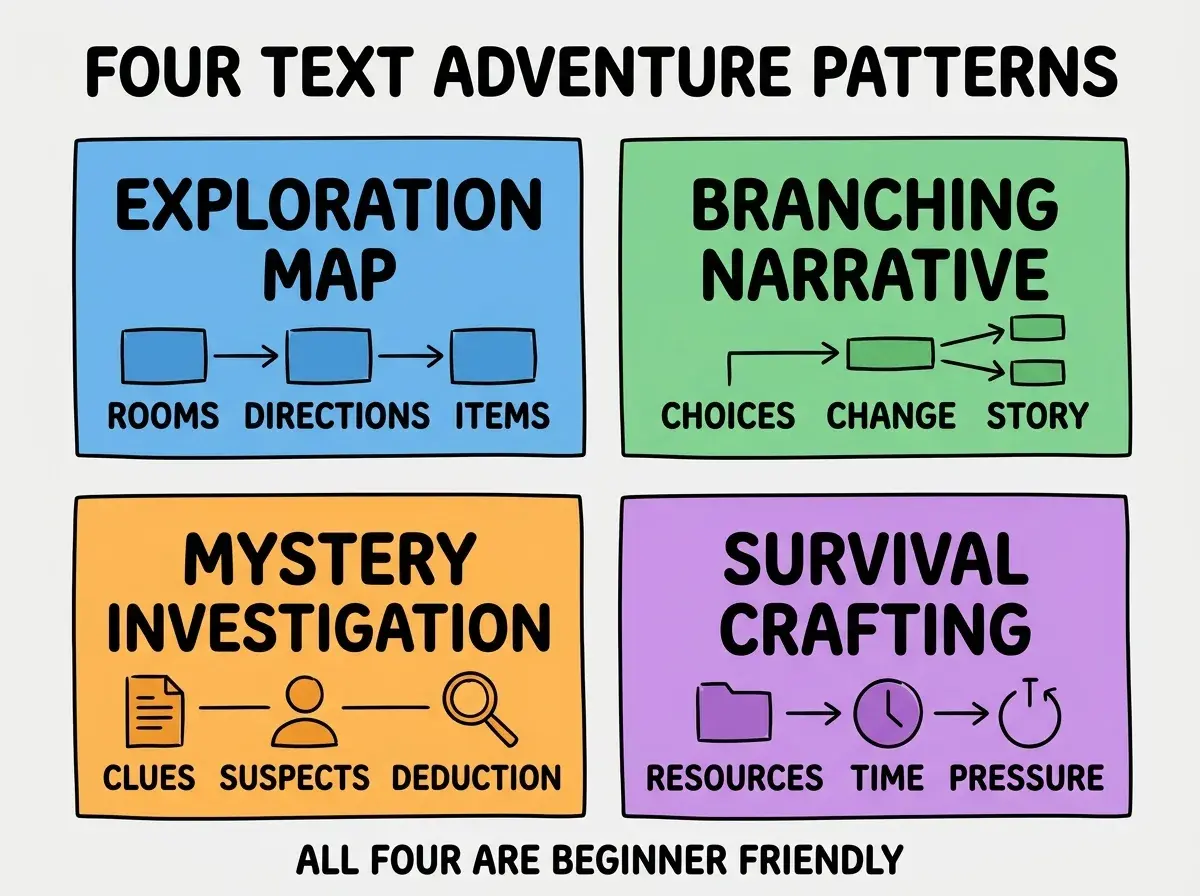
Pattern 3, mystery investigation. Player gathers clues, interviews suspects, deduces the solution. Detective stories work well in text. Highest intellectual engagement.
Pattern 4, survival/crafting. Player manages resources (food, water, energy) and tries to survive a hostile environment. Adds a strategic layer to the narrative. Highest engagement over multiple plays.
The Data Structure That Scales
The key architectural decision is storing the game as data, not as code. A JSON file describing rooms, items, and choices lets you iterate on the game without touching the engine.
Structure 1, the room. Each room has an ID, a description, a list of available actions/exits, and any items present.
Browse more game build guides
Read more build articlesStructure 2, the player state. Current room ID, inventory array, any flags (has key, killed monster, met character X). Stored separately so saves are easy.
Structure 3, the action. Each action has a label (what the player sees), a destination room, optional conditions (requires item X), and optional side effects (adds item Y to inventory).
The whole game can fit in one JSON file for a small game, or split across files for a larger one. The engine code that interprets the JSON is small (200-300 lines) and never changes; you grow the game by adding to the JSON.
How to Make the Writing Fun
Code is half the game; writing is the other half. Three patterns separate text adventures players enjoy from text adventures they abandon.
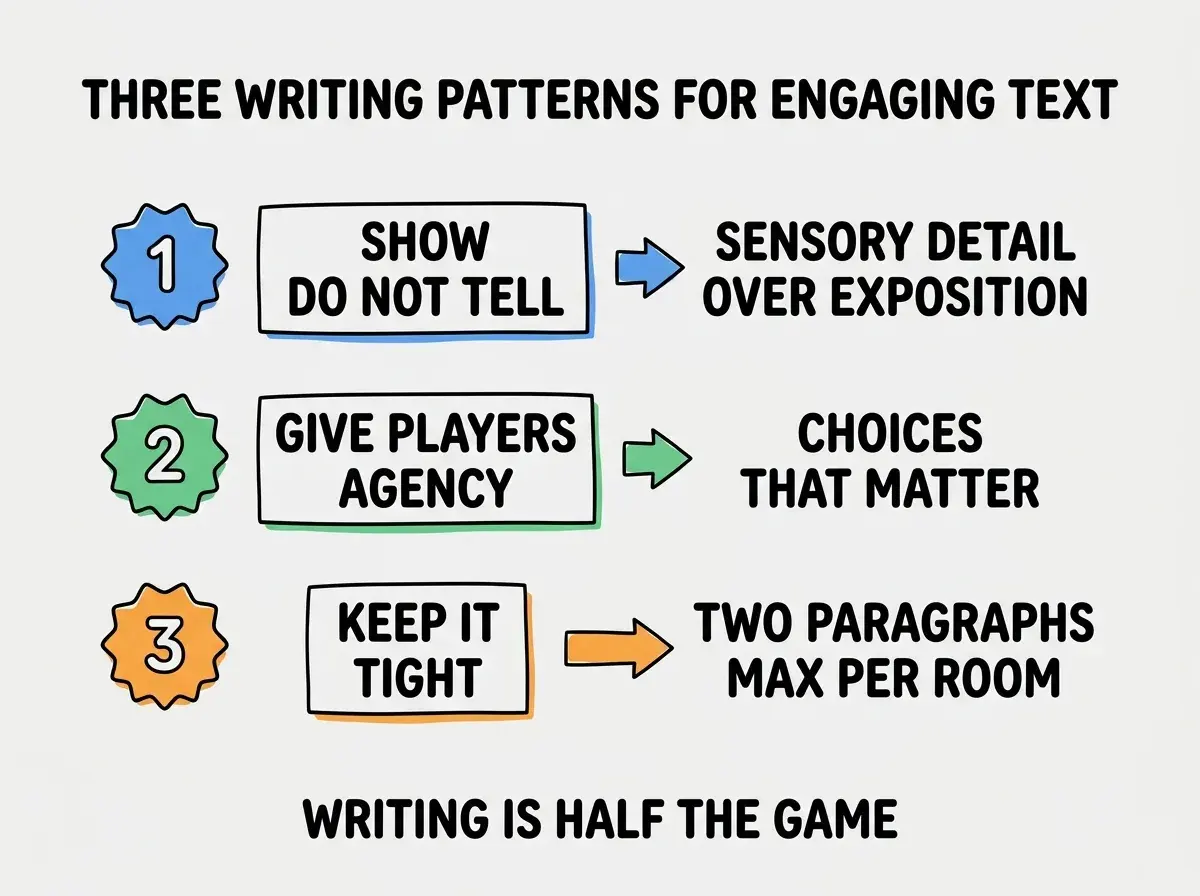
Pattern 1, show do not tell. Instead of "the room is dark and scary," write "the only light comes from a flickering torch on the wall, casting shadows that move when you do." Sensory detail beats exposition.
Pattern 2, give players agency. Choices that change something (story, state, inventory) feel meaningful. Choices that lead to the same place feel pointless. Make every choice matter.
Pattern 3, keep it tight. Two paragraphs maximum per room. Players want to play, not read essays. Dense, evocative writing beats verbose description every time.
Using AI for Writing AND Code
AI shines at both halves of text adventures. Use it for both, but with different prompts.
Code prompts. "Build a JavaScript text adventure engine that reads from a JSON file with rooms, items, and choices. Render the current room, accept input for choices, update player state, persist to localStorage."
Writing prompts. "Write a 2-paragraph room description for a haunted library. Player just entered. Include: visible exits, atmosphere, one interactive item. Voice should be slightly ominous but not over-the-top."
Iteration prompts. "The room description above is too long. Cut to one paragraph but keep the atmosphere."
The right pattern is to draft the whole game's room descriptions first, then build the engine, then plug them together. Separating the writing pass from the building pass produces better quality on both.
Iteration Tips After the First Playthrough
Once the game is playable end-to-end, iteration is where the quality comes from. Three patterns make iteration productive.
Tip 1, playtest with friends. Watching someone else play your text adventure reveals problems you cannot see yourself. The choices you thought were obvious are confusing; the descriptions you thought were vivid are flat. Friend feedback is the most valuable design input you can get.
Tip 2, track where players quit. Add simple logging that records which room players are in when they close the tab. The room with the highest quit rate is your weakest section. Rewrite it.
Tip 3, add one new feature per iteration. Inventory system, save/load, simple combat, multiple endings. Each addition takes 30-60 minutes with AI help. Adding one per playtesting session keeps the game improving without breaking what already works.
The discipline of small focused iterations beats the alternative of a big rewrite every time. Players experience your game as a series of moments; improving one moment per iteration produces dramatic improvement over a few weeks.
The most damaging text adventure mistake is over-engineering the engine before the story is fun. Beginners often spend 80 percent of their time on the engine (parser, save system, inventory management) and 20 percent on the writing, then ship a technically impressive game with boring content. The right ratio is the opposite. Spend 80 percent of the time on writing rooms, designing puzzles, and shaping the narrative. Spend 20 percent on the engine. Players remember the story, not the parser. The engine is only worth as much as the story it serves.
The other mistake is making puzzles that require trial and error rather than deduction. "Try every item on every NPC until something works" is bad puzzle design that players hate. "Combine the clues you have to figure out the right action" is good puzzle design that players love. Test puzzles on friends before shipping; if they need hints, the puzzle is too obscure.
What This Means For You
Text adventures are an underrated beginner project that teaches both programming and writing. The investment is small, the result is shareable, and the skills transfer broadly.
- If you're a founder: Build a text adventure to learn programming fundamentals. The data-driven architecture mirrors what real apps look like.
- If you're changing careers: Text adventures show off both code and creative skills. Hiring managers like the combination.
- If you're a student: Build a text adventure as your first creative project. The constraints teach you to make every detail count.
Browse more game tutorials
Read more build articles