To build a podcast transcriber and note taker with AI, follow the four phase approach (define what podcast formats and note types matter for your listening habits, build the audio ingestion pipeline that handles podcast feeds and uploaded files, design the AI processing layer that produces transcripts and structured notes, and ship with the search and export patterns that make notes useful weeks later), recognize what separates podcast tools that change listening from tools that get abandoned, and apply the patterns that produce sustained personal use. The transcriber matters because it turns ephemeral audio into searchable knowledge.
This piece walks through the four phases, the AI processing patterns, the specific tooling, and the four mistakes that produce podcast tools listeners abandon.
Why Podcast Transcribers Matter For Personal Use
Podcast transcribers turn audio content into searchable text, dramatically expanding how listeners can use podcast information. The transformation matters; without transcription, podcast knowledge stays trapped in audio that can only be reviewed by re listening.
The 2026 reality is that AI transcription has reached quality where personal use becomes practical. Whisper and similar models produce accurate transcripts that previously required expensive services or manual work.
A 2025 podcast listener survey of 800 active listeners found that listeners using transcription tools retained 64 percent more information from podcasts and revisited content 4x more often compared to listeners relying on memory alone. The retention difference reflects how much information value transcription unlocks.
The pattern to copy is the way photographers digitized their archives. Photographers who digitized old photos suddenly had searchable, shareable, organizable archives that physical photos could not provide. Podcast transcription follows similar pattern; transcripts unlock value that audio alone cannot.
The Four Phase Approach
Four phases produce podcast tools listeners use weekly.
Phase 1, define what podcast formats and note types matter. Interview podcasts, narrative podcasts, education podcasts each benefit from different note structures. Defined scope determines tool design.
Phase 2, build audio ingestion handling feeds and uploads. RSS feed integration, manual upload, batch processing. Ingestion determines what content becomes processable.
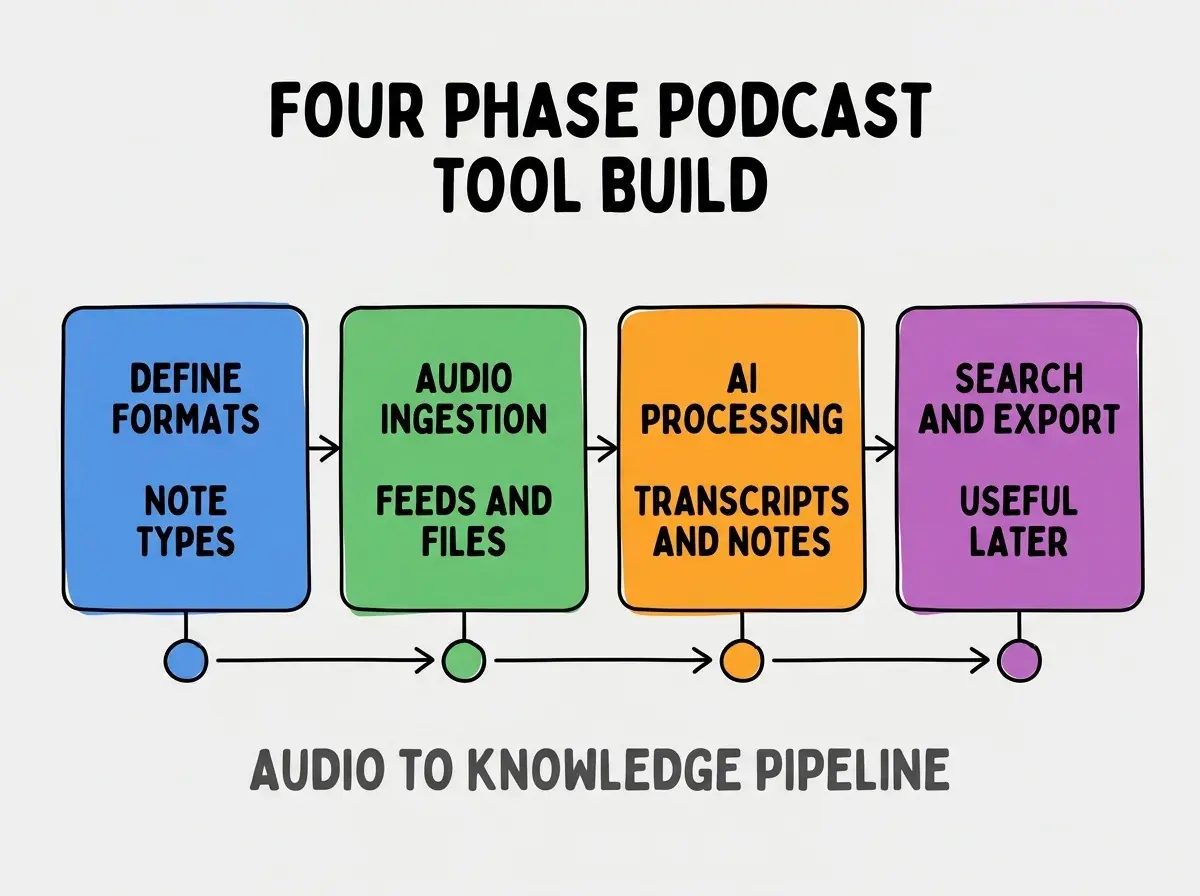
Phase 3, design AI processing for transcripts and structured notes. Transcription, summarization, entity extraction, key quote identification. AI processing determines note quality.
Phase 4, ship with search and export making notes useful. Full text search, export to notion or obsidian, sharing snippets. Search and export determine long term value.
The AI Processing Patterns That Work
Three patterns produce AI processing that produces useful notes.
Pattern 1, transcription with speaker identification. Knowing who said what matters dramatically for interview podcasts. Speaker identification transforms raw transcript into structured conversation.
Browse more personal builds
Read more build tutorialsPattern 2, automatic summary generation at multiple lengths. 50 word, 200 word, 500 word summaries. Different summary lengths serve different needs from quick recall to deep review.
Pattern 3, key quote extraction with timestamps. Memorable quotes pulled with audio reference. Quotes enable sharing and revisiting that pure transcripts cannot.
The Specific Tooling That Worked
Three tool categories combine effectively for podcast transcriber building.
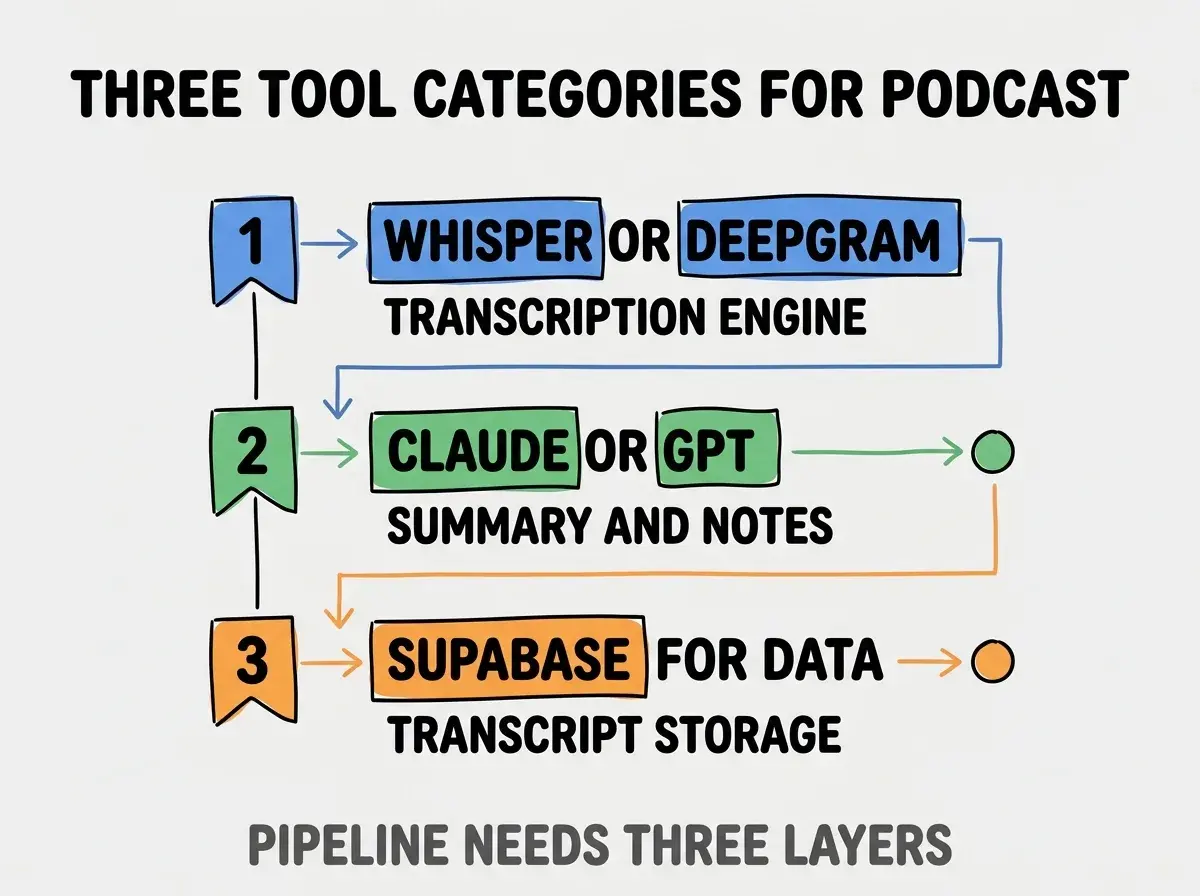
Tool 1, Whisper or Deepgram for transcription engine. Whisper local for privacy, Deepgram cloud for speed. Transcription quality determines downstream value.
Tool 2, Claude or GPT for summary and structured notes. AI processing transforms raw transcript into searchable knowledge. AI choice affects note quality.
Tool 3, Supabase for transcript and note storage. Full text search, structured data, file references. Storage enables search and revisit.
What Makes Podcast Tools Get Sustained Use
Three patterns separate sustained personal use from quick abandonment.
Pattern 1, integration with existing listening apps. Apple Podcasts, Spotify, Overcast integration eliminates switching costs. Without integration, switching costs prevent use.
Pattern 2, search across entire transcript archive. Finding old content matters dramatically; search makes archive valuable. Without search, archive becomes write only.
Pattern 3, export to existing knowledge management. Notion, Obsidian, Roam integration places notes where they already work. Without export, notes stay isolated.
The combination produces tools listeners actually use weekly. Without these patterns, tools get tried then abandoned for podcast app native features.
How To Build Your First Podcast Tool
Three implementation patterns help first podcast tools succeed.
Pattern A, start with one podcast you actively listen to. Single podcast validates tool with familiar content. Multi podcast from start often produces incomplete fits.
Pattern B, dogfood for 4 weeks of listening. Real listening reveals usability issues that brief testing misses.
Pattern C, instrument note revisit rate. Are users revisiting notes weeks later? Without revisit, value claims stay anecdotal.
The combination produces first tools that establish use patterns. Without these patterns, first tools often launch with features users do not actually use.
The most damaging podcast tool mistake is treating transcription as the entire product. Transcription is starting point, not destination; raw transcripts have limited value compared to structured, searchable, exportable notes. The fix is to invest in AI processing layer that transforms transcripts into knowledge artifacts; tools that stop at transcription produce text walls that listeners do not use, while tools that produce structured notes with summaries and quotes get sustained use.
The other mistake is missing the personal nature of personal podcast tools. Generic features serve no one well; personal tools need personalization to specific listening patterns. The fix is to build for your own listening patterns first.
A third mistake is overengineering for scale. Personal tools serve one user; enterprise patterns waste effort. Build for personal scale first.
A fourth mistake is treating audio quality as solved. Podcast audio varies dramatically; tools must handle various qualities gracefully.
How To Handle Specific Podcast Formats
Three format patterns deserve specific approaches.
Format A, interview podcasts with multiple speakers. Speaker identification matters dramatically; extract key insights per speaker. Format specific processing improves notes quality.
Format B, narrative podcasts with single host. Speaker identification simpler; topic and narrative arc matter more. Different processing serves different format.
Format C, education podcasts with structured content. Often have outline structure; preserving structure helps revisit. Format aware processing extracts more value.
The combination produces format specific value. Without format awareness, generic processing misses format specific opportunities.
How Podcast Tools Will Likely Evolve
Podcast tools will likely continue evolving with AI capability improvements.
The first likely evolution is real time processing becoming standard. Live transcription during listening rather than after. Real time enables interactive listening.
The second likely evolution is multi modal extraction. Identifying when slides or visuals are referenced. Extraction enables richer notes from podcast plus visual content.
The third likely evolution is cross podcast knowledge graphs. Linking concepts across podcasts. Graphs enable knowledge work that individual podcast notes cannot.
The combination suggests podcast tools will become more capable but also more strategic to build. Builders learning patterns now build skills that remain valuable as tools evolve.
Common Questions About Building Podcast Tools
Podcast tool building raises questions worth addressing directly.
The first question is whether to use Whisper local versus cloud transcription. Local Whisper preserves privacy but requires GPU; cloud services like Deepgram are faster but cost per minute. Choose based on privacy requirements and processing volume.
The second question is how to handle podcast feed updates. RSS polling versus push patterns; choice affects timeliness and infrastructure cost. For personal use, hourly polling usually sufficient.
What This Means For You
Podcast transcriber and note taker tools turn audio listening into knowledge work. The four phases, AI patterns, and tool combinations produce tools that change how listeners use podcasts.
- If you're a creative: Personal podcast tools demonstrate AI capability beautifully. Building for yourself produces immediate value while building portfolio.
- If you're a career changer: Podcast tools are accessible AI projects that demonstrate real skills. Build for your own listening to produce both tool and learning.
- If you're an indie hacker: Podcast tools have viable monetization paths for users beyond personal use. Personal tool can become product.
Browse more personal builds
Read more build tutorials