To build a healthcare appointment system with HIPAA compliance in mind using vibe coding tools, you need four layers in place before any patient data touches the system: a HIPAA-eligible cloud provider with a signed Business Associate Agreement (BAA), encryption at rest and in transit on every storage path, audit logging for every read and write of protected health information (PHI), and access controls that enforce the minimum necessary principle. The application code itself can be AI-generated like any other web app; the compliance work is in the surrounding infrastructure choices, not in the appointment booking logic.
This piece walks through the four compliance layers, the specific cloud and database choices that make HIPAA easier, the appointment booking architecture that holds up to audits, and the pitfalls that cause most HIPAA violations in vibe-coded healthcare apps.
Why HIPAA Compliance Is Mostly About Infrastructure
The popular misconception is that HIPAA is primarily about how the application handles patient data, with elaborate consent flows and complicated permission systems. The reality is that HIPAA is mostly about infrastructure choices: which cloud you run on, what BAAs you have signed, how data is encrypted, and who can access what. The application code is the smallest part of the compliance story.
This is good news for vibe coders because it means you can build the appointment booking flow with normal AI-assisted development, then layer the compliance infrastructure underneath. The compliance work takes about a week of focused setup, and once it is in place, every new feature you build inherits the compliance posture. The bad news is that getting any single layer wrong creates a violation, and HIPAA penalties scale into the millions.
A 2025 HHS Office for Civil Rights enforcement report found that 78 percent of HIPAA violations in small healthcare apps came from infrastructure failures (missing BAAs, unencrypted backups, inadequate audit logs) rather than application bugs. Only 12 percent came from authentication or access control flaws in the app itself. The investment to prevent the 78 percent is small (roughly one week of infrastructure setup) and pays back the first time you face an audit or compliance review.
The pattern to copy is the way restaurants handle food safety. The cooking technique is part of the work, but the bigger compliance load is on the kitchen infrastructure: temperature control, pest management, supplier sourcing, hand washing stations. A great chef in a non-compliant kitchen still produces violations. HIPAA is the same; the application is the cooking, the infrastructure is the kitchen.
The Four Compliance Layers
Each layer addresses a specific HIPAA requirement and has a specific implementation in modern cloud stacks.
Layer 1, HIPAA-eligible cloud with BAA. Use a cloud provider that explicitly supports HIPAA workloads (AWS, GCP, Azure all do; Vercel does not without a custom enterprise contract). Sign their BAA before any patient data touches the system. Without a BAA, the cloud provider is a "subcontractor without a business associate agreement," which is itself a violation.
Layer 2, encryption at rest and in transit. Every data store (database, object storage, backups) must be encrypted at rest. Every network connection must use TLS 1.2 or higher. Most managed databases (RDS, Cloud SQL, Supabase Pro) handle this by default; verify your specific configuration.
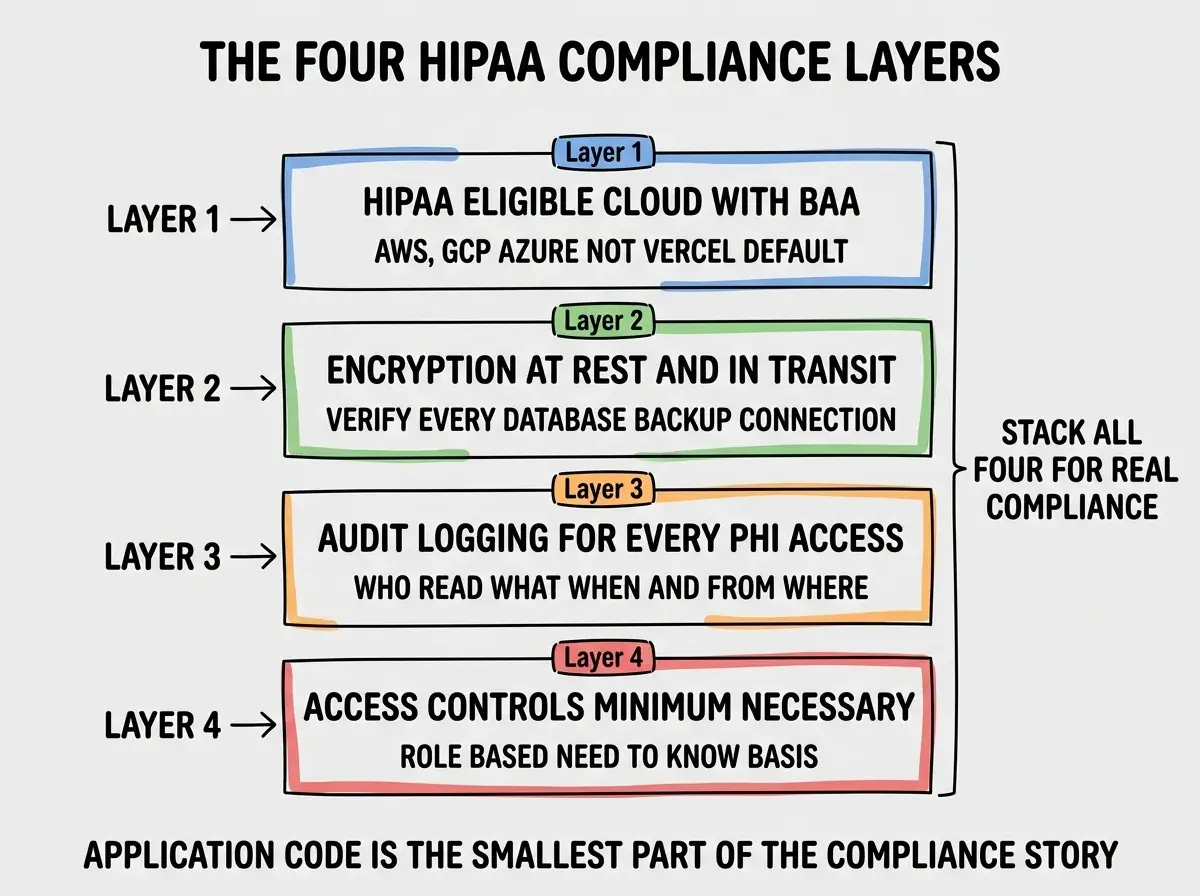
Layer 3, audit logging. Every read and write of PHI must be logged with timestamp, user ID, action, and source IP. Audit logs must be tamper-resistant and retained for at least 6 years. CloudTrail, GCP Audit Logs, or a dedicated SIEM tool (Datadog, Splunk) can handle this.
Layer 4, access controls with minimum necessary. Users only see the PHI they need to do their job. Doctors see their patients; admin staff see appointment metadata but not clinical notes. Implement role-based access control in the app and verify it at the database layer with row-level security.
The Appointment System Architecture
Once the compliance layers are in place, the appointment system itself is a normal web app architecture with a few HIPAA-specific touches.
Database schema. Patients table (with PHI), providers table, appointments table linking the two, audit_logs table tracking every access. Use UUIDs for patient IDs in URLs to avoid leaking sequential information.
Browse more domain-specific build guides
Read more build articlesAppointment booking flow. Standard calendar UI with available slots, but every slot view, booking attempt, and confirmation must be audit-logged. Notifications (email, SMS) must use HIPAA-compliant providers (Twilio with BAA, SendGrid with BAA).
Patient portal. Authenticated access with strong session management (15-minute idle timeout, MFA strongly recommended). Patients see only their own appointments and clinical data.
What Goes Wrong Most Often
Three specific failures account for the majority of HIPAA violations in vibe-coded healthcare apps. Knowing them upfront prevents most issues.
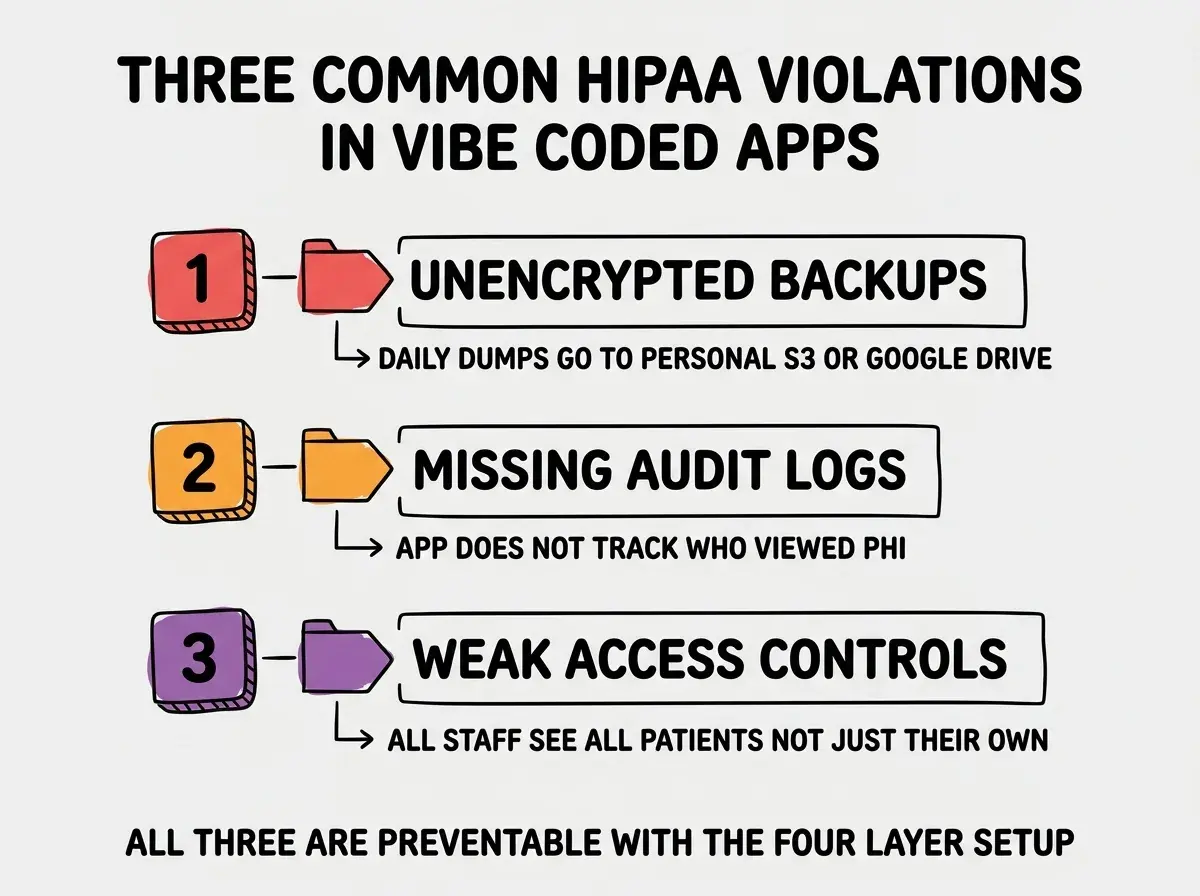
Violation 1, unencrypted backups. The main database is encrypted but daily backups go to a personal S3 bucket or Google Drive without encryption or BAA. This is a common pattern from solo developers who set up backups before fully understanding HIPAA. The fix is to ensure backup storage is also HIPAA-compliant.
Violation 2, missing audit logs. The app shows patient data on a screen but does not record that a specific user viewed it. During an audit, you cannot prove who accessed what. The fix is to add audit logging to every endpoint that returns PHI.
Violation 3, weak access controls. All staff at a clinic can see all patient data, even patients they are not treating. This violates the minimum necessary principle. The fix is role-based access control with explicit assignments (this provider treats these patients).
The single most expensive HIPAA mistake vibe coders make is starting development on Vercel or another non-HIPAA-eligible platform and then trying to migrate later. The migration is painful, and any patient data that touched the original platform is technically a violation regardless of how briefly it was there. Start on AWS, GCP, or Azure from the very first commit if there is any chance the app will eventually handle PHI. The cost of starting on the right platform is small; the cost of migration is enormous.
The other mistake is treating HIPAA as a static checklist rather than an ongoing program. Compliance requires annual security risk assessments, BAA reviews, employee training, and incident response procedures. The infrastructure is a foundation, but the program is the building. Plan for both.
A useful discipline is to run a quarterly internal compliance review where you walk through every layer (BAAs current, encryption verified, audit logs flowing, access controls enforced) and document the result. The discipline takes about half a day per quarter and produces a written record that proves diligent oversight. If you ever face an audit or breach review, this written history is the difference between a manageable conversation and a serious problem.
What This Means For You
Building HIPAA-compliant healthcare apps with vibe coding tools is genuinely possible in 2026, but it requires deliberate infrastructure choices upfront. The compliance work is concentrated in a one-week setup; once that is done, normal AI-assisted development works fine for the application layer.
- If you're a founder: Hire or consult with a HIPAA expert before you write the first line of code. The setup decisions are easier to get right upfront than to fix later.
- If you're changing careers: HIPAA expertise is a defensible specialization in healthcare tech. The compliance complexity creates demand that does not go away with AI.
- If you're a student: Study HIPAA basics even if you do not plan to work in healthcare. The principles transfer to other regulated industries you might encounter.
Browse more domain-specific build guides
Read more build articles