API testing tools fall into three categories that solve different problems: GUI tools like Postman for exploratory testing, lightweight tools like Insomnia for fast iteration, and automated tools like Playwright API tests for CI/CD integration. The right choice depends on whether you primarily explore APIs (GUI), iterate on requests (lightweight), or verify behavior continuously (automated). Most teams use multiple categories together rather than choosing one.
This comparison walks through the three categories, the four selection criteria, what each tool does best, and the four mistakes when choosing API testing approaches.
Why API Testing Tools Matter For Vibe Coded Apps
API testing tools matter for vibe coded apps because AI generates API code that often works in isolation but fails in integration. Testing tools verify integration behavior that AI cannot self verify.
The 2026 reality is that API testing is more important for vibe coded apps than for traditional apps. AI generates more code per hour; bug rate is similar; therefore bug volume is higher. Testing catches what code review cannot.
A 2025 vibe coded app quality study of 200 production apps found that apps with automated API testing experienced 64 percent fewer production API failures than apps relying on manual testing only. Automated testing measurably reduces failure rates; investment pays back through reduced incident response time.
The pattern to copy is the way builders use multiple measurement tools for different purposes. Calipers for precision, tape measure for length, level for orientation. Each tool excels at one thing; using right tool matters.
The Three API Testing Tool Categories
Three categories organize API testing tools by primary use case.
Category 1, GUI tools for exploration. Postman is the dominant tool. Visual interface, request collections, environment variables, team sharing. Best for understanding APIs and one off testing.
Category 2, lightweight tools for iteration. Insomnia, Bruno, Hoppscotch. Faster than Postman, less feature heavy, better for tight feedback loops during development.
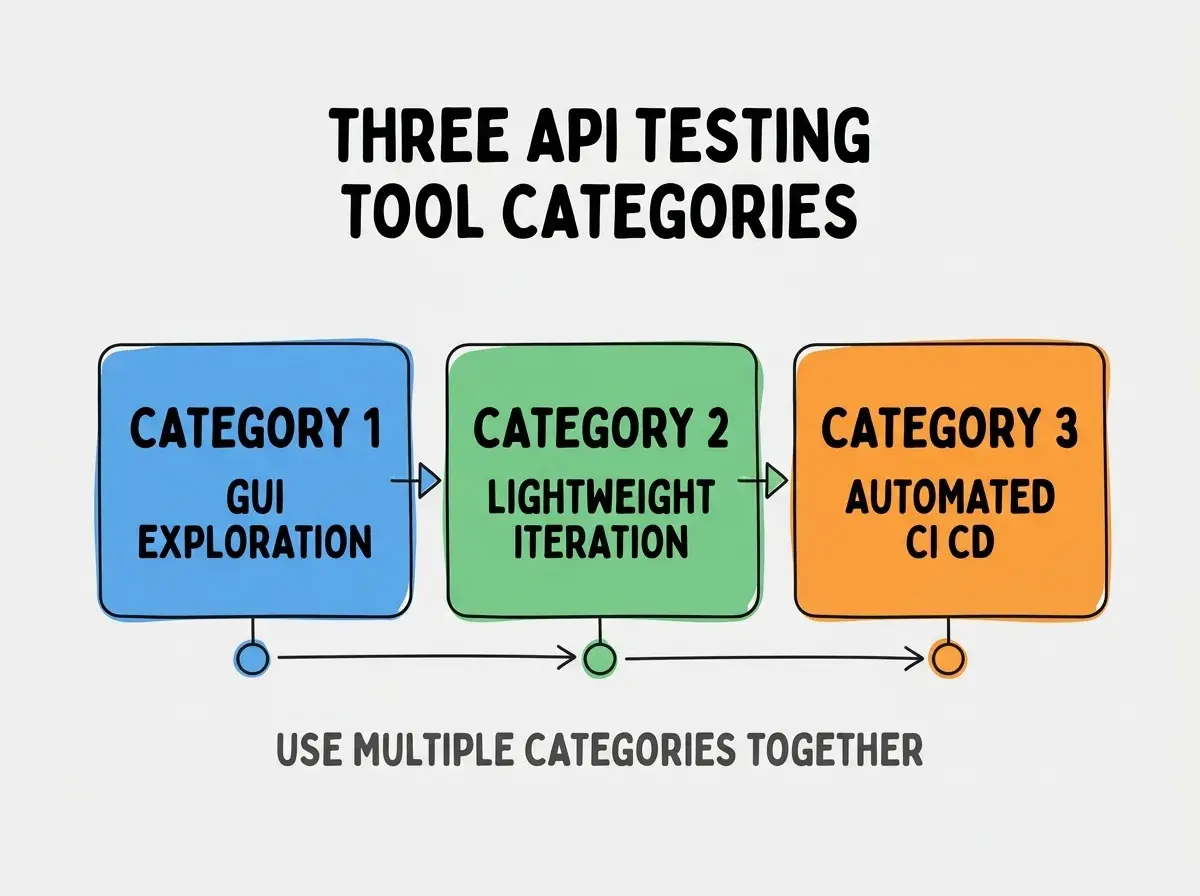
Category 3, automated tools for CI/CD. Playwright API tests, Vitest, Newman (Postman's CLI). Code based tests that run automatically; integrate with CI to catch regressions.
The Four Selection Criteria
Four criteria help choose among API testing tools.
Criterion 1, primary use case. Exploring unfamiliar APIs needs GUI; iterating on familiar APIs needs lightweight; preventing regressions needs automated.
Browse more ship articles
Read more shipCriterion 2, team size. Solo work needs simple tools; team work benefits from sharing features that Postman provides.
Criterion 3, integration with CI/CD. Code based automated tests integrate naturally; GUI tools require export to CI scripts.
Criterion 4, cost sensitivity. Postman pricing has tightened; Insomnia and Bruno are more affordable for paid tiers; automated approaches have no per user cost.
What Each Tool Does Best
Three patterns describe what each tool excels at.
Pattern 1, Postman excels at API exploration with teams. Visual collections, shared workspaces, comprehensive feature set. Best when learning new APIs in team contexts.
Pattern 2, Insomnia excels at fast personal iteration. Less ceremony, faster response, simpler interface. Best for solo developers iterating quickly.
Pattern 3, automated tests excel at preventing regressions. Catch breaking changes before deploy; protect against AI generated breaking changes. Best for production app maintenance.
What Makes API Testing Sustainable
Three patterns separate sustainable API testing from temporary testing efforts.
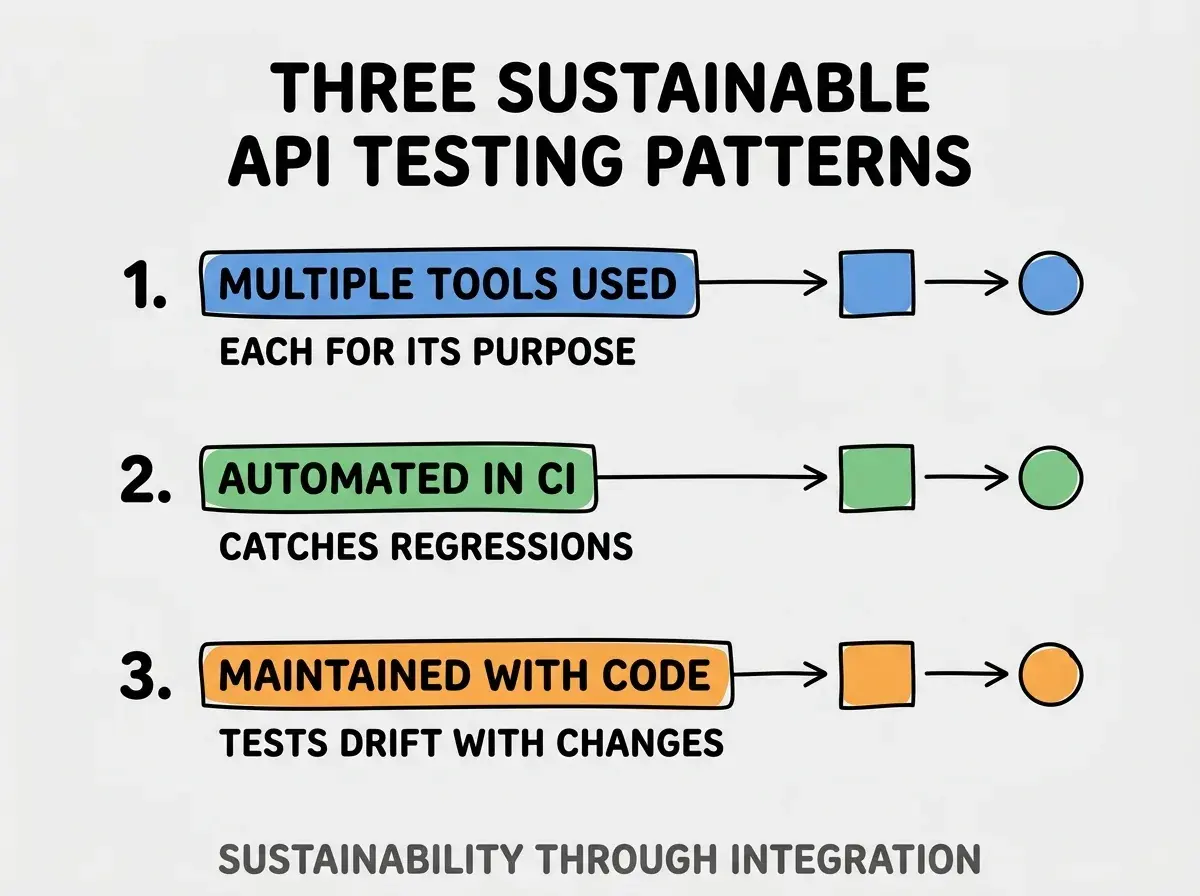
Pattern 1, multiple tools used appropriately. GUI for exploration, lightweight for iteration, automated for CI. Single tool selection misses categories.
Pattern 2, automated tests integrated in CI. Tests outside CI become stale; CI integration keeps tests current.
Pattern 3, tests maintained alongside code. Tests update when API updates; without maintenance, tests become liability.
The combination produces API testing that catches bugs over years. Without these patterns, testing decays.
How To Adopt API Testing Progressively
Three adoption patterns help teams adopt API testing without overwhelming current workflow.
Pattern A, start with one tool category. Adopt GUI exploration first; add automation when comfort is established.
Pattern B, add automated tests for new endpoints only. Avoid retroactive testing of all existing endpoints; test going forward.
Pattern C, run automated tests on critical paths first. Login, payment, signup flows get automated tests before less critical paths.
The combination produces sustainable adoption. Without progression, attempts at full coverage produce abandonment.
Common Questions About API Testing Tools
API testing tools raise questions worth addressing directly.
The first question is whether Postman is still worth using given price increases. For teams, yes; sharing features justify cost. For solo, lighter alternatives win.
The second question is whether AI tools can replace manual API testing. AI can generate test code; humans still verify test correctness. Combination beats either alone.
The third question is whether to write API tests in same language as application. Yes generally; same language reduces context switching cost.
The fourth question is how to test APIs that depend on third party services. Mock third party in tests; real third party in staging environment.
How API Testing Affects Production Reliability
API testing affects production reliability in compounding ways. Reliability effects compound across years.
The first compounding effect is incident frequency reduction. Tested APIs fail less often; failures caught in test do not become production incidents.
The second compounding effect is debug speed improvement. Test suites help reproduce production issues; reproduction enables faster fixes.
The third compounding effect is refactoring confidence. Comprehensive tests enable refactoring without breaking; refactoring keeps code maintainable.
The combination produces reliable APIs over years. Without testing, reliability degrades despite individual best efforts.
How To Choose Tools For Specific Scenarios
Three scenario patterns guide tool selection for common situations.
Pattern A, learning new third party API. Postman or Insomnia GUI; explore endpoints, build collection, document findings.
Pattern B, building new internal API. Lightweight tool for development; automated tests added before production.
Pattern C, maintaining mature API in production. Automated test suite primary; GUI tools secondary for investigations.
The combination matches tools to scenarios. Without scenario thinking, tool selection follows fashion rather than fit.
The most damaging API testing mistake is choosing a single tool for all use cases. Each category solves different problems; using GUI tools for CI integration produces brittle pipelines, using automated tests for exploration produces friction. The fix is to adopt multiple tools matched to use cases; combination beats best single tool. Teams that use multiple tools produce better outcomes than teams that standardize on one.
The other mistake is treating manual GUI testing as sufficient. Manual testing catches what manual testing tests; automated catches more reliably and continuously.
A third mistake is over investing in test coverage early. Coverage without code change frequency provides little value; invest where change happens often.
A fourth mistake is ignoring environment variables. Hard coded URLs and tokens make tests fragile; environment variables make tests portable.
What This Means For You
API testing tools serve different purposes that combine into complete API testing strategy. The three categories, four criteria, and adoption patterns produce framework for tool selection that matches your work.
- If you're a senior dev: Build the multi tool habit; each category serves real purposes that benefit from dedicated tools.
Browse more ship articles
Read more ship