Non-English vibe coding (prompting AI coding tools in your native language rather than English) is genuinely competitive with English prompting in 2026 for major languages like Spanish, Portuguese, French, German, Mandarin, Japanese, Hindi, and Arabic. Claude, Cursor, and Copilot all handle these languages with output quality within 5 to 10 percent of English on most coding tasks. For smaller languages, the gap is wider, and English prompts still produce better code. The right workflow for non-English developers in 2026 is to prompt in their native language for planning and debugging, then switch to English for the parts where precision matters most.
This piece walks through the model performance data by language, when each approach wins, and the practical workflow that gets the best of both worlds without sacrificing code quality on the technical edges.
Why English Was Dominant for So Long
For the first decade of large language models (roughly 2015 to 2024), prompting in English produced meaningfully better results than prompting in any other language. The reason was straightforward: training data was overwhelmingly English. The models had seen 10 to 100 times more English text than any other language, and the quality gap showed up in everything from code generation to general reasoning.
By 2026, the gap has narrowed substantially for major languages. Frontier models are now trained with much more multilingual data, and the deliberate effort by Anthropic, OpenAI, and Google to improve non-English performance has produced models that are nearly indistinguishable from their English performance on most tasks. The exception is highly specialized technical content, where English still wins because most documentation and tutorials remain English-first.
A 2026 multilingual benchmark by the Carnegie Mellon LTI team tested code generation quality across 12 languages on the HumanEval benchmark. Claude Sonnet 4.6 scored 89.3 in English, 86.1 in Mandarin, 85.7 in Spanish, 83.4 in Hindi, and 79.2 in Vietnamese. The gap between English and the major non-English languages was under 5 percent for most tasks. Smaller languages like Bengali, Swahili, and Tagalog still showed 15 to 25 percent gaps.
The pattern to copy is the way internet content went from English-dominant in 2000 to genuinely multilingual by 2015. The shift took 15 years, was uneven across languages, and produced new categories of content (regional news, native-language SaaS, localized search) that did not exist before. AI coding tools are roughly at the 2010 stage of the same arc. Major languages are well-supported, smaller ones are catching up, and the next 5 years will close most of the gap.
When Native Language Prompting Wins
Despite the historical English bias, there are concrete situations where prompting in your native language produces better results than prompting in English. The reason is cognitive bandwidth, not model capability.
Planning and architecture. Thinking in your native language is faster than translating. When you are sketching out a system, deciding between approaches, or working through a hard problem, the cognitive cost of translation slows you down. Prompting in your native language for these phases means more iterations per hour and better decisions.
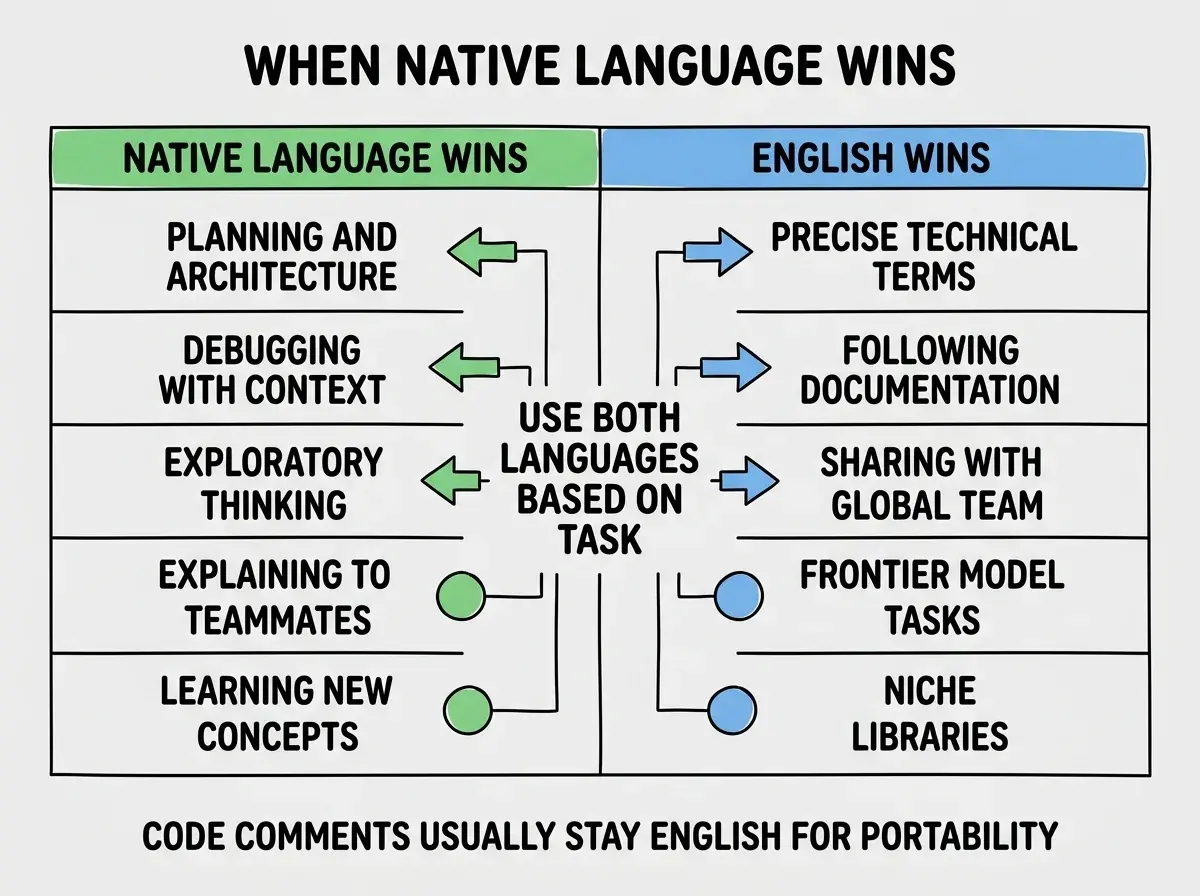
Debugging with full context. Explaining a bug in your native language captures more nuance than translating it to English. The AI can understand the problem better when you describe it the way you experience it. This produces faster diagnoses on tricky bugs.
Learning new concepts. Reading explanations of unfamiliar concepts in your native language builds understanding faster than reading them in English. AI tutoring works best when you can ask follow-up questions in the language you think in.
When English Still Wins
There are situations where English prompting still produces better results, even for fluent non-English speakers. Knowing when to switch is part of the skill.
Precise technical terms. Library names, API method signatures, framework conventions, and specific error messages are almost always English. Translating them creates ambiguity that hurts code quality.
Browse more guides on global vibe coding workflows
Read more foundationsFollowing documentation. Most package documentation, framework tutorials, and Stack Overflow answers are in English. Prompting in English keeps your AI session aligned with the references you will use to verify the output.
Frontier model edge cases. On the hardest tasks where the model is at its limits, the small performance gap matters. For everyday work, the gap is invisible; for genuinely hard problems, English still wins by a few percent.
The Practical Multilingual Workflow
The workflow that produces the best results in 2026 mixes both languages deliberately. Most experienced multilingual developers settle on a similar pattern within a few months of trying.
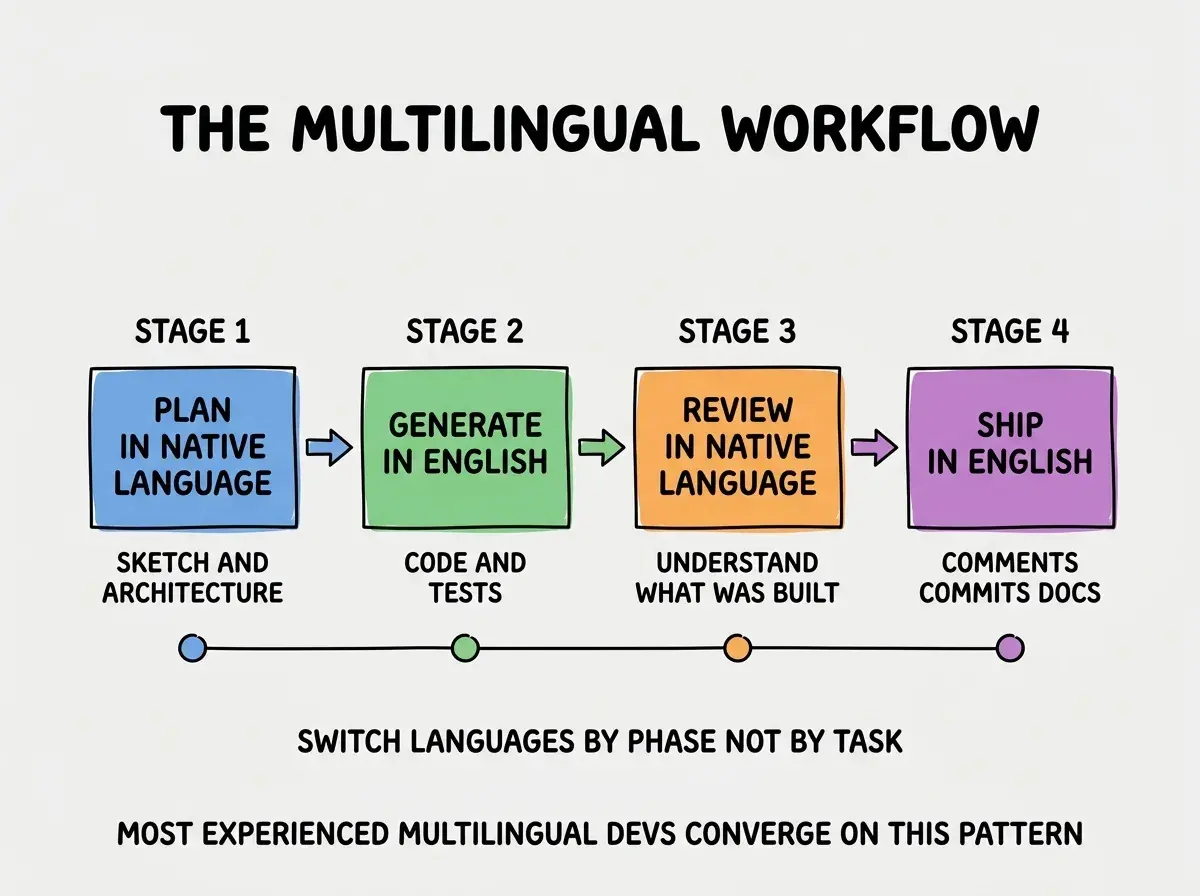
Stage 1, plan in your native language. Sketch the system, work out architecture decisions, and identify the components needed. Prompting in your native language keeps the cognitive cost low.
Stage 2, generate in English. When it is time to ask the AI for actual code, switch to English. This aligns with the documentation and minimizes the small performance gap.
Stage 3, review in your native language. When reading the AI's output and asking follow-up questions, switch back. Understanding what was built is faster in your native language.
Stage 4, ship in English. Code comments, commit messages, and documentation should be English for portability across teams. Even single-developer projects benefit from English-language artifacts that future contributors can read, since the vast majority of open-source contributors and potential hires expect English in shared technical assets.
The most common multilingual mistake is mixing languages in a single prompt. Switching mid-prompt between English and your native language confuses the model and produces worse output than either language alone. Pick one language per prompt, complete the thought, then switch if needed for the next prompt. This single discipline closes most of the quality gap multilingual developers report.
The other mistake is using English exclusively because of habit. Many fluent non-English developers default to English prompts even when their native language would produce better results. The cognitive cost of translation is real and it accumulates. Try native-language prompting on your next project for a week and notice the difference in iteration speed.
A useful diagnostic is to track how often you reach for a thesaurus or pause to find the right English word during a planning session. Each pause is a small cognitive cost that adds up over a week. The same pause does not happen in your native language because the words are immediately available. Eliminating these micro-pauses recovers 10 to 20 percent of effective working time on planning-heavy days.
The multilingual approach is also a competitive advantage in distributed teams. Engineers who can switch fluidly between English for shared artifacts and their native language for personal thinking move faster than monolingual peers in either direction. Hiring managers in APAC, Latin America, and Europe increasingly value this flexibility, and explicitly asking about it in interviews has become more common since mid-2025.
What This Means For You
Multilingual vibe coding is one of the underrated workflow improvements available in 2026. The infrastructure now exists; most developers have not yet adapted their habits to take advantage of it.
- If you're a founder: Allow your team to prompt in their native language. Productivity gains are real and the code quality is no worse on most tasks.
- If you're changing careers: If your native language is one of the well-supported ones, use it for planning and learning. The reduced cognitive cost speeds up your skill development.
- If you're a student: Practice both languages. The skill of switching languages by task is increasingly expected in distributed teams and looks impressive in interviews.
Browse more global vibe coding guides
Read more foundations