Determining whether your AI-built MVP is investor-ready comes down to one question investors will never say out loud. Can this thing survive without you prompting an AI at 2 AM? If the answer is yes, backed by evidence, you are closer than most founders think.
The fundraising landscape has shifted dramatically in the last two years. Investors have seen hundreds of AI-built products cross their desks, and they have developed a sharper eye for what separates a demo from a business. Y Combinator's Winter 2025 batch included multiple companies where the entire initial product was built using AI coding tools. Sequoia has publicly stated that capital efficiency (building more with less) is one of the top signals they look for. Building with AI is no longer a red flag. But building poorly with AI absolutely is. The difference between an investor-ready MVP and a glorified prototype is not how it was built. It is whether the builder understands what they shipped.
Why Investors Care About How Your MVP Was Built
Investors do not fund technology. They fund businesses. But the technology underneath your business determines how fast you can move, how much it costs to grow, and whether the whole thing collapses when you hire your first engineer. These are real concerns, not theoretical ones.
When an investor asks "how was this built," they are not testing your technical knowledge. They are evaluating three things simultaneously. First, can this product scale if it works? Second, can a team maintain and extend this codebase? Third, does this founder understand the trade-offs they made? A founder who says "I used Cursor and Claude to build this in three weeks" and then explains their architecture decisions, testing strategy, and known technical debt will impress investors far more than someone who spent six months hand-writing code they barely understand.
The data backs this up. According to Carta's 2025 funding data, pre-seed companies that demonstrated capital efficiency (low burn relative to product maturity) closed rounds 40% faster. Building your MVP with AI tools is the ultimate capital efficiency story, if you can tell it correctly.
Investors evaluate traction first, team second, and technology third. An AI-built MVP with 500 paying users will beat a hand-crafted codebase with zero users every single time. But when traction is equal, the founder who understands their technical foundation wins.
The real risk is not that investors will reject you for using AI tools. The risk is that your product falls apart during technical due diligence because you never looked under the hood of what the AI generated. Investors have seen this happen enough times to know the pattern, and they will probe for it.
The Investor-Ready Checklist (Think of It Like a Home Inspection Before Selling)
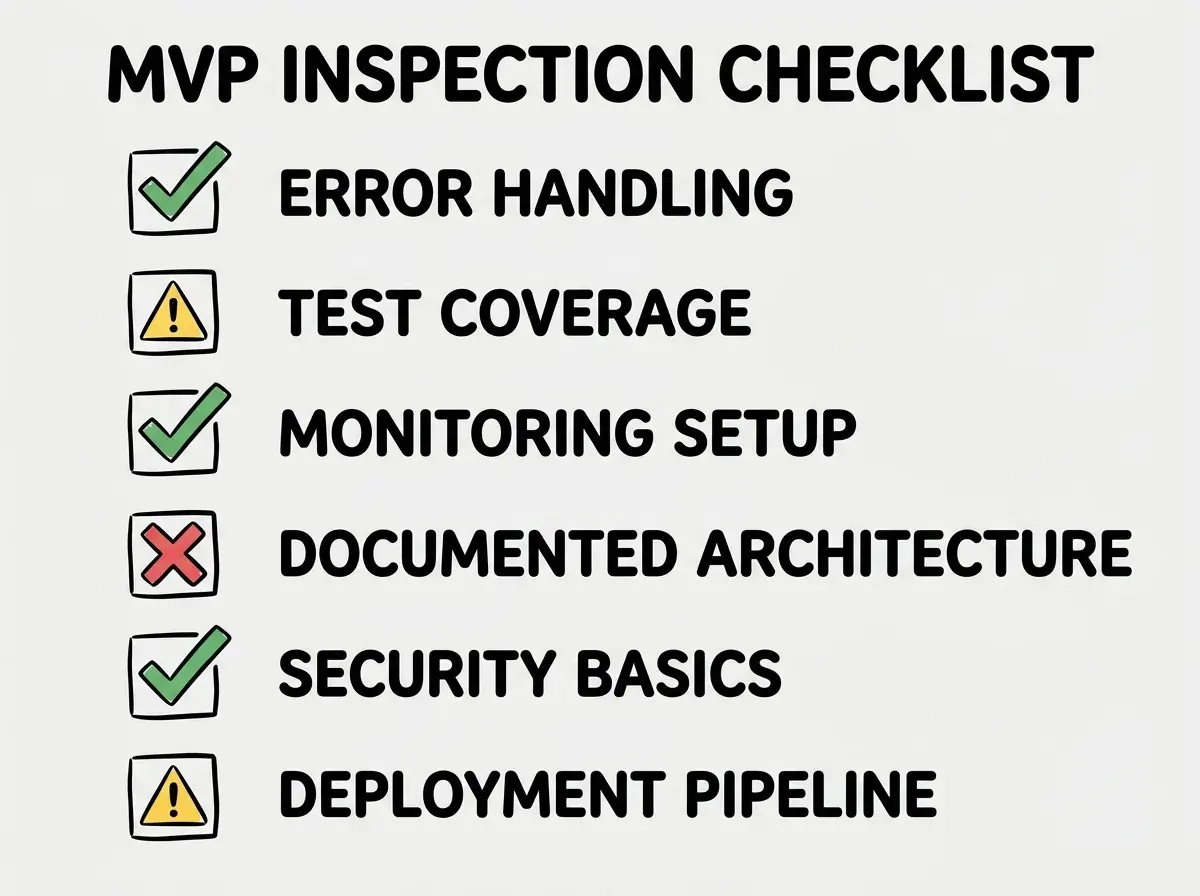
When you sell a house, the buyer sends an inspector. The inspector does not care whether you built the house yourself or hired a contractor. They care whether the foundation is solid, the wiring is safe, and the plumbing works. Investor technical due diligence works the same way.
Error handling is your foundation. Does your app crash gracefully or does it show users a blank screen with a stack trace? AI-generated code often handles the happy path beautifully and ignores everything else. Open your app, disconnect from the internet, and see what happens. Submit a form with garbage data. Try to access a page that does not exist. If any of these produce unhandled errors, you have foundation cracks that an inspector will find.
Test coverage is your electrical inspection. You do not need 90% coverage. You need tests for the things that would embarrass you if they broke. User signup, payment processing, core business logic. A technical due diligence reviewer will look for tests not because they care about the number, but because tests prove you understand what your app actually does.
Monitoring is your smoke detector. If your app goes down at 3 PM on a Tuesday, how long until you know? If the answer is "when a user emails me," you fail this inspection. Set up basic error tracking (Sentry has a free tier) and uptime monitoring (Betterstack, free for one monitor). This takes thirty minutes and signals operational maturity.
Documented architecture is your blueprint. Can someone other than you understand how the pieces fit together? A single markdown file explaining your tech stack, data flow, and deployment process is enough. Investors will not read it themselves, but their technical advisors will.
Security basics are your locks and deadbolts. Environment variables stored properly (not hardcoded). HTTPS everywhere. Input validation on forms. Authentication on API routes. Rate limiting on public endpoints. These are non-negotiable, and AI tools sometimes skip them entirely.
A deployment pipeline is your property management plan. Can you push a fix in under ten minutes? If your deployment process involves manual steps, SSH commands, or prayer, that is a red flag. A simple CI/CD pipeline (GitHub Actions to Vercel or Cloudflare) shows that you can respond to problems quickly.
Technical Due Diligence Red Flags
Investors who have been burned by AI-built products know exactly what to look for. Here are the patterns that kill deals.
Duplicated logic everywhere. AI coding tools sometimes generate similar code in multiple places instead of creating reusable functions. When a due diligence reviewer sees the same validation logic in twelve different files, they know maintenance will be expensive. Run a quick search through your codebase for duplicated blocks and consolidate them.
No separation of concerns. If your API routes contain business logic, database queries, and email sending all in one function, that is a red flag. It does not need to be perfect microservices architecture, but basic separation (routes call services, services call the database) shows that the codebase can grow.
Hardcoded values and magic numbers. AI tools love to hardcode things. Prices, API URLs, feature flags, configuration values baked directly into components. A reviewer will ctrl+F for hardcoded strings and judge the result.
Missing environment separation. Does your app behave differently in development, staging, and production? Or does it point at the same database everywhere? This one is surprisingly common in AI-built apps because the AI was never told about environments.
No error boundaries. In React apps specifically, a single component error can crash the entire page. Error boundaries catch these failures and show a fallback UI. Without them, one bad API response can take down your whole application. Investors who have seen this happen will specifically ask about it.
Get the foundations right before you think about fundraising. Start with the guides that matter.
Browse all guidesThe good news is that every one of these red flags can be fixed in a week or less. They are not architectural problems. They are hygiene problems. And fixing them before an investor's technical advisor finds them is the difference between a term sheet and a pass.
How to Present Your AI-Built Stack With Confidence
The conversation about AI tools should not be defensive. Frame it correctly and it becomes your strongest signal of founder capability.
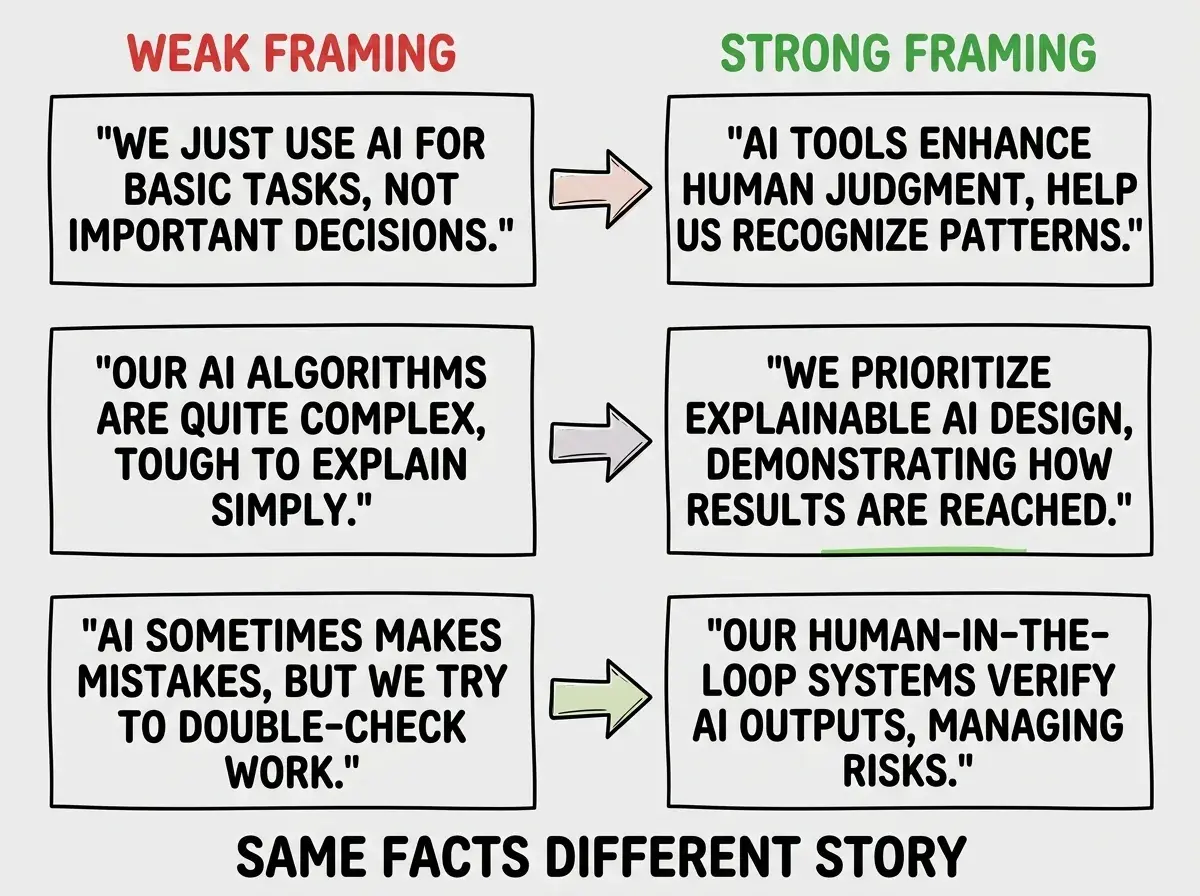
Lead with speed, not cost savings. "We went from idea to 500 paying users in six weeks" is a better story than "we saved $200K on engineering." Speed demonstrates market intuition and execution ability. Cost savings sound like you are cutting corners.
Show your understanding of trade-offs. Every engineering decision has trade-offs. Investors respect founders who can articulate them. "We used AI to generate the initial codebase, which gave us speed. The trade-off is some areas need refactoring as we scale, and we have identified those areas." That sentence alone puts you ahead of 80% of technical founders.
Have a hiring plan ready. One of the biggest investor concerns with AI-built products is the "bus factor," meaning what happens if you get sick. Show that you have thought about this. "The codebase uses standard Next.js patterns, TypeScript, and Postgres. Any mid-level full-stack engineer could onboard in a week. We have documented the architecture and our first engineering hire will focus on the three areas we have flagged for refactoring."
Demonstrate that you can debug what you built. During a pitch, an investor might ask you to explain a specific technical decision. If you cannot answer because the AI made the choice and you never questioned it, that is a deal-killer. Spend time reading your own codebase. Understand why your authentication works the way it does. Know what happens when your database connection drops. You do not need to have written every line, but you need to understand every line.
Hiding the fact that you used AI tools. Investors talk to each other. If they discover you were not transparent about your development process, trust evaporates instantly. The founders who win are the ones who say "yes, I built this with AI, and here is why that makes me a better bet, not a worse one."
Bring receipts. Show your error tracking dashboard with low error rates. Show your deployment history with frequent, small pushes. Show your test suite passing. These artifacts are worth more than any slide deck because they prove operational competence, not just storytelling ability.
Dig deeper
A few hand-picked sources if you want to go further.
What This Means For You
Not every AI-built MVP is investor-ready, and that is fine. The checklist above is not a gate you pass once. It is a ladder you climb as your product matures. If you are at the idea stage, none of this matters yet. Ship first. If you have users and you are considering fundraising, work through the home inspection checklist methodically. Fix the red items, plan for the yellow items, and prepare to talk about all of them with confidence.
The founders who raise successfully with AI-built products share three traits. They understand what they shipped (not just that it works, but why it works). They can articulate the trade-offs honestly. And they frame speed-to-market as a competitive advantage, not a shortcut. Building with AI is not a weakness to explain away. It is a superpower to demonstrate. But like any superpower, it only works if you actually control it.
Start with the right foundations and grow from there. Every successful MVP begins with the basics.
Explore the guides