Building an MVP is like building a raft to cross a river. You do not need a yacht. You do not need a speedboat. You need something that floats, moves in the right direction, and gets you to the other side before it falls apart. The question with vibe coding is whether the raft it builds will actually hold together for the crossing, or whether it will look like a raft from the shore and dissolve the moment it hits water.
That question is not theoretical anymore. 25% of Y Combinator's Winter 2025 batch had codebases that were 95% or more AI-generated. These are companies that got into the most competitive startup accelerator in the world with vibe-coded products. At the same time, developer trust in AI-generated code has dropped from 77% to 33% in the past year. Both of these facts are true simultaneously, and understanding why they do not contradict each other is the key to making the right decision for your MVP.
The Current State of Vibe Coding, Honestly
The vibe coding market has grown to $4.7 billion. 46% of all new code is now AI-generated. These are real numbers from real research, not hype from tool vendors. But numbers without context are dangerous, so here is the context.
The YC founders who shipped 95%-AI codebases were experienced builders who used AI tools to move faster through problems they already understood. They knew what good code looked like. They used AI as an accelerator, not a replacement for judgment.
The developers whose trust dropped from 77% to 33% were seeing something different: AI-generated pull requests with subtle bugs, security vulnerabilities hidden under clean-looking code, and production incidents caused by code nobody fully understood. They were right to be concerned.
Vibe coding is not inherently good or bad. It is a tool with a sharp edge. In the hands of someone who understands what they are building, it is extraordinarily powerful. In the hands of someone who does not, it produces code that looks correct but fails in ways that are expensive to diagnose and fix.
The raft analogy holds. A skilled builder with AI tools can construct a raft in an afternoon that would have taken a week by hand. But someone who has never built a raft cannot just describe one to an AI and expect it to float. They will get something that looks like a raft. They might even get something that floats in calm water. But the first time a wave hits, the logs that were not lashed correctly will drift apart.
The Decision Framework
Here is the framework. Answer each question honestly, score yourself, and the total tells you whether vibe coding your MVP makes sense for your specific situation.
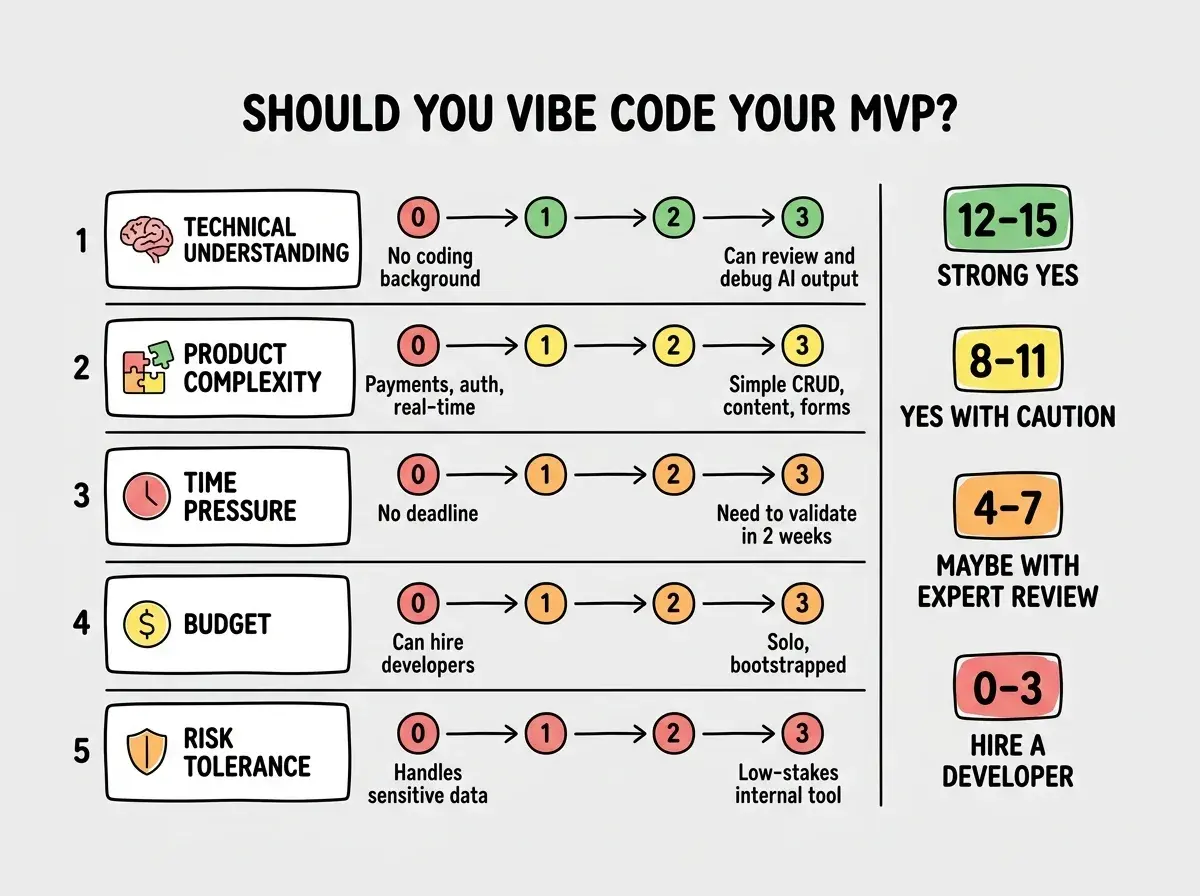
Question 1: Can you read and understand the code the AI generates? You do not need to be able to write it from scratch. But you need to read a function and understand what it does, spot an obvious bug, and know when something looks wrong even if you cannot articulate why. If you can, score 3. If you can read some code but get lost in complex logic, score 2. If code is mostly foreign to you, score 1. If you have never read code before, score 0.
Question 2: How complex is your product? A landing page with a waitlist form is a 3. A content management system or simple e-commerce store is a 2. An app with user authentication, payments, and real-time features is a 1. Anything involving sensitive data processing, financial transactions, or medical information is a 0.
Question 3: How urgent is your timeline? If you need to validate the idea in two weeks or less, score 3. One to two months, score 2. Three to six months, score 1. No deadline, score 0. Urgency favors vibe coding because the speed advantage is genuinely massive when you need a working prototype fast.
Question 4: What is your budget? Solo bootstrapped with no money for developers, score 3. Small budget that could cover a few hours of expert review, score 2. Moderate budget that could hire part-time help, score 1. Enough to hire a developer, score 0.
Question 5: What are the stakes if the code fails? Internal tool or prototype that only you use, score 3. Consumer product with no sensitive data, score 2. Product handling user data or payments, score 1. Product in a regulated industry or handling health/financial data, score 0.
Scoring. 12 to 15: vibe code with confidence. 8 to 11: vibe code but get an expert review before launch. 4 to 7: vibe code the prototype for validation, then hire help to rebuild for production. 0 to 3: hire a developer from the start.
What Vibe Coding Is Good At
Let me be specific about where vibe coding genuinely excels for MVPs, because the use cases are narrower than the hype suggests.
Validation speed. If your primary goal is testing whether anyone wants your product, vibe coding is unmatched. You can go from idea to working prototype in a weekend. That prototype will not be production-ready, but it does not need to be. It needs to be real enough for potential customers to use it and give you feedback. A working prototype with bugs teaches you more than a perfect pitch deck.
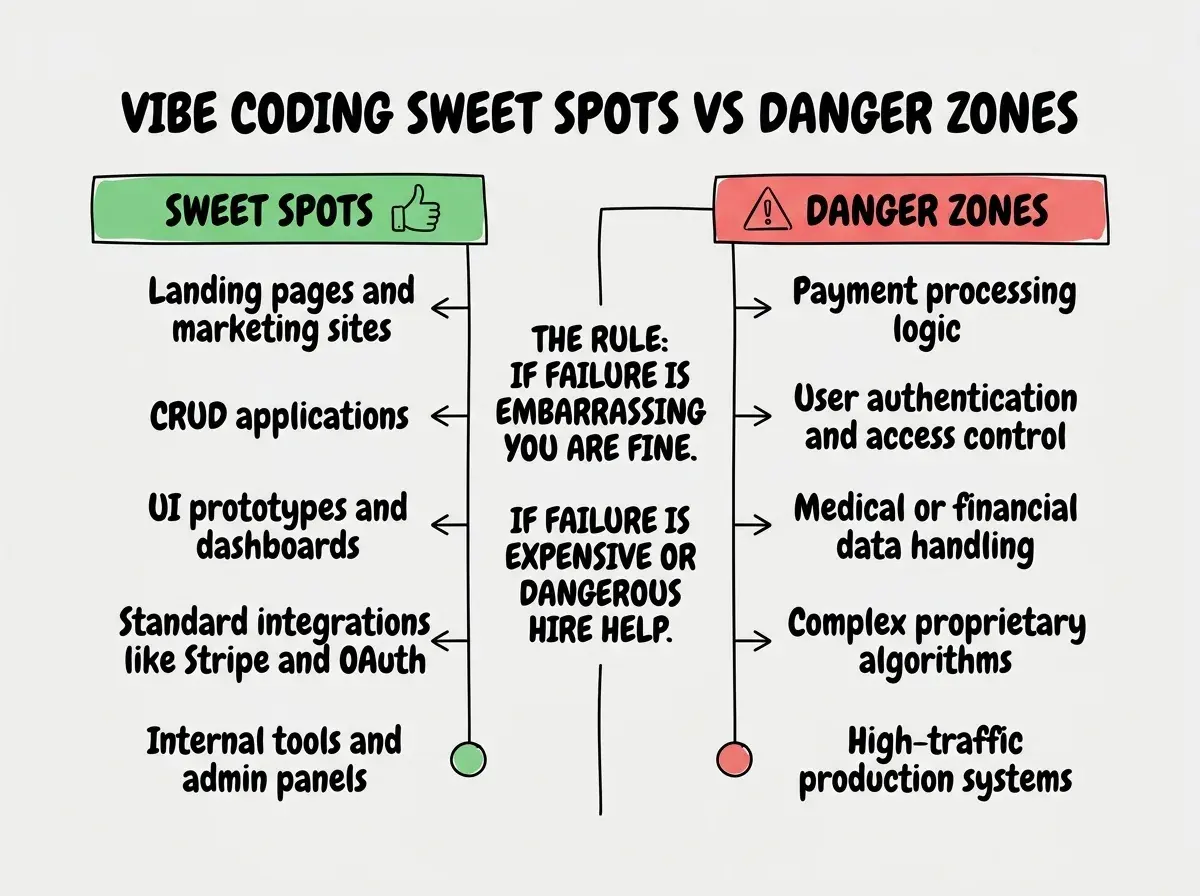
UI and frontend work. AI tools are remarkably good at generating user interfaces. Landing pages, dashboards, forms, data display components. These are well-understood patterns with clear visual expectations, and AI handles them well. If your MVP is primarily a frontend experience (a design tool, a content editor, a data visualization), vibe coding can carry you far.
Standard integrations. Connecting to Stripe, setting up email with Resend, adding OAuth login with NextAuth. These integrations have been implemented millions of times and AI tools have seen every variation. The generated code is usually solid because the patterns are well-established.
Assuming that because the AI can generate code for payments, authentication, or data processing, the generated code is automatically secure and production-ready. AI generates functional code. Functional is not the same as secure. Every payment flow, auth system, and data pipeline generated by AI needs a security review before handling real user data. Budget for this review even if you vibe code everything else.
What Vibe Coding Is Bad At
Here is where the raft falls apart in the water.
Security-critical features. Authentication flows, payment processing, data encryption, access control. AI generates code that works in testing. But security is about whether code fails safely when someone actively tries to break it. AI-generated auth code frequently has edge cases around session expiration and permission boundaries that only surface under adversarial testing.
Complex business logic. If your product's value comes from a specific calculation or decision engine, the AI does not know your business rules. It will generate plausible logic that passes basic tests and produces wrong results on the edge cases your domain requires handling correctly.
Scalability and performance. AI generates code that works but not code that works efficiently at scale. Missing indexes, N+1 query patterns, absent caching layers. These issues are invisible at 10 users and catastrophic at 10,000.
The Hybrid Approach Most Founders Should Take
Here is what I actually recommend for most founders, and it is not a binary yes or no.
Phase 1: Vibe code the prototype (Week 1 to 2). Build the entire MVP with AI tools. Focus on getting a working product in front of potential customers as fast as possible. This phase is about learning whether your idea has legs, not building software that lasts.
Phase 2: Validate with real users (Week 3 to 4). Put the prototype in front of 10 to 20 potential customers. Watch them use it. Track where they get confused. Most MVPs pivot significantly after this step. You do not want months of clean engineering invested in a product that needs to change direction.
Phase 3: Rebuild the parts that matter (Week 5 to 8). Keep the vibe-coded parts that work fine (UI, simple CRUD, content pages). Replace the parts that need to be solid (payments, data processing, core business logic) with reviewed, tested code. Hire a developer for a few hours to review the critical paths if you cannot do it yourself.
This hybrid approach gives you the speed of vibe coding for validation and the reliability of proper engineering for production.
Whether you vibe code or hire, the fundamentals of building a product that works are the same.
Explore the FoundationsReal Numbers From Real Projects
Let me share what I have seen across projects that went the vibe coding route.
The typical vibe-coded MVP takes 1 to 3 weeks to build, compared to 6 to 12 weeks with traditional development. The cost is roughly $50 to $200 in AI tool subscriptions versus $5,000 to $25,000 for a freelance developer. The trade-off is that 60% to 70% of the codebase will need significant refactoring before handling real production traffic.
That trade-off is worth it when the alternative is spending $15,000 on a product nobody wants. It is not worth it when the product handles sensitive data and a security incident would cost more than the entire development budget.
The founders who have the best outcomes treat vibe-coded MVPs as disposable learning tools. They build fast, validate fast, and then invest in proper engineering for the version that scales. The founders who struggle are the ones who try to take their vibe-coded prototype straight to production without the rebuild phase.
Learn the frameworks and decision models that help vibe coders ship products that actually work.
Read More Guides