Knowing when to hire a developer for your vibe coding project comes down to five clear signals. If you are spending more time patching problems than shipping features, your product has outgrown what AI-assisted solo development can sustain. Recognizing that threshold early saves you months of frustration and protects the momentum that got you here.
The uncomfortable truth is that vibe coding is phenomenal for getting from zero to one. You can build a working product in a weekend, validate an idea with real users in a week, and iterate faster than any traditional development team. But every tool has a ceiling. The question is not whether you will hit it. The question is whether you will recognize it when you do, or whether you will spend six more months convincing yourself that the next prompt will fix everything.
Why This Decision Matters More Than You Think
Most founders frame this as a binary. Either you are a solo vibe coder or you have a development team. That framing is wrong, and it causes people to delay hiring far too long. The real question is about leverage. Every hour you spend wrestling with infrastructure, debugging performance issues you do not understand, or manually patching security holes is an hour you are not spending on the product decisions that only you can make.
The goal of hiring a developer is not to replace your vibe coding workflow. It is to protect it. A good first hire handles the infrastructure and reliability work that eats your time, so you can keep doing what you are best at: rapidly prototyping features and translating product vision into working software.
There is also a compounding cost that people miss. When you are the only person who understands the codebase (even loosely), every bug becomes your problem. Every deploy becomes your responsibility. Every 3 AM alert is yours. That works when you have ten users. It does not work when you have a thousand. The decision to hire is not an admission of failure. It is a recognition that your product succeeded enough to need more than one person.
The Five Signals It Is Time to Hire
Think of your vibe-coded product like a studio apartment. When you first moved in, it was perfect. Everything you needed was within arm's reach. But then you got a couch, then a desk, then a bookshelf, and suddenly you are climbing over furniture to get to the kitchen. The apartment did not shrink. Your life expanded beyond what it was designed to hold. Here are the five signs you have outgrown the studio.
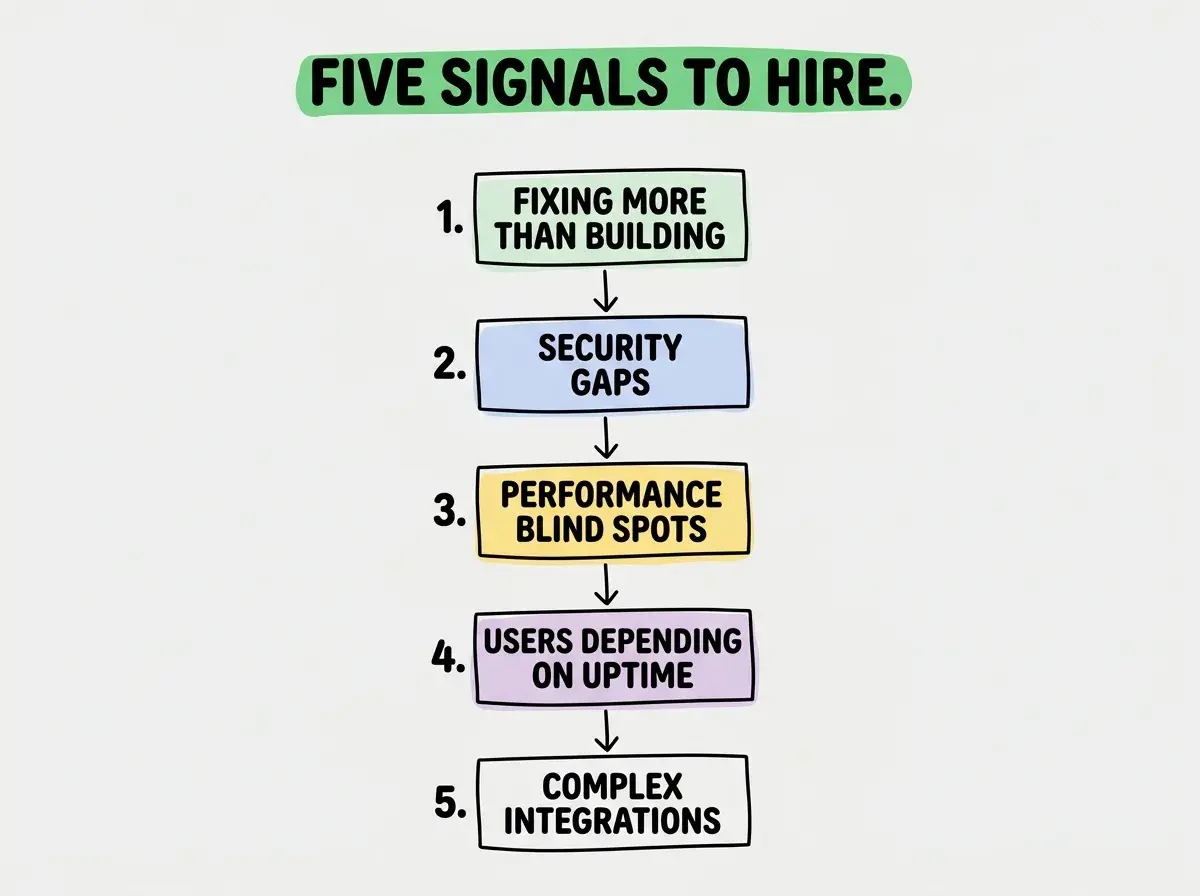
Signal 1: You are spending more time fixing than building. This is the most obvious sign, and the one people rationalize the hardest. Track your time for one week. If more than 50% of your development hours go toward fixing bugs, dealing with regressions, or re-prompting the AI to correct its own mistakes, you have crossed the line. Building is what moves your product forward. Fixing is maintenance. When maintenance dominates, you are running in place.
Signal 2: Security or compliance requirements exceed your knowledge. The moment your product handles payments, stores personal data, or operates in a regulated industry, you need someone who understands security beyond what an AI can generate. AI tools will happily produce code that looks secure but has subtle vulnerabilities. SQL injection, improper authentication flows, missing rate limiting. You do not know what you do not know, and in security, that gap can be catastrophic.
Signal 3: Performance issues you cannot diagnose. Your app is slow. Users are complaining. You have asked Claude or ChatGPT to optimize it, and the suggestions either do not help or break something else. Performance optimization requires understanding what is actually happening at the database, network, and rendering layers. If you cannot read a flame chart or explain why your API response takes three seconds, you need someone who can.
Signal 4: Multiple users are depending on uptime. When ten people use your product, downtime is an inconvenience. When five hundred people use it, downtime is a business crisis. If you do not have monitoring, alerting, error tracking, and a deployment strategy that avoids breaking production, you are one bad push away from losing users permanently. This infrastructure is not glamorous, but it is what separates a project from a product.
Signal 5: You need to integrate with systems that AI cannot handle. Legacy APIs with poor documentation. Enterprise SSO requirements. Webhooks from third-party services that behave unpredictably. These are the integration challenges where AI-generated code hits a wall because the training data is sparse and the edge cases are endless. A developer with integration experience will solve in hours what you would spend weeks prompting for.
What to Look for in Your First Developer Hire
Your first hire should not be a React specialist, a DevOps engineer, or a machine learning expert. Your first hire should be a full-stack generalist who is comfortable with ambiguity. Here is why.
Learn how to scale your vibe-coded product with the right team structure and development practices.
Explore the BlogA specialist solves one category of problems exceptionally well. A generalist solves many categories of problems well enough. At your stage, you do not have the luxury of hiring five specialists. You need one person who can look at your database schema, fix a CSS layout bug, set up a CI/CD pipeline, and debug a payment webhook all in the same week. That person exists. They are usually called "senior full-stack developer" or "founding engineer," and they thrive in exactly the kind of messy, fast-moving environment you have created.
Look for someone who has worked at an early-stage startup before. They will not be shocked by your codebase. They will not spend two weeks writing documentation before touching anything. They have seen AI-generated code, or at least code that looks like it, and they know how to work with it rather than rewrite everything from scratch.
The personality fit matters as much as the technical skills. You need someone who respects what vibe coding accomplished (getting a working product to market) and who can extend it rather than judge it. If a candidate's first instinct is to throw everything away and rebuild, they are the wrong hire. The right person looks at your codebase and says, "Okay, I can see what is going on here. Let me shore up the foundation while you keep building on top."
How to Hand Off an AI-Built Codebase
This is where most founders feel embarrassed, and they should not. Your codebase got you to the point where you can afford to hire someone. That is more than most startups achieve. But there is a practical reality: AI-generated code has patterns that experienced developers will notice immediately. Duplicated logic, inconsistent naming, over-engineered abstractions in some places and no abstractions in others. Here is how to hand it off effectively.
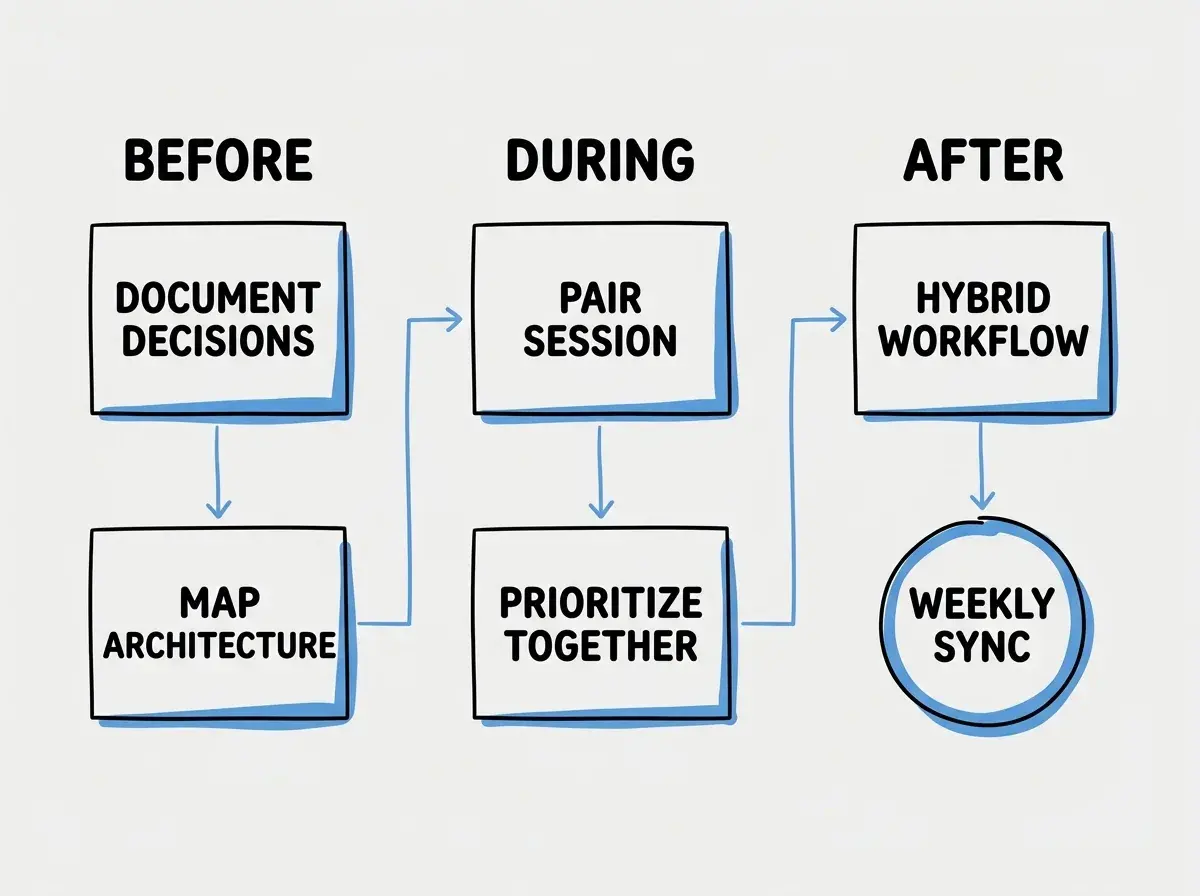
Start by writing a simple document that explains your product decisions, not your code decisions. Why does the billing page work this way? Why did you choose this authentication provider? What are the three features users care about most? A developer can read code and figure out what it does. What they cannot figure out is why you built it that way. Give them the context that the code cannot provide.
Schedule a pairing session, not a presentation. Sit down with your new developer and walk through the app together. Let them ask questions. Let them poke at things. This is not a lecture where you explain your genius architecture. It is a collaborative exploration where you both figure out what needs attention first.
Do not spend two weeks "cleaning up" the codebase before your developer starts. You will waste time on changes they might approach differently, and you will delay the point at which you start getting value from the hire. Let them see the real codebase on day one. Their fresh perspective on what to fix first is more valuable than your guesses.
Then establish the hybrid model. This is the part that most advice about hiring misses. You do not stop vibe coding when you hire a developer. You split the work. You keep doing what vibe coding does best: rapid feature prototyping, UI iteration, quick experiments. Your developer handles what requires human expertise: infrastructure, security, performance, reliability, and the integrations that AI cannot manage. You build the features. They build the floor underneath them.
The hybrid model works because it plays to both strengths. You move fast on product. They move carefully on infrastructure. Features ship quickly because you are still prompting and iterating the way you always have. But now those features land on a stable, monitored, secure foundation that someone is actively maintaining.
Set up a weekly sync where you review what you each built. This is not a status meeting. It is a technical alignment session. Your developer needs to know what you are about to vibe code so they can prepare the infrastructure. You need to know what they changed so your prompts account for the current codebase state. This feedback loop is what makes the hybrid model sustainable.
Dig deeper
A few hand-picked sources if you want to go further.
What This Means For You
The transition from solo vibe coder to a two-person team is the hardest scaling step you will take. Everything after it gets easier. But the timing matters. Hire too early and you waste money on a developer who sits idle while you are still figuring out what to build. Hire too late and you burn out fighting fires in a codebase that has outgrown your ability to maintain it.
Go back to those five signals. Be honest about where you are. If two or more of them describe your current situation, start interviewing this month. Not next quarter. Not after the next feature launch. This month. The best time to hire was before the problems started compounding. The second best time is right now.
Your vibe-coded product got you further than most people get with traditional development. That is worth being proud of. Now it is time to give it the foundation it deserves.
Get practical guides on scaling, hiring, and building products that last beyond the prototype stage.
Read More Articles