The cURL bug bounty AI story is one of those incidents that looks small on the surface but reveals something structural underneath. Daniel Stenberg, the creator and lead maintainer of cURL, announced that the project was severely restricting its bug bounty program because AI-generated reports had made it unworkable. Not a little noisy. Unworkable.
cURL is not a side project. It is one of the most widely deployed pieces of software on the planet, installed on roughly ten billion devices. Every iPhone, every Android phone, every Windows machine, every Linux distribution. When the maintainer of software that ubiquitous says "this system is broken," the industry should pay attention.
The Flood That Broke the System
Bug bounty programs work on a simple premise. Security researchers find vulnerabilities, report them through a structured channel, and receive a financial reward if the vulnerability is valid. The incentive aligns everyone: researchers get paid, projects get safer, users benefit.
What happened with cURL inverted that incentive. People began submitting AI-generated vulnerability reports in volume. The reports were generated by feeding cURL source code into large language models and asking them to find security issues. The LLMs obliged, producing detailed, professional-sounding reports that described vulnerabilities with technical specificity.
The problem was that the vulnerabilities did not exist.
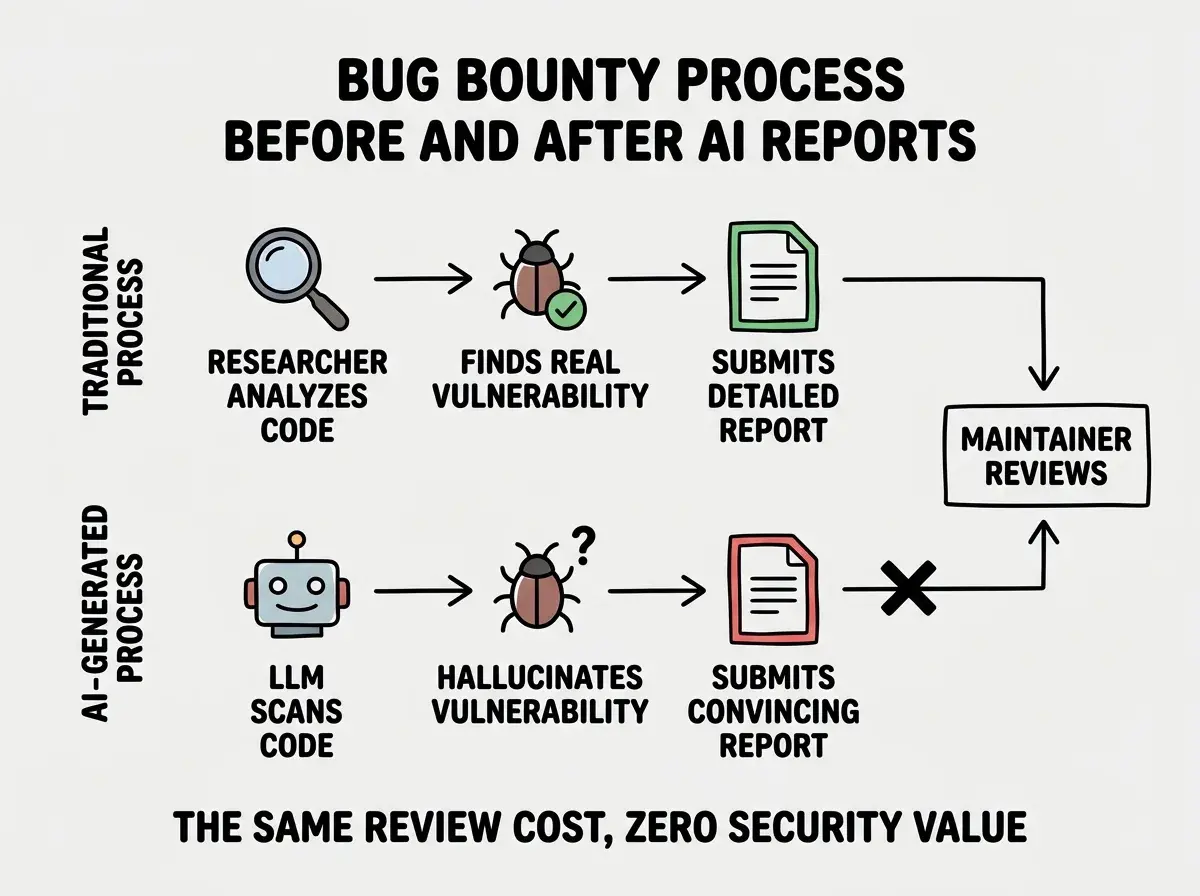
The reports described buffer overflows in functions that could not overflow. They flagged race conditions in code paths that were single-threaded. They identified use-after-free vulnerabilities in memory that was never freed. Each report was structured correctly, used the right terminology, and cited specific lines of code. A reviewer who did not deeply understand the cURL codebase might have found them plausible.
But Stenberg does deeply understand the codebase. He has maintained it for over 25 years. And he spent hours reviewing reports that, one after another, turned out to be fabricated by a language model that was confidently describing things that were not real.
The Economics of AI Noise
Here is where the math stops working. Reviewing a single bug report takes meaningful time, even for an expert. You read the description, locate the referenced code, reason about whether the described attack vector is viable, sometimes write test cases. A thorough review of a single report can take 30 minutes to several hours.
When that review leads to a real vulnerability being fixed, the time is well spent. When it leads to nothing, you have lost those hours permanently. And when ten reports arrive in a week, all AI-generated, all fictitious, you have lost a week of maintainer time that could have gone toward actual development, real security fixes, or reviewing legitimate reports that now sit lower in the queue.
The cost of AI-generated noise is not just the time spent reviewing false reports. It is the opportunity cost: real vulnerabilities that get discovered later because a maintainer was busy evaluating hallucinated ones. In security, delayed discovery means extended exposure.
Stenberg described the situation bluntly. The reporters often could not explain their own submissions when asked follow-up questions. They could not provide proof-of-concept exploits. They could not clarify ambiguous details. Because they had not found the vulnerability. They had prompted a model to generate a report, submitted it without verification, and hoped the bounty payout would follow.
The incentive structure had flipped completely. Instead of rewarding people who make software safer, the program was rewarding people who could generate plausible-looking text at scale.
AI Hallucination Meets Security Reporting
This is the AI hallucination problem applied to a domain where hallucinations carry real consequences. When a chatbot hallucinates a restaurant recommendation, the downside is a bad meal. When an AI hallucinates a security vulnerability, the downside is a maintainer spending hours investigating a phantom, potentially delaying response to a real threat.
The hallucination pattern in security reporting is particularly dangerous because it is hard to detect quickly. A fabricated vulnerability report does not look obviously wrong. It uses real function names pulled from actual source code. It describes real vulnerability classes like buffer overflows and memory corruption. It follows standard disclosure format. The fabrication is in the analysis, not the structure, and analyzing the analysis requires someone who already knows the answer.
This creates a devastating asymmetry. The cost of generating a worthless report is near zero, a few API calls, maybe a few cents. The cost of evaluating that report is measured in hours of expert time. When a single maintainer reviews all submissions, even a modest volume of AI-generated noise can overwhelm the system.
The Pattern Extends Beyond cURL
Stenberg was among the first to speak publicly, but the pattern is not unique to cURL. Other open-source projects have reported similar floods of AI-generated bug reports, feature requests, and pull requests that sound reasonable but do not hold up under scrutiny.
The Linux kernel mailing list has dealt with AI-generated patches that introduce subtle bugs. GitHub repositories have seen pull requests that "fix" nonexistent issues with changes that break working code. Security platforms like HackerOne and Bugcrowd have acknowledged the growing challenge of AI-generated submissions across their entire portfolio of programs.
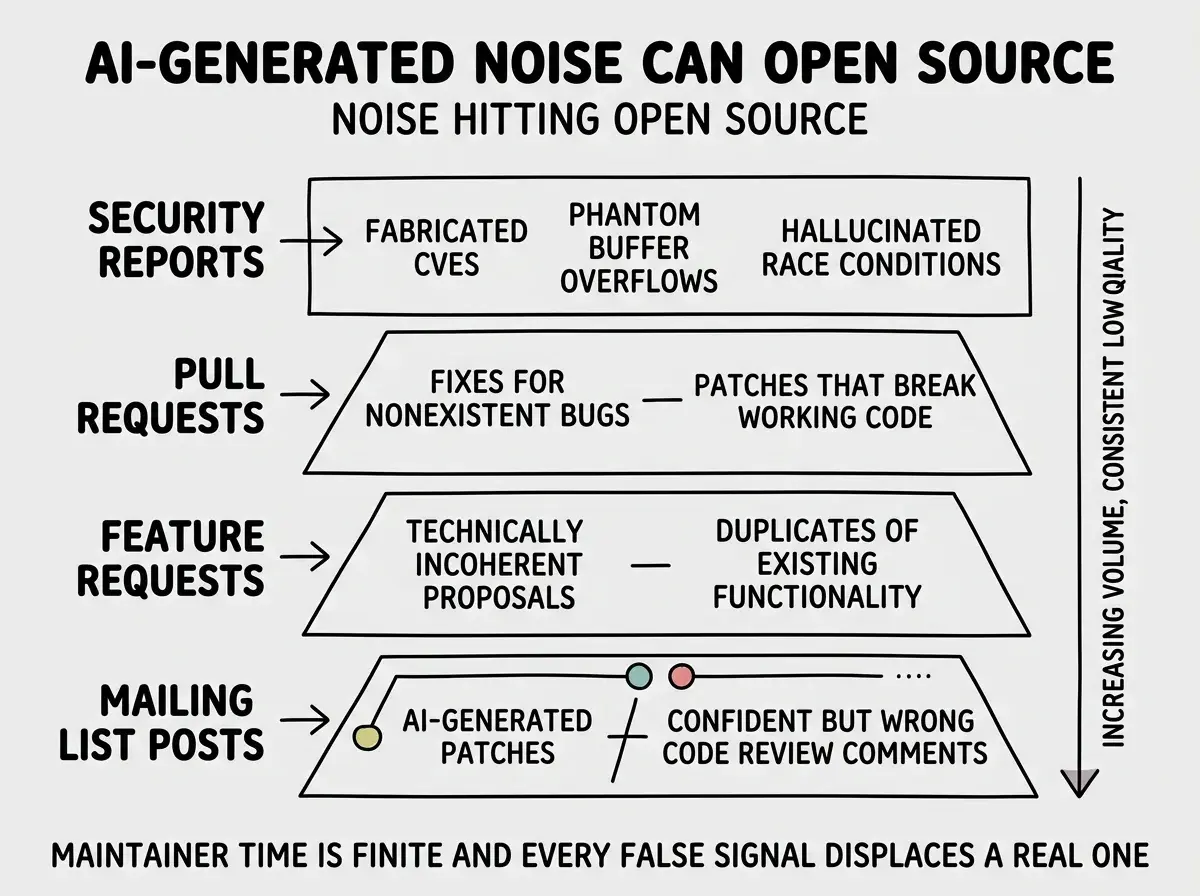
The common thread is that language models are very good at producing text that looks like a legitimate contribution and very bad at ensuring the contribution is actually correct. The surface quality masks the substance problem.
What This Reveals About AI Quality at Scale
The cURL situation is a case study in what happens when AI-generated content hits a system that requires accuracy, not just plausibility. It exposes a gap that matters for anyone building with AI tools.
Language models optimize for coherence and pattern matching. A security report that follows the right structure, uses the right terminology, and references real code is "coherent" from the model's perspective. Whether the described vulnerability actually exists is a factual question that the model has no reliable mechanism to verify.
This is the same dynamic that makes AI-generated code look functional but produce security vulnerabilities. The same dynamic that makes AI-generated legal briefs cite nonexistent case law. The surface looks right. The substance might not be.
For builders, the lesson is that AI output requires domain-specific verification, and the cost of that verification cannot be zero. Someone has to check the work. When no one checks, you get the cURL scenario: a system flooded with confident, well-formatted, entirely wrong information.
Assuming that AI output is reliable because it sounds technical and specific. In the cURL case, every AI-generated report used correct function names, proper vulnerability terminology, and standard report formatting. The fabrication was not in the language. It was in the reasoning. Volume and polish are not proxies for accuracy.
The Open-Source Sustainability Question
This incident feeds into a broader conversation about open-source sustainability that has been building for years. cURL is maintained primarily by one person. Stenberg works on it full-time, funded through sponsorships and contracts, but the review burden of the bug bounty program fell largely on him.
AI-generated noise makes an already difficult situation worse. Open-source maintainers already deal with unreasonable expectations, insufficient funding, and burnout. Adding a firehose of AI-generated submissions that each require expert review to debunk is not a minor inconvenience. It is a direct tax on the most constrained resource in open source: maintainer attention.
The response from Stenberg was not to eliminate the bug bounty entirely but to add significant friction. Higher barriers to submission, more stringent validation requirements, potentially requiring proof-of-concept code rather than just written descriptions. These measures filter out lazy AI-generated submissions but also add overhead for legitimate researchers.
This is the collateral damage of AI noise. The defenses against low-quality submissions inevitably create friction for high-quality ones too. Everyone pays the cost that the AI-generated flood imposed.
The gap between AI output that looks right and AI output that is right defines the next era of software.
Explore moreThe Trust Problem
Perhaps the most important takeaway is about trust. Bug bounty programs run on trust. Researchers trust that valid reports will be rewarded. Maintainers trust that reports represent genuine findings. When AI-generated submissions poison that trust, the entire system degrades.
This trust erosion mirrors what is happening in other domains. Peer review in academic research is struggling with AI-generated paper submissions. Job applications are flooded with AI-generated resumes. Every system that relies on good-faith human input is vulnerable to the same dynamic: AI-generated content that is cheap to produce, expensive to evaluate, and often worthless.
Any system offering a reward for text-based submissions will eventually need defenses against AI-generated spam. This is not a cURL-specific problem. It is a structural consequence of making text generation nearly free while keeping text evaluation expensive.
What This Means For You
The cURL bug bounty shutdown is a signal, not an isolated event. Here is what it means depending on your position.
- If you maintain an open-source project, evaluate every channel that accepts external text input. Bug reports, feature requests, pull requests, and discussion forums are all vulnerable to AI-generated noise. Adding structured validation (proof-of-concept requirements, reproduction steps, test cases) increases friction but protects maintainer time.
- If you are a founder using AI tools to build, recognize that the same hallucination pattern that generates fake vulnerability reports also generates code with fake security properties. Your AI tool might produce code that looks secure, uses security-related function names, and follows security patterns, while being substantively insecure. Verification is not optional.
- If you are a senior developer reviewing AI output, the cURL example is your calibration point. Professional-sounding, technically detailed, structurally correct output can still be entirely fabricated. Review AI contributions with the same skepticism you would apply to an unfamiliar junior developer, then add more.
- If you care about the open-source ecosystem, the AI noise problem is a funding problem. Every hour a maintainer spends debunking an AI-generated report is an hour not spent improving software your applications depend on. Supporting open-source projects financially helps offset the new costs that AI noise imposes.
The gap between generating something and verifying something is the defining tension of this moment. cURL's experience shows what happens when that gap goes unmanaged.
Understanding AI's limitations is the first step toward using it well.
Read more