Vibe coding at 50 plus is not about keeping up with the younger generation. It is about finally having a tool that matches the way experienced people think. After decades of solving problems in your career, raising families, managing teams, and navigating complex systems, you have something that most twenty-somethings do not: the ability to describe exactly what you want and why. That skill, it turns out, is the single most important thing vibe coding requires.
There is a persistent myth that technology belongs to the young. That if you did not grow up with smartphones in your hand, you are permanently behind. That the best time to learn something technical was twenty years ago, and the second best time is never. This myth is wrong, and the data proves it.
Senior professionals with ten or more years of experience ship 2.5 times more AI-generated code than junior developers. They report 81% productivity gains from AI tools. The people with the most life experience are not struggling with vibe coding. They are outperforming everyone else.
The Master Gardener Planting New Seeds
Think of vibe coding like gardening. A twenty-year-old gardener might know the latest hydroponic techniques and have great energy, but they have never watched a full growing season from start to finish. They have never lost a crop to an unexpected frost and learned to check the almanac. They have never spent years improving the same patch of soil until they understand its particular quirks.
You are the master gardener. You know what grows well and what does not, even if the tools in the garden shed have changed since you last planted something. Vibe coding is a new tool in that shed, and a really good one. It requires you to bring all of your knowledge to the table and use it to direct a very capable assistant who can dig faster than you ever could.
You are not starting from zero. You are starting from decades of accumulated wisdom about how things work, what people need, and how projects go wrong. The AI handles the syntax. You handle the judgment calls, and judgment is the one thing that cannot be automated.
Senior professionals with 10+ years of experience ship 2.5x more AI-generated code than junior developers and report 81% productivity gains. Experience is not a handicap with AI tools. It is the primary differentiator. The ability to describe problems clearly, anticipate edge cases, and make good decisions about scope comes from years of real-world experience that no bootcamp can replicate.
The master gardener does not need to understand the metallurgy of their new pruning shears. They need to know which branches to cut and when. That is exactly the skill that experienced people bring to vibe coding, and it is the skill that matters most.
Is It Too Late to Start Coding After 50
A post appeared on Hacker News that racked up over 1,058 points, one of the highest-scoring discussions of the year. It was from a sixty-year-old who had spent decades working in legacy technology, languages and frameworks that most younger developers have never heard of. This person had drifted away from active coding as the industry moved toward modern stacks they did not know. Then they discovered Claude Code and vibe coding, and something unexpected happened.
They did not just keep up. They thrived. Their decades of understanding how software systems work, how data flows, how users interact with applications, all of that translated directly into effective vibe coding. The AI handled the parts they did not know (modern frameworks, new syntax) while they handled the parts the AI could not (architecture decisions, user experience intuition, knowing when something "felt" wrong).
They described it as rediscovering the joy of building. Not the joy of writing code, specifically, but the joy of having an idea and making it real. That joy had been locked behind a wall of unfamiliar modern tooling, and vibe coding removed the wall.
A fifty-year-old echoed the same sentiment: "Tools like Claude Code are the ultimate cheat code for me." Not because they are taking shortcuts, but because AI tools finally let them apply their accumulated expertise without first spending months learning a new programming language. The bottleneck was never their ability to think through problems. It was the gap between knowing what should be built and knowing how to build it with today's tools.
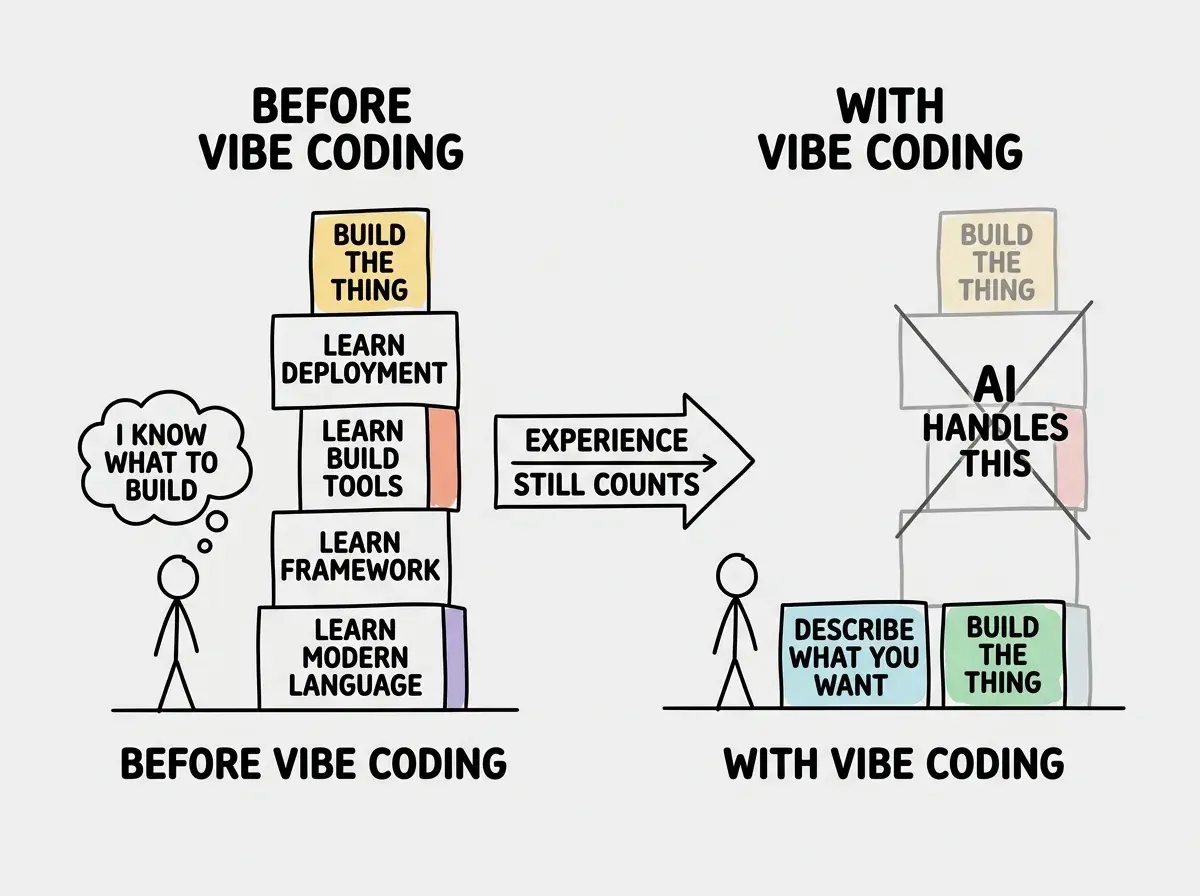
Perhaps the most striking story is from a sixty-six-year-old who built three Laravel applications from the ground up using AI coding tools, and sold one of them. Not a toy project. Not a learning exercise. A real product that someone paid real money for. This person had business experience and domain knowledge that told them exactly what product to build and for whom. The AI gave them the technical means to build it.
Why Experience Is the Differentiator
This confuses everyone at first. People assume that younger, more technically native users would be better at vibe coding. The tools are digital. The output is code. Surely the generation that grew up coding would have the advantage.
But vibe coding is not coding. It is directing. And directing well requires knowing what you are directing toward.
You might think that the hardest part of building software is writing the code. But actually, the hardest part has always been figuring out what to build and making the thousand small decisions that determine whether the finished product is useful or not. What should happen when the user enters invalid data? How should the navigation work on mobile? These are judgment calls, and they improve with experience, not with youth.
When a fifty-five-year-old sits down with a vibe coding tool, they bring decades of watching people interact with systems, decades of knowing what frustrates users and what delights them, decades of understanding the difference between what people say they want and what they actually need.
That 81% productivity gain for experienced professionals is not because older people type faster or write better prompts. It is because they waste less time building the wrong thing. They know how to scope a project. They know when a feature is essential versus nice-to-have. These skills take years to develop, and no AI tool can substitute for them.
The fundamentals of vibe coding apply to every age and background.
Learn the basicsThe pattern repeats across every story of successful older vibe coders. The technology is new. The skills that make it work are not.
Getting Started Without Getting Overwhelmed
The biggest barrier for people over fifty is not capability. It is the feeling that everyone else already knows this stuff and you are impossibly behind. Let that feeling go. Most people using AI coding tools right now are figuring it out as they go. There is no established curriculum. There is no "right" way. The person next to you who seems confident is probably three days ahead of you at most.
Start with a problem you understand deeply. Not a generic tutorial project. Something from your actual life or work. The spreadsheet you have been using to track something for years that really should be an application. The manual process at your company that you know could be automated. The tool you wished existed every day at your old job.
You already know the requirements because you have been the user for years. That is an enormous advantage. Most software projects fail because the builder does not understand the user's needs. You are the user.
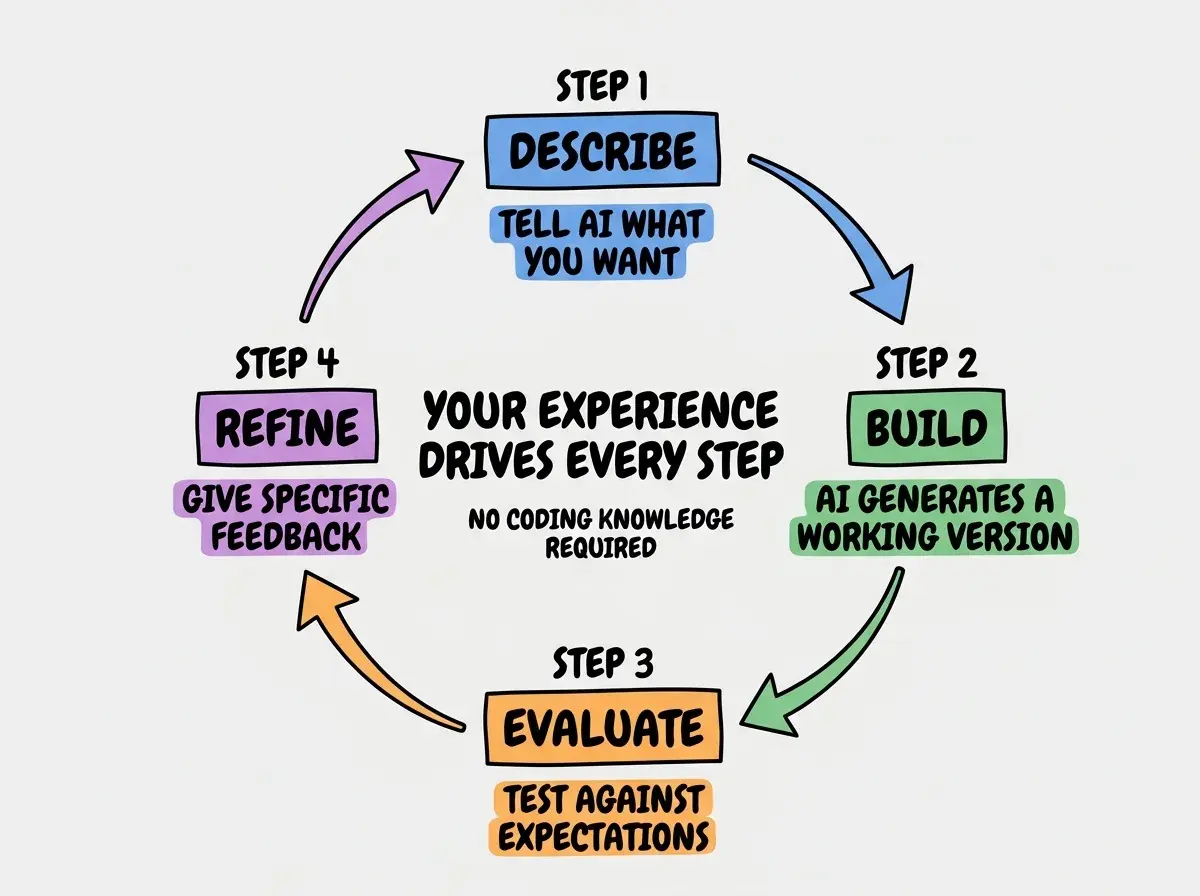
Talk to the AI like you would talk to a new employee. You do not need to learn special syntax or programming terminology. Describe what you want the way you would describe it to a smart person who just joined your team. "I need a tool that lets me enter my weekly expenses, categorizes them automatically, and shows me a monthly summary chart." That is a perfect vibe coding prompt. It describes the problem, the desired behavior, and the expected output, all in language you already use naturally.
Expect to iterate. The first version will not be perfect. This is normal and fine. Think of it like giving feedback to that new employee. "This is good, but the categories should be in alphabetical order, and I need a way to export the data to a spreadsheet." The AI will adjust. You will refine. After a few rounds, you will have something that works the way you want it to.
Trying to learn programming concepts before starting to build. You do not need to understand JavaScript, Python, HTML, or any other language. The AI writes the code. Your job is to describe what you want, evaluate whether the result matches your expectations, and provide specific feedback when it does not. Spending weeks on programming tutorials before touching a vibe coding tool is like studying engine mechanics before learning to drive. Start driving first.
Give yourself permission to not understand the code. You are used to understanding your tools deeply. With vibe coding, you might look at the code the AI generates and feel lost. That is okay. You need to evaluate whether the result works, and that evaluation relies on your domain expertise, not your coding knowledge.
The Joy Part Matters
There is a reason the word "joy" appears in the title of this article. The viral stories about older vibe coders are not primarily about productivity metrics or business outcomes. They are about people rediscovering something they thought they had lost.
The sixty-year-old on Hacker News was not celebrating because they shipped code faster. They were celebrating because they felt the thrill of creating something again. The sixty-six-year-old who sold a Laravel app was not just making money. They were proving to themselves that their best years of building were not behind them.
If you are over fifty and you have felt that quiet frustration of having ideas but no way to make them real, vibe coding is worth your time. Not because it will make you a developer, but because building things you care about is genuinely fun. And fun is allowed at any age.
What This Means For You
Vibe coding does not care how old you are. It cares how well you can describe a problem and evaluate a solution. If you have spent decades doing both of those things professionally, you are better prepared for this than almost anyone.
- If you are a founder: Stop overlooking experienced candidates and collaborators who did not grow up with modern tech stacks. People over fifty who learn vibe coding bring judgment, domain knowledge, and project management instincts that are extraordinarily difficult to hire for. A fifty-five-year-old who understands your industry and can vibe code a prototype might be more valuable than a twenty-five-year-old who can write React but has never run a business. Evaluate people on their problem-solving ability, not their GitHub profile.
- If you are a career changer: This is your invitation. If you have been watching the AI revolution from the sidelines, thinking you missed the window, you did not. The window is wide open, and your experience is an asset, not a liability. Start with one small project that solves a real problem in your life. Do not sign up for a course first. Do not read five books first. Open an AI coding tool, describe what you want, and see what happens. You will be surprised how far your existing knowledge carries you.
- If you are a student: Learn from the experienced people around you. The biggest lesson from vibe coding is that domain expertise matters more than technical skill. A fifty-year-old who spent their career in logistics knows things about supply chain management that you cannot learn from a textbook, and that knowledge makes their vibe-coded logistics tool better than anything you could build without it. Seek out mentors with deep industry experience, even if they cannot write a line of code. Their knowledge combined with your technical comfort is a powerful partnership.
Everything you need to know about vibe coding, regardless of your age or background.
Explore the guide