The question of whether developers trust AI code has a surprising answer. 92% of US developers use AI coding tools every day, but only 33% trust the accuracy of what those tools produce. The industry is hooked on something it does not believe in.
That number, 33%, is down from 77% just two years earlier. Developers did not become more skeptical because the tools got worse. The tools got better. But as developers used them more, they saw more failures, more hallucinated APIs, more subtle bugs that passed code review and broke production a week later. Familiarity bred distrust.
The Contradiction Nobody Talks About
This is not normal technology adoption. When people use a tool more and trust it less, something unusual is happening. Usually, experience with a technology builds confidence. You use your car every day and trust it to start. You use your phone every day and trust it to send messages. But with AI coding tools, the opposite pattern has emerged.
Hashnode's research described the situation bluntly: the industry is "hooked on something it doesn't trust." That phrase captures the dynamic perfectly. The 92% usage rate is not driven by confidence. It is driven by pressure, by the fear of falling behind, by the productivity gains that are real even when the output is unreliable.
Think of it like eating fast food every day while telling everyone you prefer home cooking. The convenience wins, even when you know the quality is worse. You keep going back to the drive-through because cooking takes time you do not have. You keep accepting AI suggestions because writing the code yourself takes time your sprint does not allow. The gap between what you trust and what you use is filled by urgency.
Developer trust in AI code accuracy dropped from 77% to 33% between 2023 and 2025, even as usage climbed to 92%. More experience with AI tools led to less confidence, not more, because developers saw the failures firsthand.
This paradox shapes every decision in modern software development. It affects how teams structure code review, how managers estimate timelines, and how individual developers feel about their own work at the end of the day.
The Fast Food Habit You Cannot Quit
The fast food analogy runs deeper than convenience. Fast food is engineered to taste good in the moment. The first bite is satisfying. The immediate experience is positive. But the long-term effects, the health consequences, the nutritional gaps, those show up later. AI-generated code works exactly the same way.
The first time you use Copilot or Cursor to generate a function, it feels like magic. The code appears instantly. It usually works. The dopamine hit is real. You saved ten minutes, maybe thirty. Over a day, you saved hours. Over a week, you shipped features that would have taken twice as long. That is the first bite, and it tastes great.
The consequences show up later. A study found that 41% of AI-generated code gets reverted within two weeks. That means nearly half of those quick wins turn into rework. The time you saved generating the code gets spent debugging it, reviewing it, or replacing it entirely. Just like fast food, the full cost is hidden from the moment of consumption.
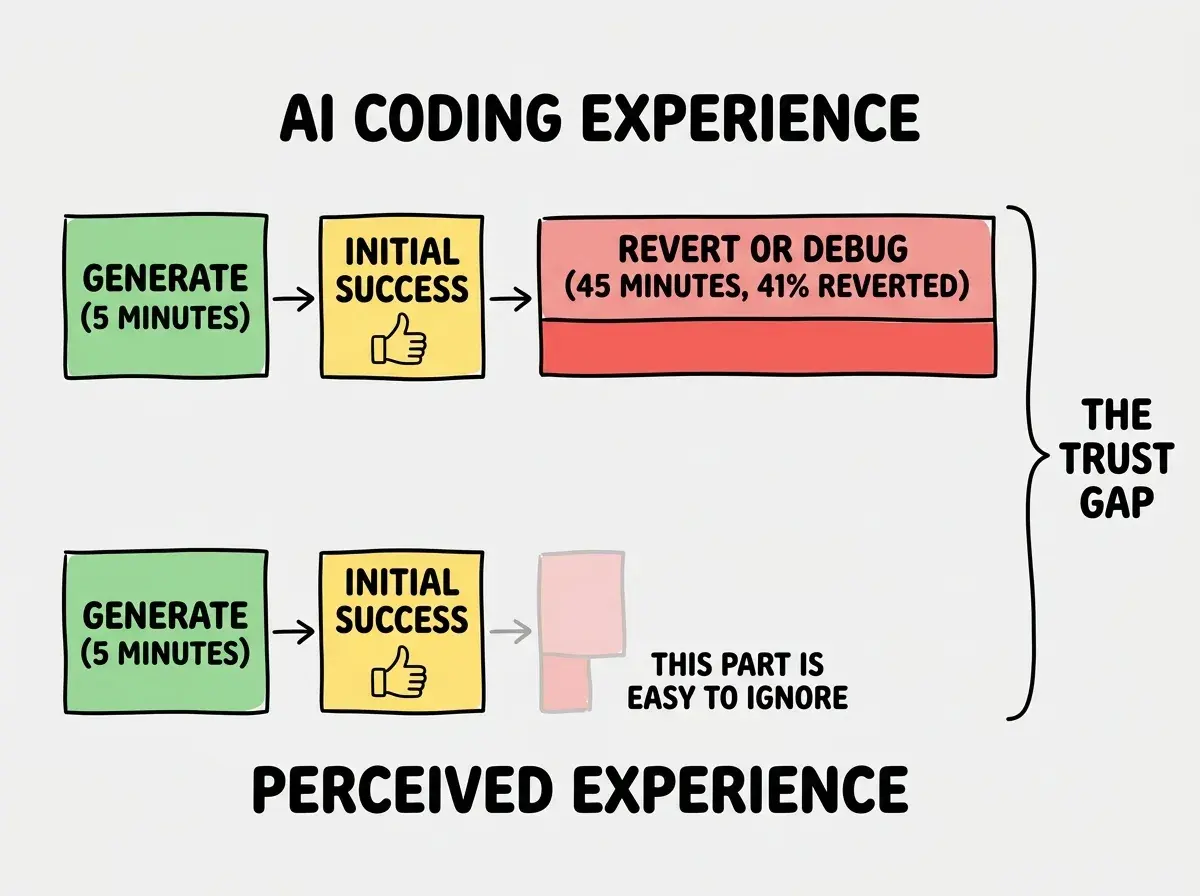
This confuses everyone at first. If the code gets reverted that often, why keep using it? Because the 59% that sticks is still an enormous productivity gain. Because the alternative, writing everything by hand, feels impossibly slow once you have experienced the speed. Because your team, your manager, your competitors are all using these tools, and opting out feels like choosing to lose.
Why the Trust Collapse Happened
You might think the drop from 77% to 33% trust happened because of a few high-profile failures. But actually, it happened because of thousands of small, personal ones.
Every developer who uses AI tools daily has a private collection of horror stories. The function that looked correct but had an off-by-one error buried in a loop. The API call that used a parameter that does not exist. The database query that worked in development but timed out in production because the AI did not know about the table sizes. None of these stories make headlines. All of them erode trust.
The trust collapse also reflects a maturation of understanding. In 2023, many developers were new to AI coding tools. The novelty created optimism. By 2025, those same developers had been using the tools for two years. They had a much clearer picture of the failure modes, the patterns of when AI helps and when it hurts. Their lower trust rating was not pessimism. It was accuracy.
Learn the patterns that make AI coding tools work for you instead of against you.
Start learningThe security dimension makes the trust gap even more rational. Research from Veracode in 2025 found that 45% of AI-generated code introduces security vulnerabilities. AI-generated code is 2.74 times more likely to introduce cross-site scripting flaws than human-written code. Developers who distrust AI output are not being paranoid. They are responding to measurable risk.
The Competitive Trap That Keeps You Eating
The deepest part of the fast food analogy is the competitive pressure. If everyone else is eating fast food and moving faster because of it, you cannot afford to cook every meal from scratch. The speed advantage matters even if the quality is lower.
This is the trap the software industry has built for itself. AI coding tools create genuine speed advantages. Teams that use them ship faster. Developers who use them produce more code. In a market that rewards speed, opting out of AI tools is a competitive disadvantage even if you know the output needs heavy review.
The Lovable platform incident illustrates what happens when the trust gap meets real users. CVE-2025-48757 revealed that Lovable, an AI coding platform, had missing Row Level Security that exposed over 170 production applications. The AI-generated code worked. It shipped. But it was fundamentally insecure, and nobody caught it because the convenience of accepting AI output had outpaced the discipline of reviewing it.
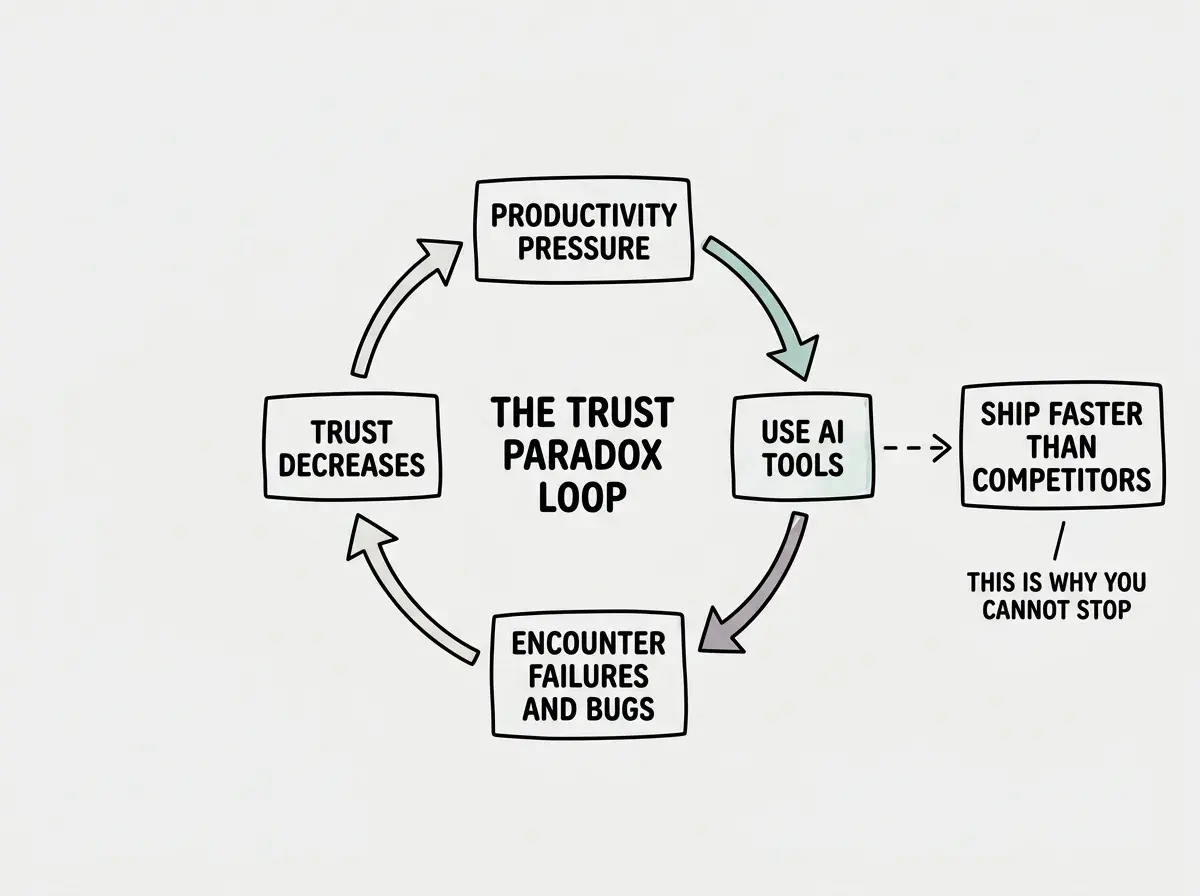
The question is not whether to use AI tools. That decision has already been made by market forces. The question is how to use them while maintaining the quality standards that justify your existence as a developer.
Treating AI coding tools as either fully trustworthy or completely untrustworthy. The productive middle ground is treating every AI suggestion like code from a junior developer: probably useful, definitely needs review, occasionally dangerous.
The developers who navigate this paradox successfully are the ones who separate speed of generation from speed of acceptance. They let AI generate quickly but review deliberately. They use AI for the first draft and their own judgment for the final version. They eat the fast food but add the salad themselves.
What This Means For You
The trust paradox is not going away. As AI tools become more capable, the temptation to skip review will increase while the consequences of skipping review will also increase. Understanding this dynamic is essential for anyone building with AI today.
- If you are a senior developer, your instinct to distrust AI output is backed by data. But the solution is not avoidance. Build review processes that assume AI code needs verification. Treat AI output the way you would treat a pull request from someone who just joined the team: read it carefully, test it thoroughly, and do not merge it just because it looks right.
- If you are a student, you are entering an industry where the primary tools are not fully trusted by the people who use them. This is actually an opportunity. Developers who can effectively review and improve AI-generated code will be more valuable than developers who can only generate it. Learn to read code critically, not just write it.
Build the review habits that turn AI speed into real quality.
Keep reading