Is vibe coding real programming? The answer depends entirely on how you define "real programming." If programming means writing syntax by hand, then no. If programming means creating working software that solves problems, then yes. The question itself is less useful than it appears, and both sides are missing something important.
This debate generates enormous heat online. Experienced developers feel their years of hard-won expertise being dismissed. Non-developers feel gatekept from a field they are actively contributing to. Both feelings are valid. But the framing is wrong.
Why This Debate Keeps Going in Circles
The "is it real programming" argument has been happening in software for decades. It happened when visual programming tools emerged in the 1990s. It happened when web developers were told they were not "real programmers" because JavaScript was not a "real language." It happened when no-code tools appeared and people built functional businesses on Webflow and Bubble.
Every time the barrier to building software drops, the same territorial debate reignites. And every time, the debate eventually becomes irrelevant because the people building things stop caring what the gatekeepers think.
But this round is different in scale. Sixty-three percent of active vibe coding users are non-developers. Forty-six percent of all new code is AI-generated. Eighty-seven percent of Fortune 500 companies are using vibe coding tools. When the majority of people creating software and the majority of large companies adopting the tools are already on one side, the debate is less about legitimacy and more about identity.
46% of all new code is now AI-generated, and 92% of US developers use AI coding tools daily. The question is no longer whether AI-assisted building counts as programming. It is the way most programming is already being done.
The intensity of the debate reveals something real, though. For people who spent years learning to code, vibe coding can feel like a threat to their professional identity. For people who are new to building, being told their work is not "real" can feel like a slap. Acknowledging both of those emotional realities is more productive than pretending this is a purely technical question.
The Calculator Question
Here is the analogy that cuts through the noise. Is using a calculator "real math"?
If you are a student learning arithmetic, using a calculator to skip the fundamentals will leave you without number sense. You will get answers without understanding why they are right. You will not catch errors because you have no intuition for what a reasonable answer looks like. In this context, the calculator is genuinely harmful to learning.
If you are an engineer designing a bridge, refusing to use a calculator is absurd. Nobody cares whether you can do long division by hand. They care whether the bridge stays up. The tool is not the point. The outcome is the point.
The same split applies to vibe coding. If you are trying to understand how software works at a fundamental level, skipping straight to AI-generated code can leave you without the mental models you need to debug, maintain, and extend what you build. You will hit the 70% wall and not understand why.
If you are a founder shipping a product, a marketer building an internal tool, or a creative making an interactive experience, nobody cares whether you typed the semicolons yourself. They care whether it works. The 36.4% of vibe coding users who are founders are not being asked whether they are "real programmers." They are being asked whether their product solves a real problem.
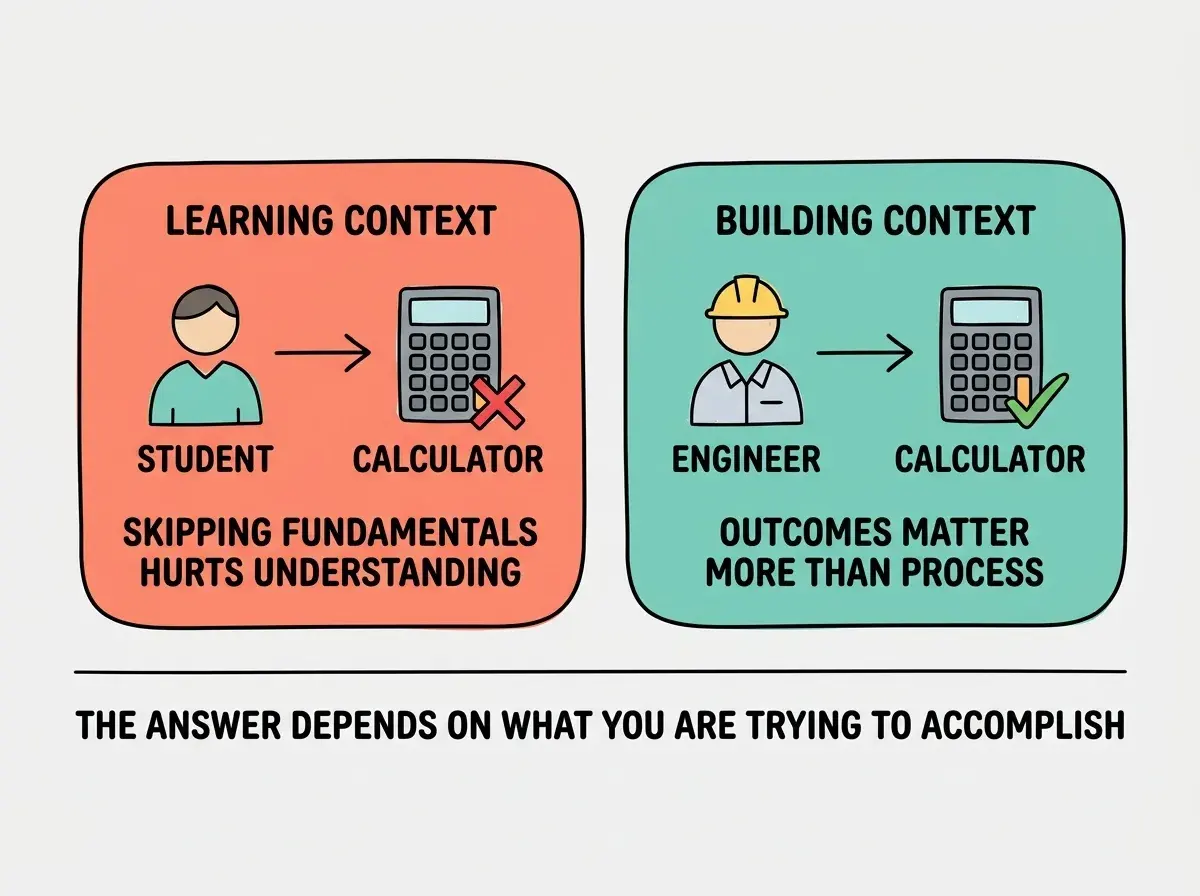
The calculator analogy carries further than most people realize. Professional mathematicians use calculators, computers, and symbolic algebra systems constantly. Using tools does not make their work less mathematical. It makes them more productive at the parts of mathematics that require human insight. Similarly, senior developers using vibe coding tools report 81% productivity gains. They are not doing less programming. They are spending less time on the mechanical parts and more time on the parts that require judgment.
What Both Sides Get Wrong
The "vibe coding is not real programming" camp gets several things right. Understanding fundamentals matters. Blindly accepting AI output leads to fragile, insecure, unmaintainable code. The 70% wall is real, and people who hit it without any conceptual foundation struggle badly. Bug loops, hallucinated APIs, and context window degradation are genuine problems that affect real projects.
But this camp also makes a critical error. They conflate the process of writing code with the discipline of programming. Programming, at its core, is about decomposing problems, thinking through edge cases, designing systems that handle failure gracefully, and building things that work reliably. None of that requires typing syntax by hand. Mitchell Hashimoto famously banned AI-generated code from his Ghostty project, and that is a perfectly valid choice for someone building a performance-critical terminal emulator. But it is not the only valid choice.
Our beginner guides help you cut through the noise and start building.
Start hereThe "vibe coding is the future, traditional coding is dead" camp also gets things right. The accessibility gains are real and transformative. People who could never build software before are building it now. The speed advantages are documented and significant. The democratization of software creation is, on balance, a positive development.
But this camp makes its own critical error. They underestimate how much traditional programming knowledge amplifies vibe coding effectiveness. The data is unambiguous: senior developers get 2.5 times more output from the same AI tools than juniors. The 81% productivity gain goes to people who understand what the AI is generating. Dismissing traditional coding knowledge is like saying you do not need to understand directions because you have GPS. It works until it does not, and then you are lost.
The Middle Ground Nobody Talks About
You might think this debate has two sides. But actually, there is a large, quiet middle ground that gets almost no attention because it is not provocative enough for social media.
Y Combinator's Winter 2025 batch tells this story perfectly. Twenty-five percent of their startups had 95% or more AI-generated codebases. These are not hobbyists. These are funded companies building real products that real users depend on. But they are also not working without technical understanding. The founders and small teams at these startups understand what their AI-generated code does, even if they did not write it by hand.
This confuses everyone at first. How can you understand code you did not write? The same way you understand a document you did not author. You read it. You test it. You ask questions about it. You develop a mental model of what it does and verify that model against reality. That is a skill, and it is a form of programming literacy, even if it does not look like traditional coding.
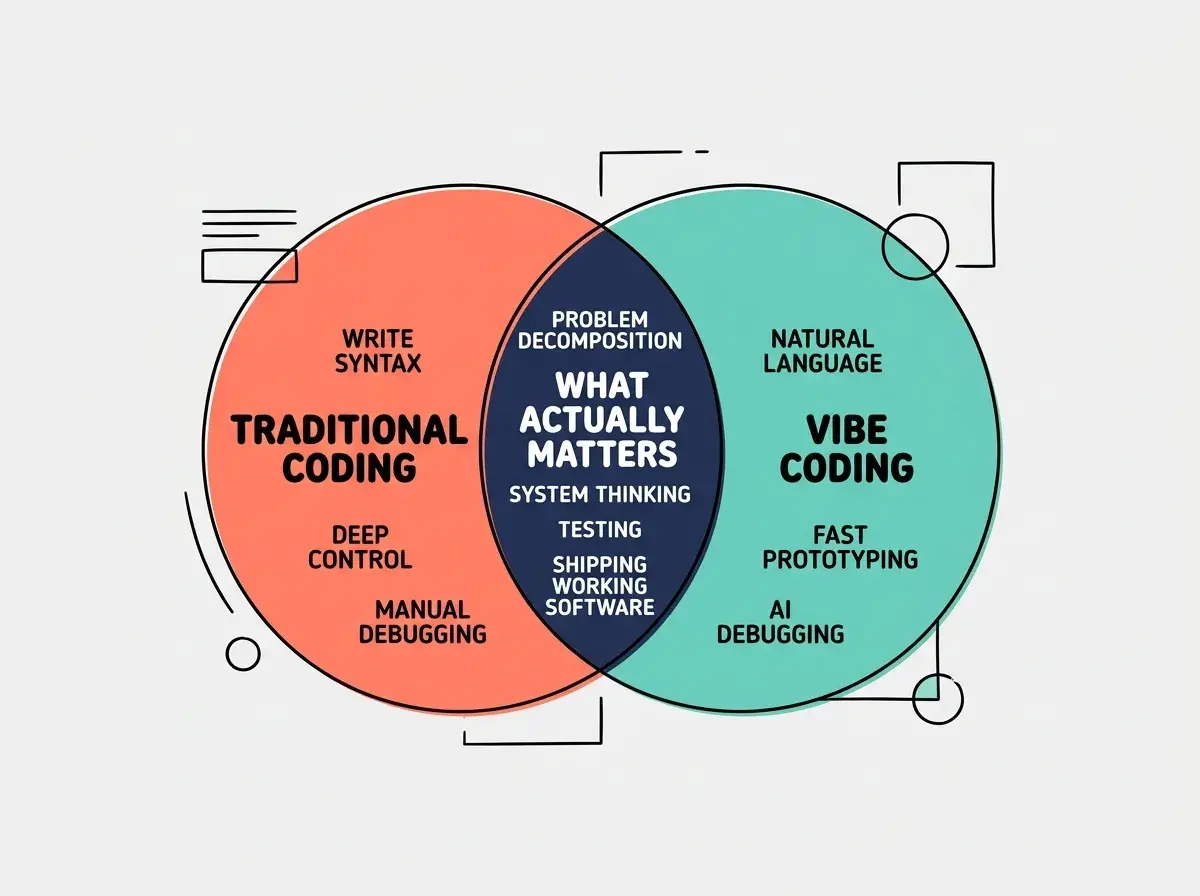
The overlap in that diagram is where productive conversation happens. Problem decomposition, system thinking, testing, and shipping working software are the core of programming regardless of how the code gets written. A founder who clearly decomposes a problem into components, thinks through edge cases, and tests the output thoroughly is doing real programming work, even if an AI wrote every line.
The biggest mistake in this debate is picking a side and dismissing the other entirely. Developers who refuse to use AI tools ship slower. Non-developers who refuse to learn any programming concepts hit walls they cannot overcome. The most effective builders are the ones who refuse to treat this as an either-or question.
The 33% of developers who trust AI code accuracy are not wrong to be cautious. Trust should be earned, and AI code does contain bugs, security vulnerabilities, and architectural problems that require human judgment to catch. But the 92% who use AI tools daily have already made a practical decision: the productivity gains outweigh the risks, as long as you maintain human oversight.
Reframing the Question
The better question is not "is vibe coding real programming?" It is "what does it take to build, ship, and maintain working software in 2026?"
The answer includes clear problem definition, iterative development, testing, debugging, understanding your users, and taking responsibility for what you ship. Some of that requires technical knowledge. Some of it requires domain expertise. Some of it requires communication skills. None of it requires a specific method of generating code.
The internet will keep arguing about whether vibe coding is "real" programming. That debate generates engagement. But the people who are actually shipping products, whether they are traditional developers, vibe coders, or (most commonly) some combination of both, have already moved past the question. They are too busy building.
What This Means For You
The "is it real programming" debate is a distraction from the question that actually matters: can you build things that work? The answer to that question has nothing to do with how the code gets written and everything to do with how clearly you think, how carefully you test, and how honestly you assess what is working.
- If you're a student: Do not let anyone gatekeep your learning. If you are building working software with AI tools, you are programming. But also invest time in understanding the fundamentals, because that knowledge will make you dramatically more effective with AI and will serve you for decades regardless of how tools evolve.
- If you're a senior developer: Your expertise is more valuable than ever, not less. The 81% productivity gains and 2.5x output multiplier go to people with your knowledge. Embrace AI tools as amplifiers of your skills rather than threats to your identity. The builders who combine deep knowledge with AI speed will define the next era.
- If you're changing careers: You do not need permission from the programming establishment to build things. Sixty-three percent of vibe coding users are non-developers, and many of them are shipping products that generate real revenue. Start building, learn concepts as you encounter them, and let your results speak for themselves.
Practical guides to help you ship your first project, regardless of your background.
Get building