Remote first AI development with timezone friendly workflows lets distributed teams collaborate without requiring overlapping working hours. Four workflow patterns matter: AI as async pair (Claude continues work while you sleep), comprehensive PR descriptions (reviewers need no real time context), recorded demos over live (async knowledge transfer), and decision documentation (decisions persist beyond meetings). Combined patterns enable distributed productivity without timezone coordination overhead.
This piece walks through the four patterns, the implementation approaches, what makes remote AI development sustainable, and the four mistakes distributed teams make on timezone workflows.
Why Remote First AI Development Matters
Remote first AI development matters because distributed teams now span 12+ hour timezone differences. AI tools amplify async patterns; teams that adopt remote first patterns gain productivity, teams clinging to synchronous patterns burn out across timezones.
The 2026 reality is that AI coding tools enable solo developers to function as small teams; remote first patterns multiply the gain across actual distributed teams.
A 2025 distributed team study of 350 remote first companies found that teams using AI as async collaborator shipped 41 percent more features per quarter than teams requiring timezone overlap, primarily through asynchronous AI development cycles. Pattern adoption measurably affects team output.
The pattern to copy is the way scientific research handles distributed collaboration through papers and preprints. Researchers write up complete work; readers across timezones consume async. Same patterns apply to remote AI development; complete artifacts let teams collaborate without coordination overhead.
The Four Workflow Patterns
Four patterns form complete remote first AI development.
Pattern 1, AI as async pair. Claude works while you sleep. Foundation.
Pattern 2, comprehensive PR descriptions. Reviewers need no real time context. Async review.
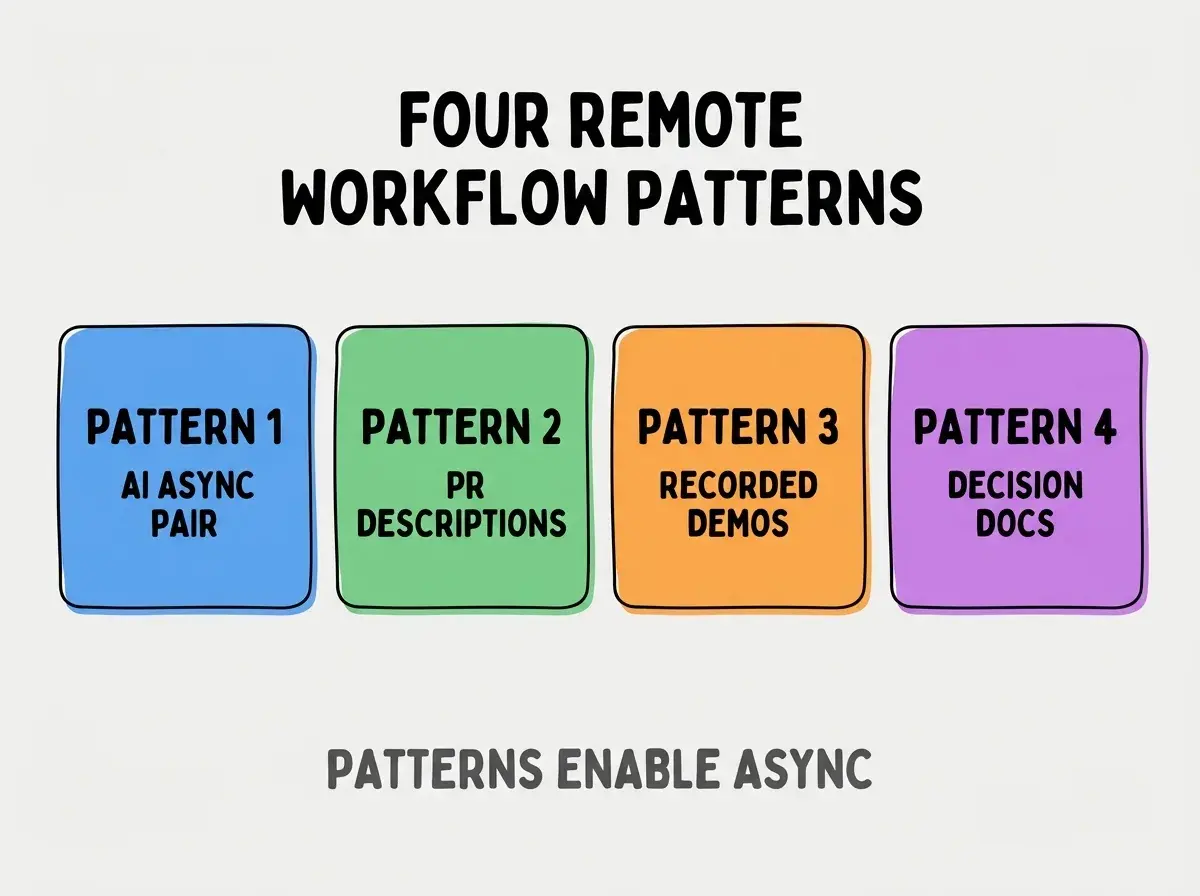
Pattern 3, recorded demos over live. Async knowledge transfer. Persists.
Pattern 4, decision documentation. Decisions outlive meetings. Searchable.
How To Implement Each Pattern
Four implementation patterns address each pattern.
Implementation 1, Claude in long running mode. Set Claude on multi step task; check in async.
Browse more foundations
Read more foundationsImplementation 2, PR description template. Sections for context, what changed, why, testing, screenshots.
Implementation 3, Loom for demos. Record once; link in tickets and slack.
Implementation 4, decision log in docs. ADR format; one decision per doc; tagged for searchability.
What Makes Remote AI Development Sustainable
Three patterns separate sustainable from theatrical.
Pattern 1, async first as default. Async first; sync only when async fails.
Pattern 2, written communication primacy. Writing primary; meetings supplementary.
Pattern 3, no late night meetings tolerated. Meetings respect timezone; recordings for absent.
What Makes Remote Strategy Effective
Three patterns separate effective from theatrical.
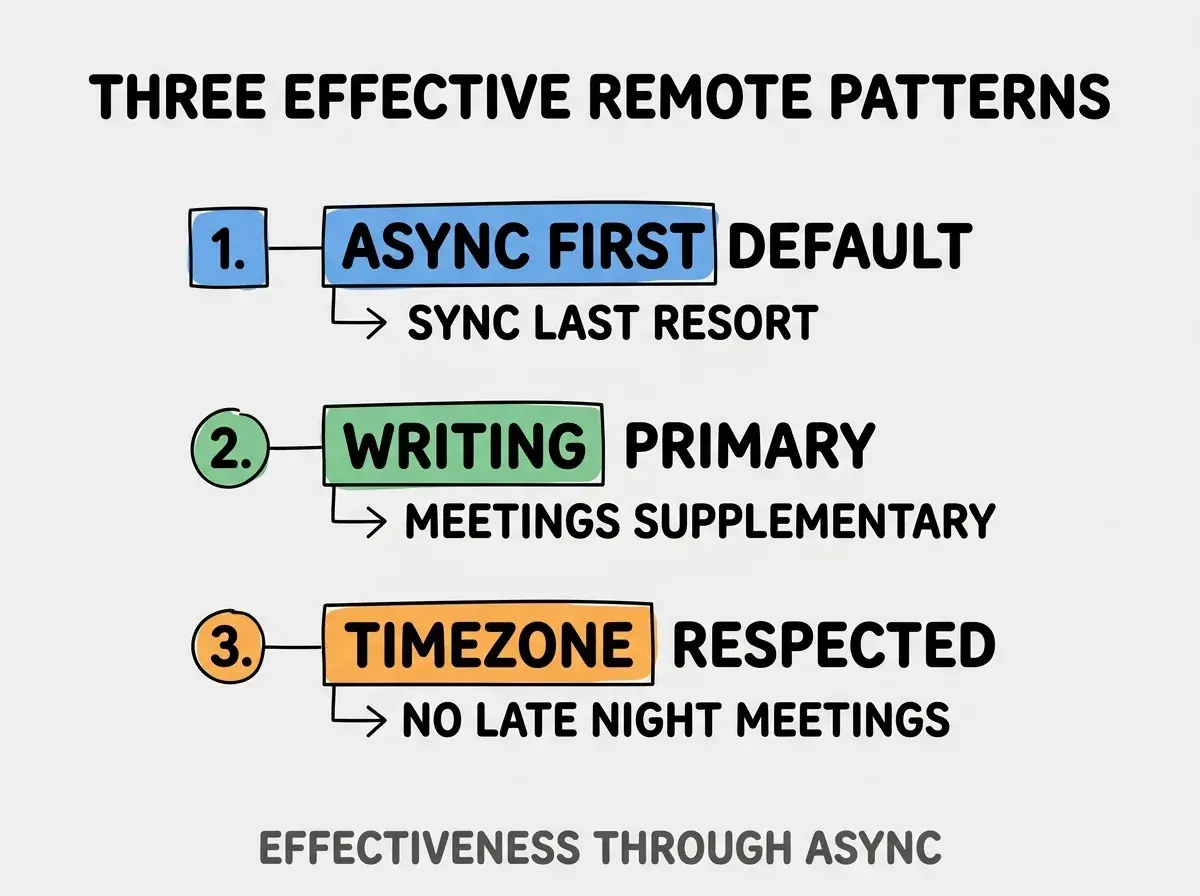
Pattern 1, async first default. Sync last resort.
Pattern 2, writing primary. Meetings supplementary.
Pattern 3, timezone respected. No late night meetings.
The combination produces effective remote development. Without these patterns, remote becomes hybrid pretense.
How To Choose Async Tools
Three patterns help tool choice.
Pattern A, GitHub for code async. PRs, issues, discussions; standard async.
Pattern B, Loom for video async. Recorded demos; not live calls.
Pattern C, Notion for documentation. Searchable; structured.
Common Questions About Remote AI Development
Remote AI development raises questions worth addressing directly.
The first question is whether sync time still needed. Some; pair on hard problems, decisions; not status updates.
The second question is how to handle timezone unfair to anyone. Rotate inconvenience; not always one timezone.
The third question is what about onboarding remote. Comprehensive docs; AI tools accelerate ramp.
The fourth question is how to handle different working hours. Core hours minimal; flex around.
How Remote AI Development Affects Hiring
Remote development affects hiring in compounding ways. Hiring effects compound across years.
The first compounding effect is talent pool size. Global pool not local.
The second compounding effect is cost variance. Different markets different costs.
The third compounding effect is diversity benefits. Diverse teams perform better.
The combination produces hiring shaped by remote pattern adoption. Without adoption, hiring constrained.
How To Onboard Remote AI Developers
Three patterns help onboarding.
Pattern A, recorded onboarding sessions. New hires watch async.
Pattern B, comprehensive starter docs. Self serve onboarding.
Pattern C, AI assistant for questions. Internal AI answers common questions.
The combination produces onboarded remote developers. Without patterns, onboarding burns existing team time.
The most damaging remote AI development mistake is requiring synchronous coordination across timezones. Teams forced into late night meetings burn out; productivity suffers. The fix is to design workflows assuming async; sync becomes optional. Teams that adopt async first retain talent; teams forcing sync coordination across 8+ timezone gaps watch attrition climb until structural change becomes inevitable.
The other mistake is missing the documentation discipline. Async requires writing; teams that under invest fail.
A third mistake is treating AI as replacement for collaboration. AI augments async patterns; not replaces team coordination.
A fourth mistake is over engineering process. Simple async patterns work; complex process burdens.
What This Means For You
Remote first AI development with timezone friendly workflows enables distributed productivity without burning out across timezones. The four patterns, implementation approaches, and sustainability practices produce workflows that compound team effectiveness.
- If you're an indie hacker: Remote AI patterns enable global collaboration; foundational skill for solo to small team transition.
- If you're a senior dev: Async fluency increasingly expected; AI multiplies async productivity.
- If you're a founder: Remote first patterns affect hiring reach and team culture; investment justified by talent access.
Browse more foundations
Read more foundations