The Moltbook data leak exposed 1.5 million authentication tokens and 35,000 email addresses from an application built entirely by AI. The founder said it plainly: "I didn't write a single line of code." That statement was meant as a point of pride. It became the diagnosis.
This is not a story about one bad app. It is a case study in what happens when the person responsible for a product does not understand the product. When nobody reviews the code, nobody audits the security, and nobody tests for the vulnerabilities that every web application carries by default, the question is not whether a breach will happen. It is when.
What Moltbook Was and How It Got Built
Moltbook was a social networking application that let users create profiles, connect with others, and share content. By all outward appearances, it worked. The interface was polished. The features functioned. Users signed up, created accounts, and trusted the platform with their email addresses and login credentials.
The founder built the entire application using AI coding tools without writing any code by hand. This approach, sometimes called vibe coding, is not inherently dangerous. Thousands of founders are building real products this way. But the Moltbook case reveals what happens when the speed of AI-generated development runs far ahead of the security knowledge of the person directing it.
Think of it like a self-driving car with no brakes. The AI built the car. It designed the body, installed the engine, wired the electronics, and painted it a beautiful color. The car looked perfect. It could accelerate, turn, and navigate highways. But nobody checked whether it could stop. Nobody tested the braking system because nobody involved in the process knew enough to ask whether brakes existed, let alone whether they worked.
The Moltbook breach was not caused by sophisticated hacking or a zero-day exploit. It was caused by basic security failures that any standard code review or penetration test would have caught. Authentication tokens were exposed through improperly secured API endpoints, and email addresses were accessible without authorization. These are introductory-level vulnerabilities, not advanced attack vectors.
The self-driving car analogy holds throughout this entire story. Every part of the Moltbook failure maps to a car that was built to move forward but never tested for anything else. The AI generated functional code, code that did things, without generating safe code, code that prevented the wrong things from happening. Security is almost entirely about prevention, and AI coding tools are almost entirely about creation. That gap is where 1.5 million tokens leaked through.
The Specific Failures Behind the Breach
The leak was discovered by security researchers who found that Moltbook's API endpoints were returning authentication tokens in plaintext. These tokens are the digital equivalent of house keys. Every user who logged into Moltbook received a token that proved their identity to the system. Those tokens were supposed to be stored securely on the server side and transmitted only through encrypted, protected channels.
Instead, the tokens were accessible through API responses that required no authentication to read. An attacker did not need to break into the system. They needed to ask politely, and the system handed over the keys.
The 35,000 email addresses were exposed through a similar mechanism. User profile data, including email addresses that should have been private, was returned by API endpoints without checking whether the person making the request had permission to see that data. The system had no concept of "this data belongs to this user and nobody else should see it." It simply returned whatever was asked for.
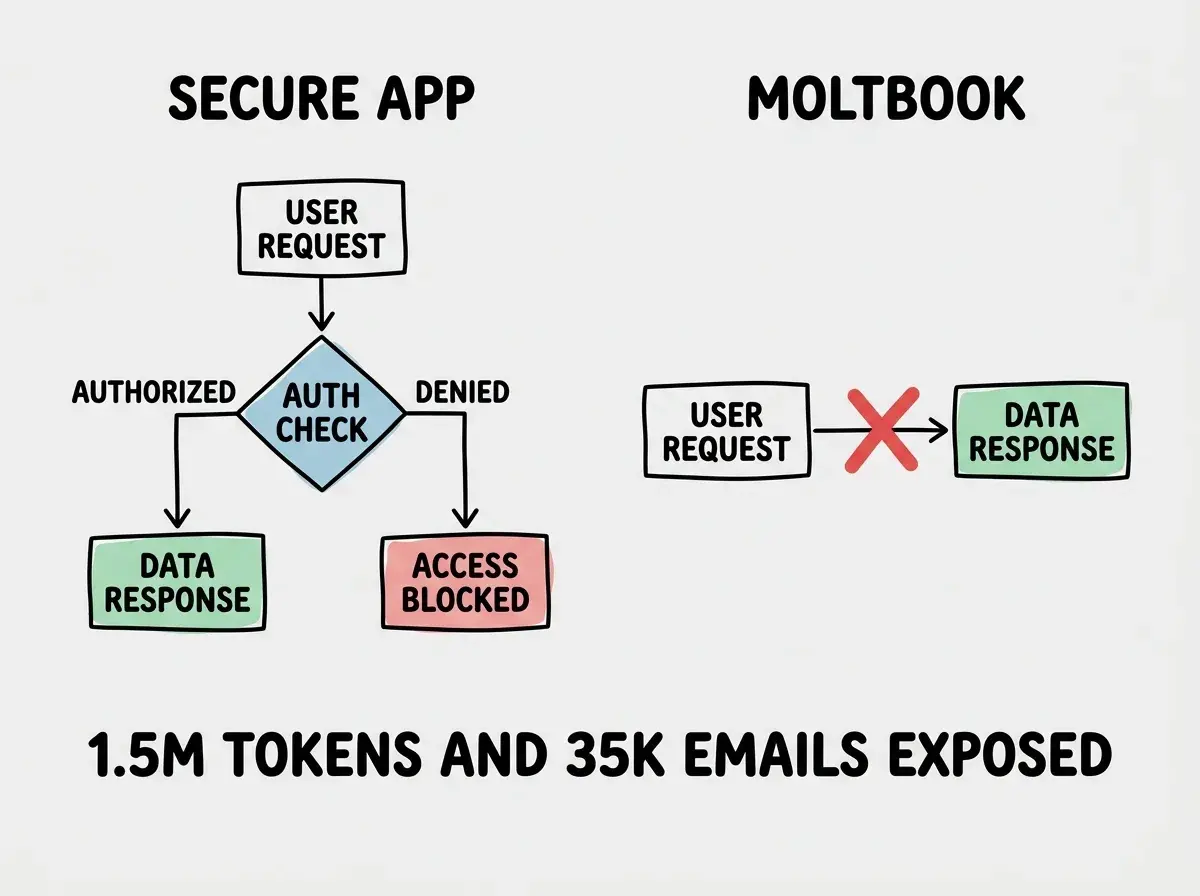
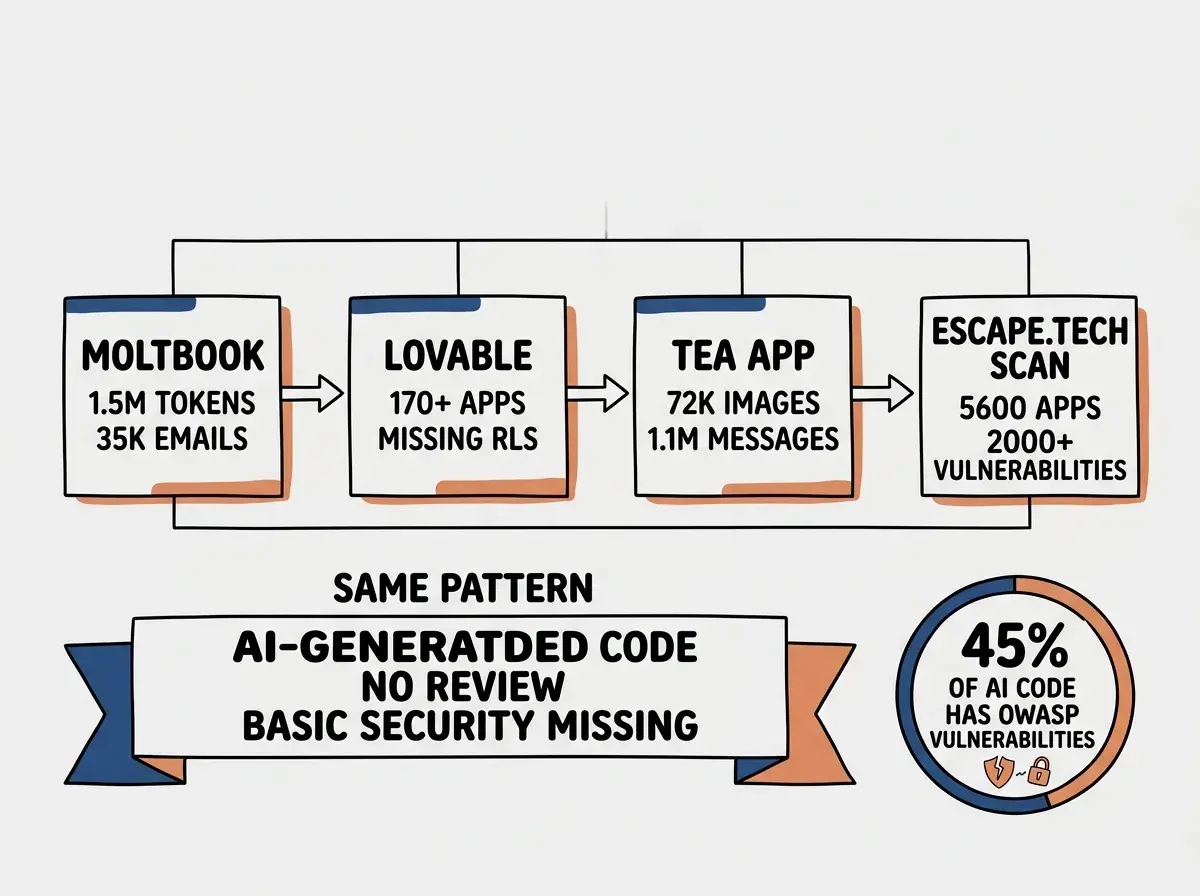
This pattern, missing authorization on API endpoints, is the single most common vulnerability in AI-generated code. Veracode's 2025 research found that 45% of AI-generated code introduces security flaws. Escape.tech scanned 5,600 AI-built applications and found over 2,000 vulnerabilities. The Moltbook breach was not an outlier. It was the median case made visible.
Why "I Didn't Write a Single Line of Code" Is the Problem
The founder's statement was revealing in ways they probably did not intend. "I didn't write a single line of code" was meant to demonstrate the power of AI tools. What it actually demonstrated was a complete absence of the one process that would have prevented the breach: human review.
When a traditional development team builds an application, the code passes through multiple checkpoints. A developer writes it. A second developer reviews it. An automated test suite runs against it. A security scanner checks for known vulnerabilities. Before launch, a penetration tester tries to break in. Each checkpoint catches different categories of problems. The code that ships is not perfect, but it has been examined by multiple sets of eyes, both human and automated.
Moltbook had none of these checkpoints. The AI generated the code. The founder deployed it. Between generation and deployment, there was nothing. No code review. No security audit. No penetration testing. No automated scanning. The brakes were not broken. They were never installed.
This is not unique to Moltbook. It is the default workflow for a large and growing number of AI-built applications. The tools make it trivially easy to go from idea to deployed product without ever pausing to examine what the AI actually built. The speed that makes these tools attractive is the same speed that makes them dangerous, because speed without inspection is just faster failure.
Speed without security review is the most expensive shortcut you can take.
Learn the fundamentalsThe self-driving car analogy resurfaces here. Imagine buying a car that assembled itself overnight. In the morning, you find a gleaming vehicle in your driveway. It starts. It drives. Everything seems to work. Would you take it on the highway without checking the brakes, the airbags, and the structural integrity? Most people would say no. But that is exactly what happens when an AI builds an application and the builder deploys it without review. The application is the car. Your users are the passengers. And you just merged onto the highway at 70 miles per hour without knowing whether the car can stop.
The Pattern That Keeps Repeating
Moltbook is not an isolated incident. It sits in a growing list of AI-built applications that have suffered preventable breaches. The Lovable platform had CVE-2025-48757, where over 170 production apps shipped without Row Level Security on their Supabase databases. The Tea App leaked 72,000 images and 1.1 million private messages. Each breach followed the same pattern: AI-generated code, no human review, missing fundamental security controls.
Escape.tech's scan of 5,600 AI-built applications found a consistent picture. The vulnerabilities were not exotic or novel. They were the same OWASP Top 10 issues that have plagued web applications for twenty years: broken access control, missing authentication, exposed sensitive data, injection flaws. AI tools did not introduce new categories of vulnerability. They reproduced old ones at unprecedented speed and scale.
The responsibility gap is the core issue. In traditional development, the person who writes the code is responsible for its security. They may not be a security expert, but they are expected to follow basic practices: validate input, check authorization, encrypt sensitive data. When AI writes the code, this responsibility does not transfer to the AI. The AI has no concept of responsibility. It does not know it is building a production application that real humans will trust with their data. The responsibility stays with the person who directed the AI, even if that person does not know what to look for.
Assuming that AI-generated code is secure because it "looks right." AI tools produce code that is syntactically correct, well-formatted, and functional. It passes every visual inspection. But security vulnerabilities are invisible to visual inspection. You cannot see a missing authorization check by reading code casually. You can only find it by systematically testing what happens when unauthorized users make requests they should not be allowed to make.
This is where the self-driving car analogy reaches its conclusion. The brakes on a car are not visible from the outside. You cannot tell whether a car has functioning brakes by looking at its paint job, its interior, or even by driving it in a straight line. You only discover the brakes are missing when you need to stop. For Moltbook's 35,000 users, that discovery came too late.
What This Means For You
The Moltbook breach is a template for the kind of incident that will become more common as more applications are built entirely by AI without human security review. Understanding the pattern gives you the ability to avoid it.
- If you are a founder building with AI tools, the Moltbook story is your cautionary tale. You do not need to write code yourself, but you absolutely need someone to review the code your AI writes. This can be a freelance security consultant, an automated scanning tool like Snyk or Semgrep, or a technical co-founder. The cost of a security review before launch is trivial compared to the cost of a data breach after one. Budget for it the way you budget for hosting: it is not optional.
- If you are an indie hacker, you are the most likely person to repeat this pattern because you are building alone, moving fast, and optimizing for shipping. Run
npm auditon every project. Use your AI tool to check its own code by prompting it to "find security vulnerabilities in this codebase, especially missing authorization checks and exposed API endpoints." It is not perfect, but it catches the obvious failures that caused the Moltbook breach. - If you are a senior developer evaluating AI tools, the Moltbook case confirms what the data already suggests. AI-generated code needs the same review process as junior developer code, possibly more rigorous, because the volume is higher and the confidence the output inspires is disproportionate to its actual security quality. Build review gates into your CI/CD pipeline. Treat AI output as untrusted input until verified.
The lesson from Moltbook is not that AI coding tools are too dangerous to use. It is that AI coding tools are too powerful to use without oversight. The car can drive itself, but someone still needs to check the brakes.
Every AI-built application needs the same security review that every human-built one does.
Start learning