To set up and analyze conversion funnels for AI-built apps in 2026, define the four funnel stages that matter for almost every app (visitor lands, visitor takes interest action, visitor signs up, user reaches activation moment), instrument the events at each stage, identify the largest drop-off in your funnel, and fix the highest-impact drop-off first rather than spreading effort across all of them. Funnel analysis is the most leveraged growth analysis you can do; the work pays back across every marketing dollar and every product change.
This piece walks through the four funnel stages, the instrumentation needed, the patterns for fixing common drop-offs, and the four mistakes that turn funnel analysis into reports nobody acts on.
Why Funnel Analysis Matters Most
Most growth metrics (page views, social followers, email opens) are interesting but not actionable. Funnel analysis is different: it shows exactly where visitors give up, which means it shows exactly where to focus optimization. The data tells you what to fix; you do not have to guess.
The 2026 reality is that funnel tooling has matured dramatically. PostHog, Mixpanel, GA4 all support funnel analysis with reasonable effort to set up. The infrastructure that previously required dedicated analyst teams now runs on managed services accessible to any team.
A 2025 GrowthHackers survey of 600 SaaS founders found that founders who actively used funnel analysis improved their key conversion rates 2.4x faster than founders relying on intuition alone. The mechanism was straightforward: funnel data shows where to focus; without it, founders spread effort across many areas with smaller returns. Funnel analysis is one of the highest-leverage growth practices for any AI-built app.
The pattern to copy is the way emergency room triage works. ER doctors do not treat every patient equally; they focus on the most serious cases first because that produces the most lives saved. Funnel optimization follows the same pattern: focus on the biggest drop-off first because that produces the most conversions saved.
The Four Funnel Stages That Matter
Almost every AI-built app has the same four funnel stages. Naming them explicitly is the first step.
Stage 1, visitor lands. A person arrives on your site (homepage, landing page, or blog post). The traffic source matters; track it.
Stage 2, visitor takes interest action. Clicks a CTA, watches a demo, reads a feature list. Signals consideration. The first behavioral commitment.
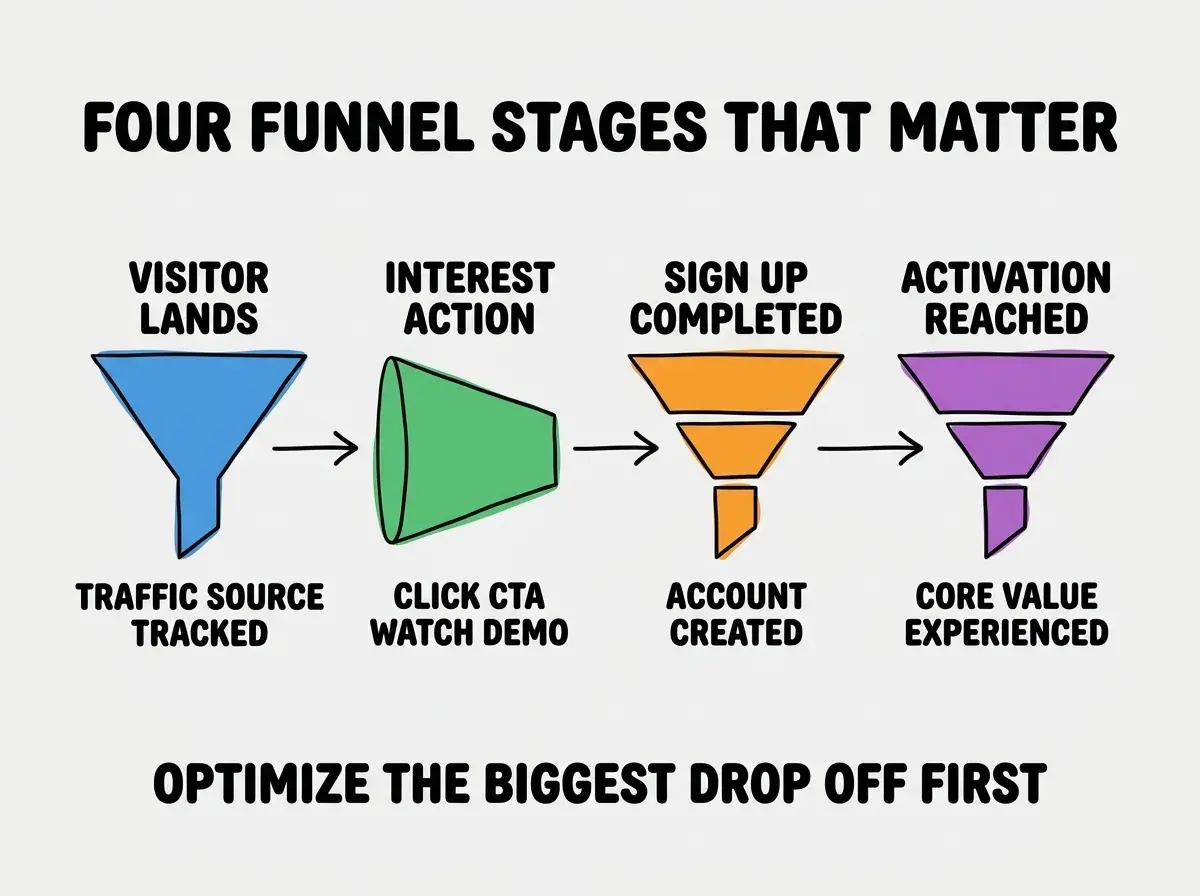
Stage 3, visitor signs up. Account creation. The conversion from anonymous visitor to identified user. Marketing optimization typically targets this conversion.
Stage 4, user reaches activation. First moment of real product value (first project created, first message sent, first integration connected). The activation event predicts long-term retention better than any other early signal.
How to Set Up the Funnel
Three steps configure funnel analysis in any modern analytics tool.
Step 1, define each stage as an event. "Page view" for stage 1, specific CTA clicks for stage 2, signup completion for stage 3, activation for stage 4. Events should be specific enough to track; not so specific they fragment.
Browse more analytics guides
Read more grow articlesStep 2, configure the funnel in your tool. PostHog, Mixpanel, GA4 all let you define funnels by listing the sequence of events. The tool calculates conversion rates between stages.
Step 3, segment by traffic source. Different sources convert differently. SEO traffic often converts better than paid; both convert better than social. Segment your funnel by source for actionable insights.
How to Fix the Worst Drop-Off
Three patterns help fix funnel drop-offs systematically. Pick the largest drop-off and apply these patterns.

Pattern 1, understand why users leave. Session recordings (Hotjar, FullStory) and exit-intent surveys reveal what the data alone cannot. Watch 10 sessions where users dropped off; patterns emerge.
Pattern 2, hypothesize the fix specifically. "Make signup easier" is too vague to test. "Reduce signup form from 6 fields to 3 fields" is testable. Specific hypotheses produce measurable experiments.
Pattern 3, A/B test the change. Run the new version against the old version. Measure the lift. Decide based on data, not opinions. PostHog and similar tools handle the experiment infrastructure.
How to Set Conversion Targets That Matter
Three principles help set realistic conversion targets so you know when funnel work is succeeding.
Principle 1, benchmark against industry data. OpenView Partners and similar firms publish SaaS conversion benchmarks by category. Use them as starting points. SaaS visitor-to-trial typically runs 1-3 percent; trial-to-paid runs 15-25 percent.
Principle 2, set targets relative to your baseline, not absolute numbers. A 50 percent improvement from your current baseline is dramatic regardless of where you start. Setting absolute targets ("we should have 5 percent conversion") often produces frustration without context.
Principle 3, separate near-term and long-term targets. Quarterly target should be 20-30 percent improvement; yearly target can be 2-3x. Mixing these creates either disappointment (yearly targets feel hopeless) or complacency (quarterly targets feel too easy).
The combination produces motivating but realistic targets that drive sustained funnel work without demoralizing the team when individual experiments fail.
Common Drop-Off Patterns and Fixes
Three drop-off patterns appear in most apps. Knowing them accelerates your optimization work.
Pattern A, big drop between landing and interest. Usually a messaging problem. The page does not communicate value clearly. Fix by clarifying the headline and CTA copy.
Pattern B, big drop between interest and signup. Usually friction in the signup process. Fix by reducing form fields, adding social signup, allowing trial without signup.
Pattern C, big drop between signup and activation. Usually onboarding problem. Users sign up but do not see the value fast enough. Fix by accelerating time-to-value in onboarding. Pre-populate sample data, skip optional setup, show the value moment within the first 60 seconds of the user experience.
The combination of these patterns covers most app funnel problems. Each has well-established solutions; the work is identifying which pattern applies and applying the fix systematically.
The most damaging funnel analysis mistake is trying to fix every drop-off simultaneously. Founders see leaks in multiple stages and try to plug them all at once. The result is many small experiments without enough traffic to measure any of them well. The fix is to focus on the largest drop-off first, run a big enough experiment to measure the lift, ship the winner, then move to the next-largest drop-off. The discipline of sequential focus produces 2-3x faster compound improvements than parallel scattered effort.
The other mistake is optimizing the funnel without understanding the underlying user behavior. A drop-off is a symptom; the cause is what users are thinking and feeling at that moment. Without qualitative research (interviews, session recordings, surveys), funnel optimization becomes random A/B testing with low success rates. Combine quantitative drop-off data with qualitative insight for high-impact improvements.
A third mistake is ignoring funnel changes over time. A funnel that worked well at 1K monthly visitors often breaks at 10K because the traffic mix changes. Re-analyze your funnel quarterly even if numbers look stable; the underlying segments shift in ways aggregate metrics hide. The teams that catch these shifts early adjust before drop-offs become disasters; the teams that ignore them get surprised by sudden conversion drops they cannot explain.
What This Means For You
Funnel analysis is one of the highest-leverage growth practices for any AI-built app in 2026. The work pays back across every marketing dollar and every product change.
- If you're a founder: Set up basic funnel analysis in your first month of having traffic. The data foundation enables every subsequent growth decision.
- If you're changing careers into growth or marketing: Funnel analysis is core skill for growth roles. Practice with public datasets if your current role does not provide opportunities.
- If you're a student: Study how successful companies analyze their funnels. Many publish growth retrospectives that walk through the patterns.
Browse more analytics guides
Read more grow articles