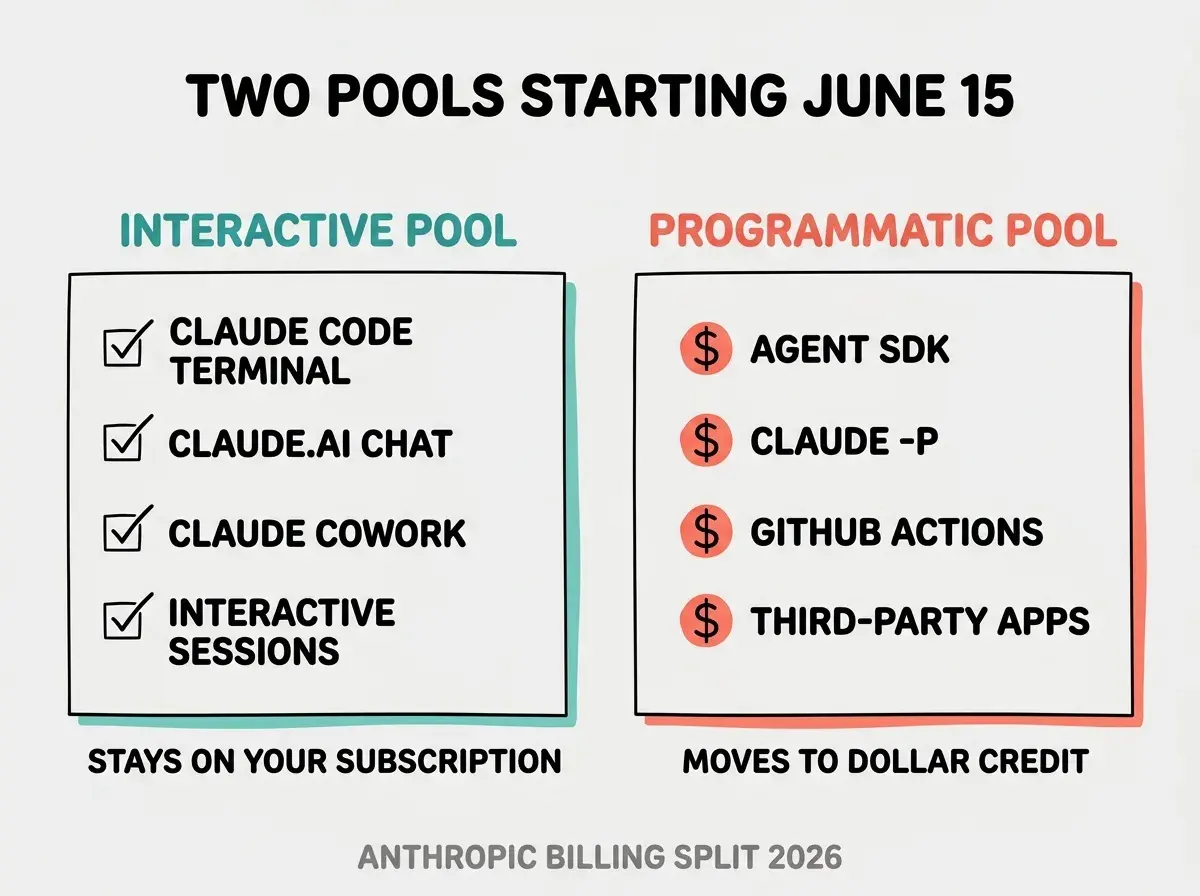
Starting June 15, Anthropic is separating Claude subscription billing into two distinct pools. If you run automations using the Agent SDK, claude -p, Claude Code GitHub Actions, or any third-party app built on Claude, that usage no longer counts against your subscription rate limits. It draws from a new dollar-denominated credit pool instead, metered at full API list prices.
This matters for anyone who has built around the assumption that their Claude subscription covers programmatic usage the same way it covers chat. That assumption stops being true in 14 days, and the required action has a deadline of its own.
Why Did Anthropic Make This Change
The billing separation reflects a structural difference between interactive and programmatic Claude usage that the flat subscription model was not designed to handle.
Interactive use is paced by human conversation. You type, Claude responds, you read, you type again. Even power users rarely send more than a few hundred thousand tokens in a session. Subscription limits were sized for this rhythm. Programmatic use is different: an agent running autonomously through a large codebase, or a GitHub Action firing on every pull request, can burn 200,000 to 500,000 tokens in a single run without any human pacing it. Put 50 engineers on a team plan, all running CI agents, and the math breaks down quickly.
As The Register reported on May 14, Anthropic's reasoning was direct: "We've heard your questions about SDK and claude -p usage sharing your subscription rate limits with Claude Code and chat. Starting June 15, programmatic usage gets its own dedicated budget instead. Your subscription limits don't change, they're now reserved for interactive use."
Anthropic is giving each plan a monthly credit specifically for programmatic use: $20 for Pro, $100 for Max 5x, $200 for Max 20x. Credits are consumed at standard API list prices with no subscription discount, and they do not roll over. A Pro subscriber spending $20 of Agent SDK credit per month at Sonnet 4.6 rates gets roughly 1.3 million output tokens per month for programmatic tasks. Once the credit runs out, additional usage either bills you directly (if extra usage billing is enabled) or stops until your next cycle.
The result is a cleaner architecture: your Claude.ai chat and interactive Claude Code sessions keep their existing limits, and your automations operate within a separate, predictable budget. For light automation users, the included credit is generous. For heavy CI pipelines running on every push, the math is worth checking before June 15.
What Exactly Moves to the New Pool
The split follows a clear interactive-versus-programmatic line. Knowing which side your usage falls on is the most important thing to check before June 15.
Moving to the new programmatic credit pool starting June 15: the Claude Agent SDK, claude -p in scripts and pipelines, Claude Code GitHub Actions, and third-party apps built on the Agent SDK. If Claude is running without a human typing in real time, it is probably programmatic.
Staying on your existing subscription limits: interactive Claude Code terminal sessions (the CLI where you type to Claude directly), Claude.ai chat on web, desktop, and mobile, and Claude Cowork. If you are the one actively typing and waiting for a reply, that usage is interactive and nothing changes for you on June 15.
The practical dividing line is whether a human is present in the loop. A developer opening a terminal and running Claude Code is interactive. A GitHub Actions workflow that fires on every pull request and asks Claude to review the diff is programmatic. Both use Claude, but they have fundamentally different cost profiles.
How Far Do the Credits Actually Go
The credit amounts matter more in context than they do in isolation. Understanding what they buy at different usage patterns helps you decide whether to enable extra usage billing and whether you need to change anything about your current setup.
Sonnet 4.6 is priced at $3 per million input tokens and $15 per million output tokens on the standard API. With the $20 Pro credit, you can generate roughly 1.3 million output tokens per month in programmatic mode, assuming a typical 1:1 input-to-output ratio with a 200K-token context. A code review run that processes a medium pull request uses somewhere between 30,000 and 100,000 tokens total. At those rates, $20 covers between 20 and 65 code review runs per month on Sonnet 4.6.
If you use Opus 4.8 for programmatic tasks (priced at $10 per million input and $50 per million output), the numbers tighten substantially. A session that uses 100,000 tokens total on Opus 4.8 costs roughly $3 to $5. The $20 Pro credit covers four to six such sessions. The Max 5x plan's $100 credit covers 20 to 25 Opus 4.8 sessions.
The Vibe Coder Blog covers the pricing and tooling shifts that change vibecoder workflows.
Read MoreTeams and CI-heavy projects will feel the constraint more than solo developers. If your team runs automated tests, code review, or deployment checks on every commit across multiple repositories, the programmatic credit can exhaust within the first week of the month. For those workflows, enabling extra usage billing and treating it as an infrastructure cost (rather than a subscription line item) is the more sustainable approach.
Light automation users including weekly scheduled tasks, occasional batch jobs, and single-repo GitHub Actions will likely stay well inside their included credit. The $20 Pro allocation is not designed to cover enterprise-scale autonomous agents; it is designed to cover the casual use that subscriptions were never intended to monetize separately.
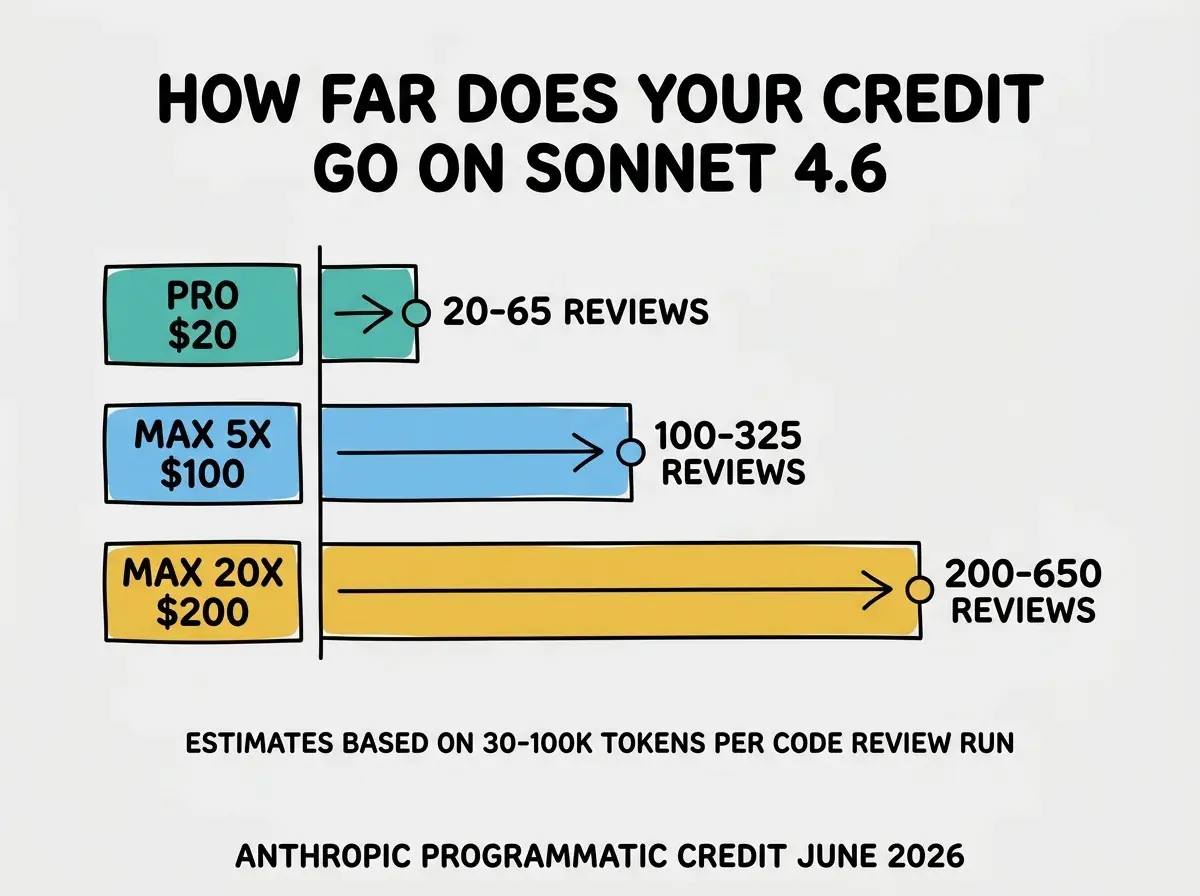
The numbers above assume no context caching. Anthropic's prompt caching feature is available via the API and can substantially reduce input token costs on tasks that repeat the same large context, such as running a linter against a long codebase file on multiple pull requests. If you have not enabled caching in your Agent SDK calls, the actual cost per run may be higher than the estimates suggest.
The most common mistake vibecoders will make here is assuming the credit enrolls automatically. It does not. Anthropic is sending a claim email to eligible users on or around June 8. You must open that email and claim your programmatic credit through your Claude account settings. If you miss the email or do not claim, your Agent SDK and claude -p usage will still be subject to the June 15 change, but without the included credit buffer. Check your Claude account settings and confirm claim status if you use any programmatic Claude features.
What Should You Do Before June 15
The required actions are specific and can be completed in under 15 minutes if you start now.
First, audit your Claude usage for programmatic patterns. Search your codebase for claude -p, imports from the Anthropic Agent SDK, and any GitHub Actions workflows that call Claude. If you find them, make a list of how frequently they run and roughly how many tokens each consumes.
Second, look for the Anthropic claim email around June 8. The subject line will reference your programmatic usage credit. Open it and complete the claim from your Claude account. This is a one-time action; the credit refreshes automatically on each subsequent billing cycle once claimed.
Third, decide whether to enable extra usage billing. This is the setting that governs what happens when your credit runs out. With extra usage on, automations continue and you receive a separate charge for the overage. With extra usage off, automations stop when the credit is exhausted until the next billing cycle. For production pipelines where downtime has a real cost, extra usage billing is the safer setting.
Fourth, revisit your model selection for programmatic tasks. If you currently use Opus 4.8 by default for all Claude calls, including programmatic ones, switching non-reasoning steps to Sonnet 4.6 reduces your credit burn rate by 3x to 4x with minimal quality difference for tasks like formatting, summarization, or simple code review.
The Vibe Coder Blog covers the tooling and pricing shifts that matter to builders who ship.
Browse All Posts