Vibe coding for journalists and writers means building the exact tool you need, even if nobody else in the world needs it. Not downloading an app that sort of works. Not cobbling together five services with Zapier. Building the precise thing that fits your workflow, using plain language instead of code.
Kevin Roose, a technology columnist at the New York Times, coined the term "software for one" to describe this shift. He built a podcast transcriber tailored to his interview workflow and a meal planner that matched his family's dietary preferences. Not because commercial versions do not exist. But none of them worked exactly the way he needed. So he built his own.
That phrase, "software for one," is the single most important idea in this article. Hold onto it.
The Bespoke Tailor in Your Laptop
Think of commercial software like buying clothes off the rack. The sizes are standardized. The fit is approximate. For most people, most of the time, it is good enough. But if you have ever worn something tailored, you know the difference is not subtle. Every seam sits where it should. Nothing bunches. It was made for your body and nobody else's.
Vibe coding gives you a bespoke tailor that lives inside your laptop. You describe what you want in plain sentences and the tailor produces something fitted exactly to you. "I need a tool that takes my interview recordings, transcribes them, highlights quotes longer than two sentences, and organizes them by topic." No existing app does precisely that. But you can describe it, and an AI can build it.
A bespoke tailor does not ask you to learn pattern-making. You need to know what you want, describe it, and recognize when the result fits well. The same is true for vibe coding. You do not need to learn programming. You need to know your workflow, describe it clearly, and evaluate whether the result matches.
63% of active vibe coding users are non-developers. You are not an outlier for trying this. You are in the majority.
"Software for one" is not a compromise. It is actually an advantage. Commercial tools are designed for the average user, which means they serve everyone adequately and no one perfectly. A tool built for your specific workflow fits your needs better than any general-purpose app ever could, because it only has to solve your problems, not everyone's.
This analogy also explains why journalists and writers are particularly well-suited for vibe coding. Your entire profession is built on describing things precisely with words. That skill, writing a clear description of what a tool should do, is the primary skill vibe coding requires. You have been training for this your entire career.
What "Software for One" Actually Looks Like
This confuses everyone at first because people assume "building software" means creating something polished enough to sell. It does not. Software for one is personal. It does not need a login page or thousands of users. It just needs to work for you.
Here are the kinds of tools journalists and writers are building:
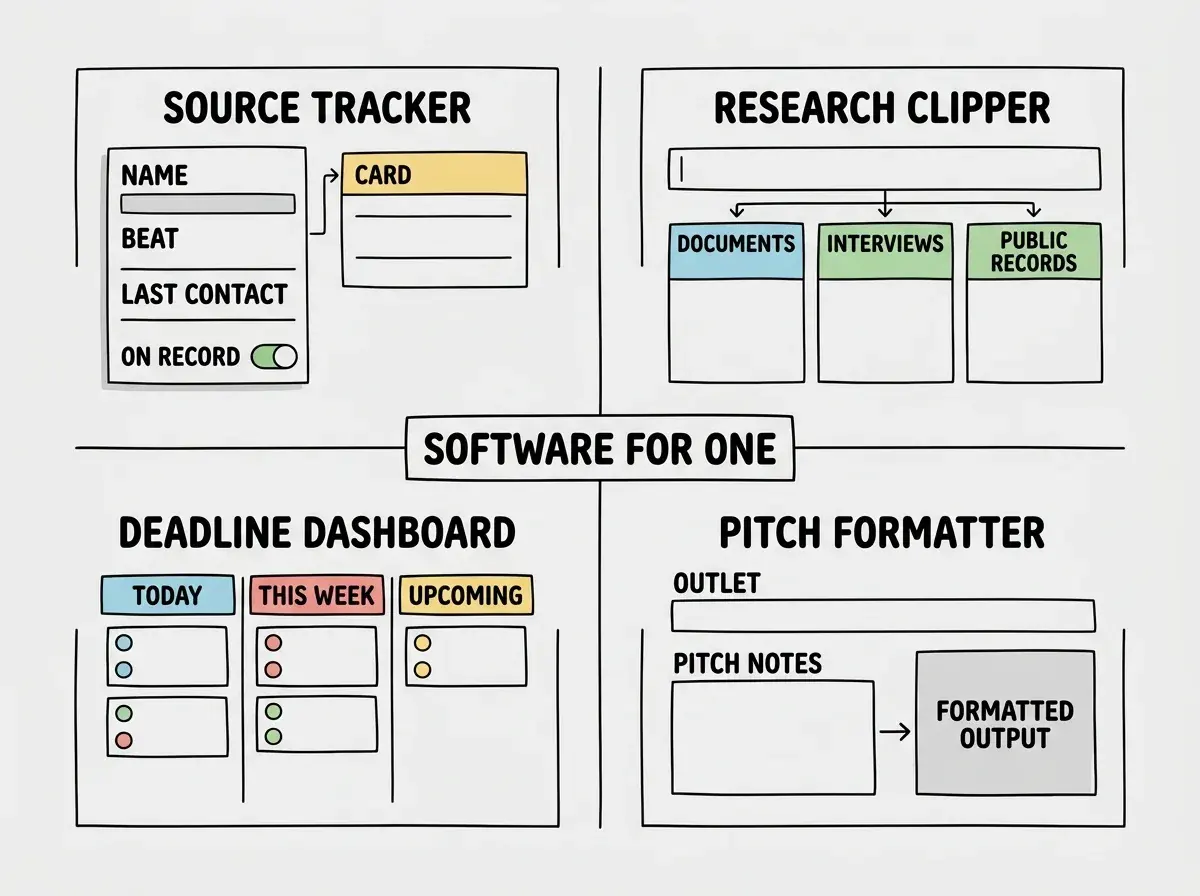
A source tracker. You talk to dozens of people across multiple stories. You need a way to search your sources by topic, see when you last contacted them, and flag who is willing to go on record. CRM tools exist, but they are built for salespeople, not journalists. Your version has the fields that matter to you and none of the fields that do not.
A research clipper. When you are deep in a story, you collect information from court documents, social media posts, and interviews. You need one place to drop all of it with tags that match your story's structure, not someone else's organizational system.
A deadline dashboard. You are juggling three stories with different editors and publication dates. Project management tools are too much. A spreadsheet is too little. Your version shows exactly what needs your attention today, tomorrow, and this week.
A pitch formatter. Every publication has slightly different pitch requirements. Your version takes rough pitch notes and formats them for each outlet, pulling in relevant clips.
Two CNBC journalists took a two-day introductory class on vibe coding and replicated the core functionality of Monday.com in under one hour. Not a simplified version. A functional project management tool with boards, tasks, and status tracking. They were not programmers. They were journalists who described what they wanted and let the AI build it.
Another CNBC journalist from that same class shipped a complete product within 48 hours. From "I have never written a line of code" to "I have a working tool" in two days.
Your First Build, Step by Step
You might think you need a course or documentation before you start. But actually, the most important preparation is something you already do every day: think clearly about what you need and describe it in words.
Step one: Identify your paper cut. What is the small, recurring frustration in your workflow that you have been tolerating? Not the huge, systemic problem. The small one. The thing that takes you fifteen minutes every day and annoys you every single time. Maybe it is reformatting your notes after every interview. Maybe it is manually checking five websites for updates on a story. Start there.
Step two: Describe it like you are briefing a new intern. Write out exactly what this tool should do. "When I paste in a transcript, the tool should break it into paragraphs, identify direct quotes, highlight quotes longer than two sentences, and let me tag each quote with a topic." The more specific you are, the better the result. This is journalism skills in action.
Step three: Use an AI coding tool and paste your description. Tools like Claude, Cursor, or Replit will take your description and generate a working version. It will not be perfect on the first try. You are going to iterate.
Get familiar with the AI coding landscape before your first build.
Explore the basicsStep four: Test it with real data. Paste in a real transcript. Upload a real document. Use your actual workflow. This is where you will discover what the AI got right and what it missed.
Step five: Tell the AI what to fix. "The quote detection is picking up sentence fragments. Only highlight complete sentences longer than fifteen words." You are editing the tool the same way you edit a story: identify the problem, describe the fix, review the result.
Three or four rounds of iteration usually produce a tool that genuinely works. The whole process takes an afternoon.
Overcoming the "I Am Not Technical" Barrier
There is a belief embedded deep in our culture that building software requires a special kind of brain. A mathematical brain. A logical brain. Writers, the thinking goes, have a different kind of brain.
This is wrong. Journalism is systems thinking. You take complex situations with many actors and competing incentives and map them into coherent narratives. That is exactly what software design requires. The only thing you lacked was the translation layer. Vibe coding is that layer. The thinking was always there. The barrier was always just the syntax.
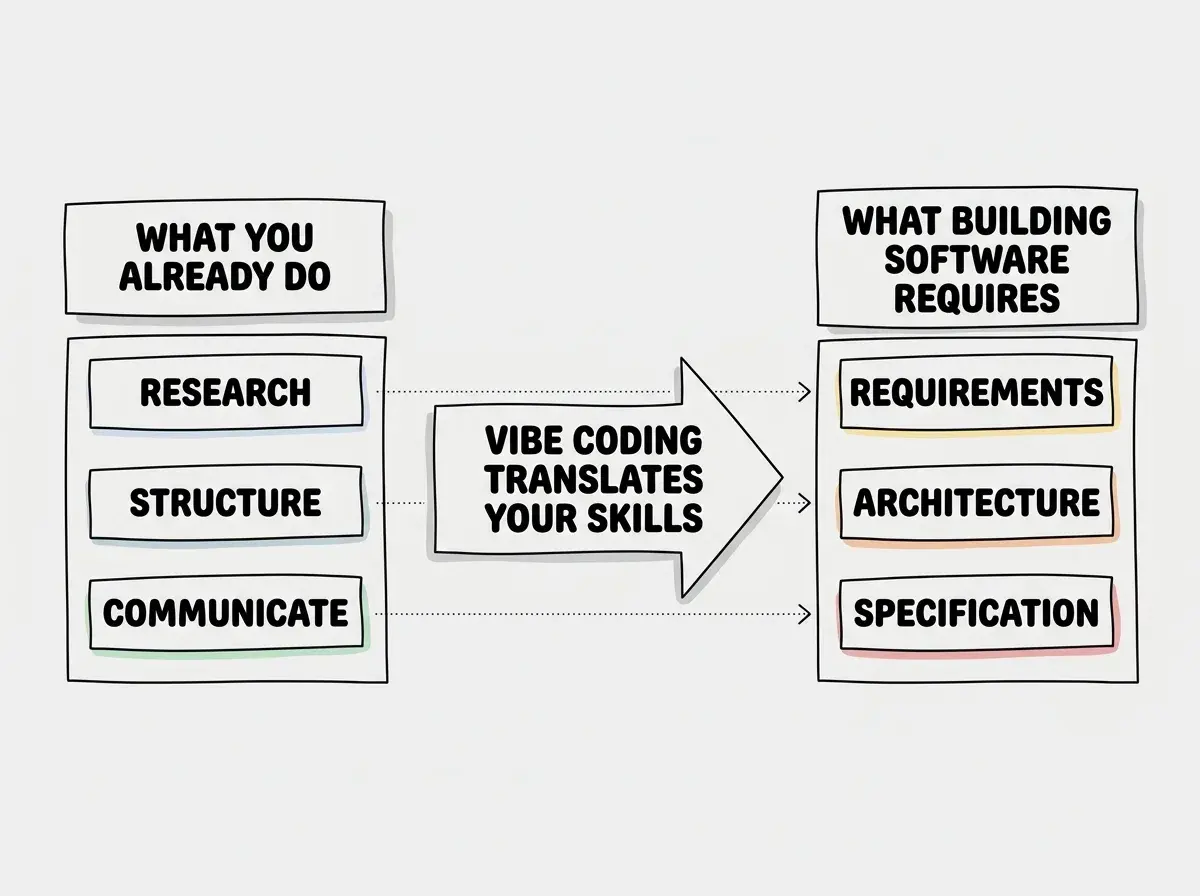
The parallel is not a coincidence. Both disciplines require gathering scattered information, structuring it coherently, and communicating it clearly. The only difference was the output format.
Trying to learn programming terminology before starting. You do not need to know what an API is, what a database schema means, or how HTTP requests work. Describe what you want in plain English. "I want to save my sources so I can search them later" is a perfectly valid instruction. The AI will figure out that it needs a database. Let it handle the technical translation while you focus on the requirements.
The CNBC journalists who replicated Monday.com did not study programming first. They described what a project management tool should do in plain language, and the AI built it. Their skill was clear communication, the same skill they use every day in their jobs.
The Permission Slip You Have Been Waiting For
If you are a journalist or a writer reading this, you probably have a small voice saying, "This is not for me." Maybe you tried to learn Python once and gave up. Maybe you think of yourself as a "words person."
The gatekeeping that kept non-programmers out of software development was always about syntax, not about ability. Now you have tools that speak your language. The worst outcome is a few hours spent on something that does not quite work. The best outcome is a tool that saves you fifteen minutes every day for the rest of your career.
What This Means For You
Vibe coding is not asking you to become a programmer. It is offering you the ability to build the exact tools your workflow needs, without depending on anyone else. The "software for one" concept is not a limitation. It is a superpower.
- If you are a founder building a media product: Instead of hiring a developer to build an internal tool, describe what you need and build a working version in an afternoon. Use that version to clarify your requirements before you invest in a production build. You will save weeks of back-and-forth and end up with something closer to what you actually wanted.
- If you are a career changer moving from writing to tech: Your communication skills are the most valuable asset in vibe coding. The people who struggle with AI tools are the ones who cannot describe what they want clearly. That is your strength, not your weakness. Start by building tools for yourself, then build tools for other writers you know. Your portfolio will demonstrate something rare: the ability to bridge human needs and technical solutions.
- If you are a student studying journalism or writing: Learning vibe coding now means you will graduate with the ability to build your own tools and demonstrate technical capability without a technical degree. In a media industry that values cross-disciplinary skills, strong writing combined with the ability to build software will set you apart from every other candidate in the room.
Start with the fundamentals that turn ideas into working software.
Start learning