Vibe coding for indie hackers means building and shipping products at a speed that was physically impossible two years ago. Solo builders are launching revenue-generating products in hours instead of months, and the economics of one-person software businesses have fundamentally changed. If you have been stuck in the cycle of "I have an idea but no technical co-founder," that bottleneck no longer exists.
The indie hacker community runs on a simple principle: ship fast, validate faster, and only invest deeply in what works. Vibe coding did not invent this principle, but it compressed the timeline so dramatically that the entire playbook needs rewriting. What used to take a solo developer three months of nights and weekends now takes a focused weekend. Sometimes less.
The Assembly Line That Builds Itself
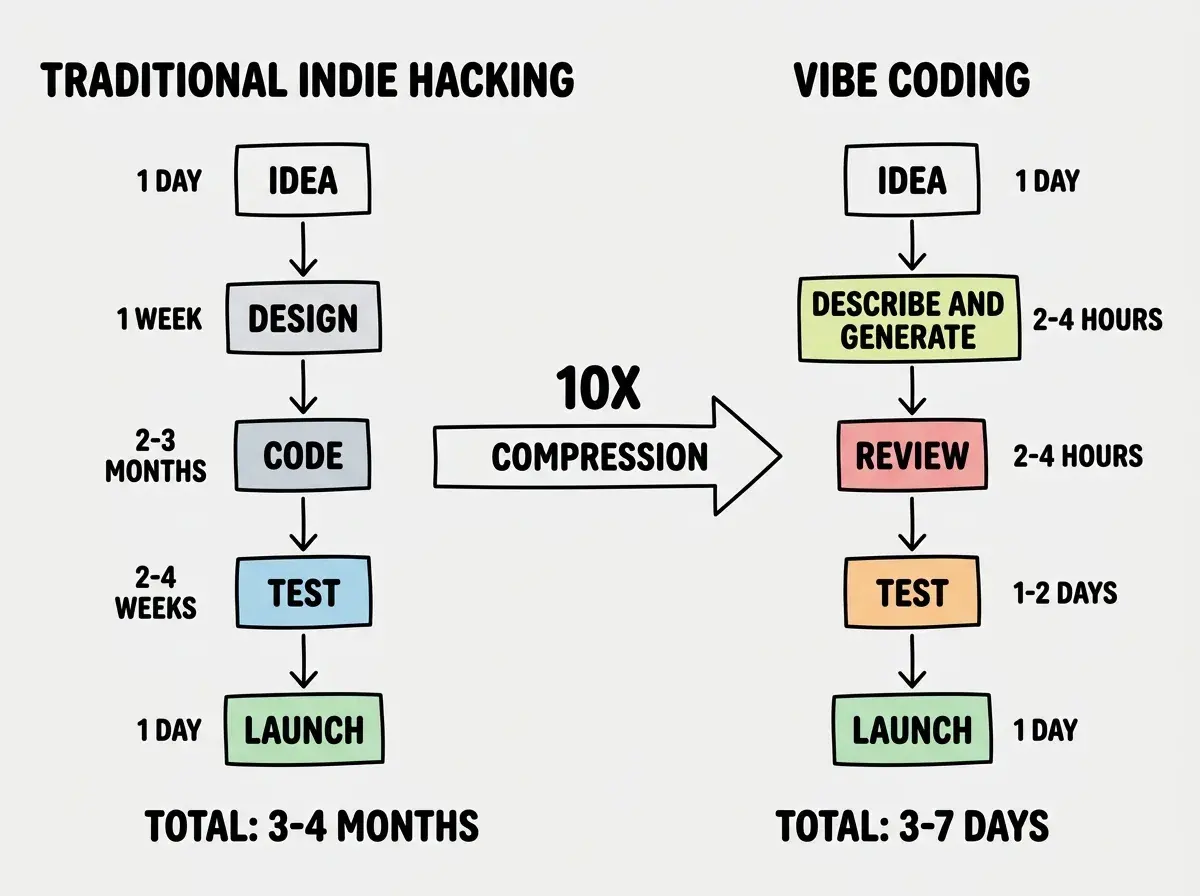
Think of traditional indie hacking like running a one-person factory. You are the designer, the machinist, the quality inspector, and the shipping clerk. You can build good products this way, but only at the speed of one human doing four jobs sequentially.
Vibe coding turns that factory into an assembly line that builds itself while you supervise. You describe what each station should produce, inspect the output, make corrections, and move on. You still decide what gets built and whether it meets your standards. But the manual labor of translating ideas into code happens in parallel instead of sequentially.
This reframes what "10x faster" actually means. It does not mean cutting corners. It means the implementation step, which used to consume 80% of your time, now consumes 20%. The design thinking, product decisions, and market validation still require your full attention.
Pieter Levels demonstrated this when he built a multiplayer flight simulator in roughly three hours. Not a mockup. A working multiplayer game that now generates over a million dollars per year in revenue. Three hours from nothing to a live product. In 2023, that timeline would have been absurd. In 2025, it was a Tuesday afternoon.
The YC CEO reported that ten engineers using vibe coding are delivering what used to require fifty to one hundred engineers. For indie hackers, that math is even more powerful, because you only need to match the output of one small team to build a viable business. Vibe coding gives a solo builder the shipping capacity of a five-person startup.
The assembly line analogy breaks down in one important way, and this is worth being honest about. A real assembly line produces identical outputs repeatedly. Your vibe coding assembly line produces novel outputs that need evaluation every time. You cannot automate the judgment. You can only automate the construction.
Why This Moment Is Different
Indie hackers have always used whatever tools gave them speed. Rails, then Node, then no-code tools, then serverless. Each wave made it faster to go from idea to product. Vibe coding is not just another incremental improvement. It is a category shift.
Previous tools gave you better building blocks but you still had to write the application logic yourself, line by line. Vibe coding removes the line-by-line requirement. You describe what you want the application to do, and the AI writes the implementation. You review it, correct it, and iterate. The feedback loop is minutes instead of days.
The numbers back this up. 25% of the startups in Y Combinator's Winter 2025 batch had codebases that were 95% or more AI-generated. These are not hobby projects. These are venture-backed companies building real products for real customers, and nearly all of the code was written by AI under human direction.
The 2025 Vibe Code Game Jam saw over 1,170 submissions, most from solo builders or tiny teams who built complete, playable games in a matter of days. A game jam is the purest test of shipping speed, and vibe coding turned it into the largest one in the community's history. These were not simple games. Many had multiplayer features, complex mechanics, and polished interfaces.
The Workflow That Actually Works
This confuses everyone at first because indie hackers assume vibe coding means typing a single prompt and getting a finished product. That is not how it works. The workflow is iterative, and the quality of your direction determines the quality of the output.
Start with the smallest possible version. Do not describe your full product vision in one prompt. Describe the core feature, the one thing that proves the idea works. If you are building a habit tracker, start with "a page where I can add a habit and mark it complete today." Nothing else. Get that working perfectly before expanding.
Work in vertical slices, not horizontal layers. You might think you should build all the database models first, then all the API routes, then all the frontend pages. But actually, vibe coding works better when you build one complete feature at a time, from database to UI. The AI generates more coherent code when it can see the full context of a single feature rather than an abstract layer that spans many features.
Treat the AI like a junior developer who is very fast but needs clear direction. Be specific about what you want. "Add user authentication" is too vague. "Add email and password login with a simple form, store the user in the database, and redirect to the dashboard after successful login" gives the AI enough context to produce something useful on the first try.
Understand the core concepts before diving into your first build.
Learn the fundamentalsReview everything before moving on. The speed advantage disappears if you accumulate technical debt by accepting every output without inspection. Spend five minutes reading through each generated feature. You do not need to understand every line, but you should understand the structure. Does it have the pages you expected? Are the database tables reasonable? Does the user flow make sense?
The Revenue Question
Shipping fast only matters if people pay for what you ship. The indie hacker community has always understood this, and vibe coding does not change the fundamentals of finding a market. What it changes is the cost of testing whether a market exists.
Before vibe coding, building an MVP was an investment of weeks or months. That investment created pressure to stick with an idea even when early signals were bad. Vibe coding drops the cost of an MVP to hours. You can test three ideas in a week instead of one idea in a quarter.
When your MVP took a weekend to build, abandoning it costs almost nothing. You are free to be ruthless about what deserves more investment. The sunk cost trap, one of the biggest killers of indie hacker projects, loses its grip entirely.
This is why the "100x developer" narrative resonates so strongly in the indie hacker community. It is not about writing 100x more code. It is about testing 100x more ideas and finding the ones that actually work, faster than anyone who is still building the old way.
Skipping the validation step because building is so fast. The speed of vibe coding can create a "build everything" mindset where you ship ten products without properly testing any of them. Shipping fast only works if you also validate fast. Spend as much time talking to potential users as you do building. The tool changes, but the game stays the same: find a real problem, confirm people will pay, then build the solution.
The Pieter Levels playbook illustrates this perfectly. He did not succeed because he built one product really fast. He succeeded because he built many products quickly, killed the ones that did not work, and doubled down on the ones that did. Vibe coding accelerates every step of that cycle.
Hardening for Production
There is an honest conversation to have about what vibe coding produces versus what production software requires. AI-generated code tends to work well for the happy path, the scenario where everything goes right. It tends to be weaker on edge cases, error handling, and security.
For indie hackers, this is actually less of a problem than it sounds. Your first hundred users will not stress-test your infrastructure. The edge cases that matter in enterprise software are not your day-one problems. Your day-one problem is getting anyone to use the product at all.
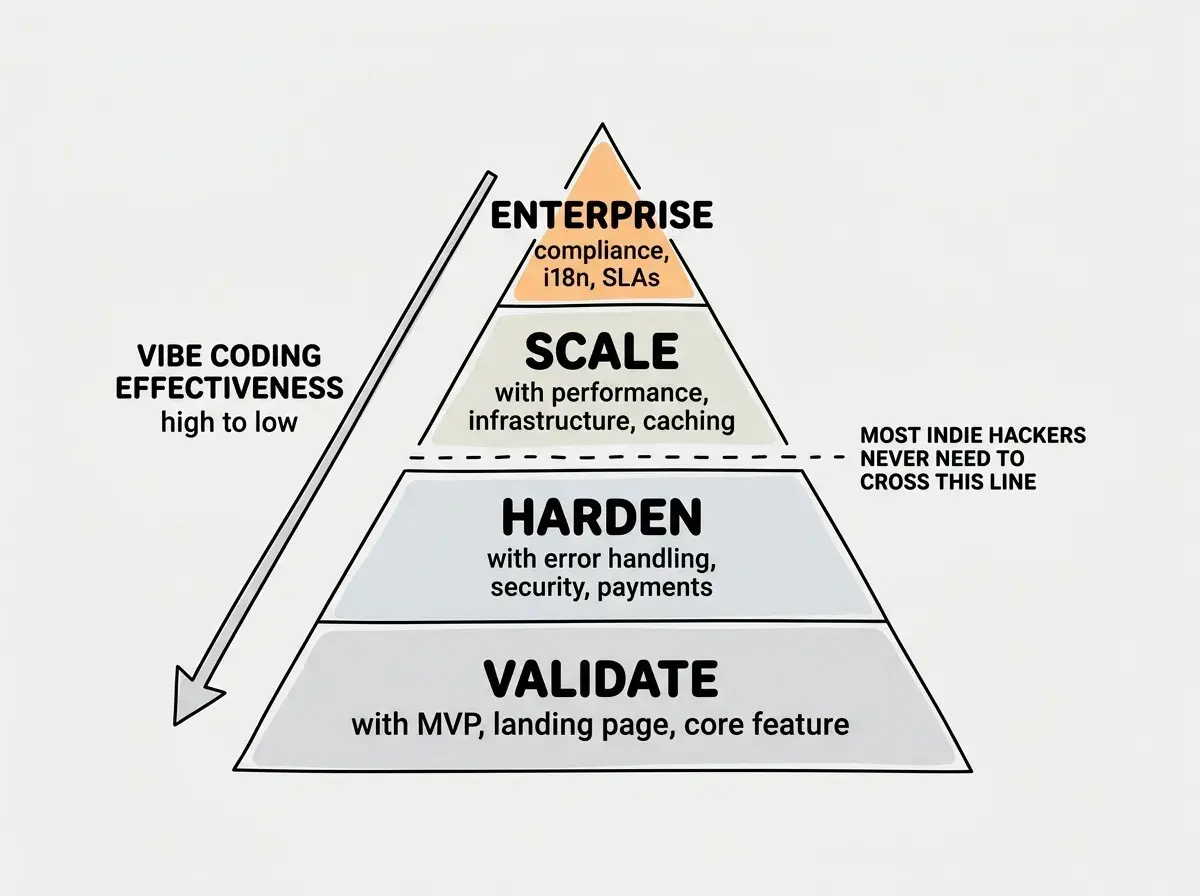
As your product gains traction, you will need to harden it. Invest more carefully in AI-directed improvements or hire specific expertise. But that investment is justified by revenue, not by speculation. You are hardening a product that people already pay for, not over-engineering a product that might never find a market.
Dig deeper
A few hand-picked sources if you want to go further.
What This Means For You
Vibe coding does not guarantee that your indie hacker project will succeed. Market fit, positioning, distribution, and persistence still determine outcomes. What it does is remove the implementation bottleneck that stops most solo builders before they ever get to the market. You can finally move at the speed of your ideas instead of the speed of your typing.
- If you are a founder building solo: Pick your simplest product idea (not your best one) and try to build a working version in a single day. The goal is not to launch a business. The goal is to experience the speed difference firsthand. Once you feel that speed, you will never go back to the old timeline.
- If you are a career changer moving into tech: Indie hacking with vibe coding is one of the fastest paths from "I want to build things" to "I have a product people use." Start with a small tool that solves a problem you personally have, build it with AI assistance, and iterate based on feedback. Your non-technical background is actually an advantage because you understand problems from the user's perspective.
- If you are a student: You do not need funding, a co-founder, or years of programming experience. You need an idea, a weekend, and the willingness to put something imperfect in front of real people. The worst case is that you learn the entire product development cycle. The best case is that you graduate with revenue instead of just a degree.
Learn the tools and workflows that make solo building possible.
Get started