Vibe coding for freelancers is not just a new skill to learn. It is a new line of revenue. Independent professionals across every discipline, from designers to marketers to copywriters, are discovering that AI-powered development lets them offer services they could never have sold before. And clients are paying premium rates for it because the alternative is hiring an agency or a full development team.
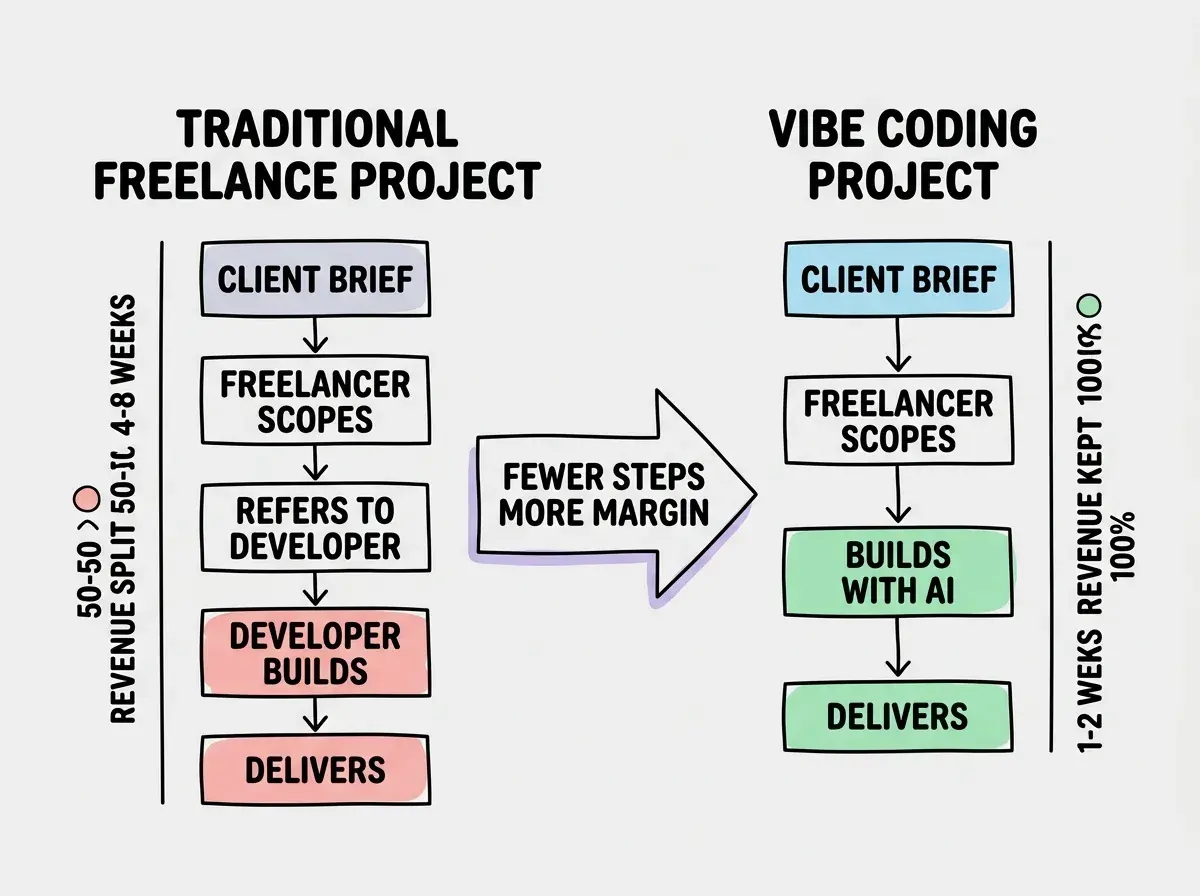
Here is the freelancer's fundamental problem. You have expertise in your domain. You understand your client's business. You know exactly what they need. But when the solution involves building something custom, a dashboard, an internal tool, a landing page with real interactivity, you either partner with a developer (splitting your revenue), refer the client elsewhere (losing the revenue entirely), or hack something together with no-code tools that never quite does what the client wanted.
Vibe coding eliminates that fork in the road.
The Swiss Army Knife in Your Toolbox
Think of vibe coding as the Swiss Army knife you have been carrying around in your pocket without realizing it. You already own it. Your years of client work, your understanding of business problems, your ability to scope projects and manage expectations, that is the knife. Vibe coding just flips open a new blade.
Before AI development tools, that missing blade meant you needed to call someone else every time a project required building something custom. Need a small web app? Call a developer. Need a custom calculator? Call a developer. Every call meant splitting the project, extending the timeline, and adding communication overhead.
Now the blade is there. It might not be a full machete, but for the vast majority of client projects that need a functional tool or a working prototype, it is more than enough.
The numbers back this up. 63% of active vibe coding users are non-developers. They are people like you, professionals with domain expertise who are using AI to extend their capabilities into development. Digital agencies have already hit a 61% adoption rate for AI development tools. Freelancers who move now are not early adopters. They are keeping pace with the agencies they compete against.
Lovable reports that 60% of its users are non-developers, and digital agencies have reached 61% adoption of AI development tools. Freelancers who add vibe coding to their service offerings are not experimenting with fringe technology. They are matching the capabilities that agencies already offer their clients.
The Swiss Army knife metaphor clarifies what vibe coding is not. It is not a career pivot. You are not becoming a developer. You are adding one more blade to the tool you already carry, and that blade happens to unlock a category of projects you previously had to turn down or outsource.
What Clients Actually Pay For
This confuses everyone at first. Freelancers assume that if they are using AI to generate code, clients will not pay premium rates for the output. Why would they? The AI did the work, right?
But that misunderstands what clients are buying. Clients are not buying lines of code. They never were. They are buying a solution to a business problem, delivered by someone they trust, on a timeline that works. Whether you wrote the code by hand, used a template, or directed an AI to build it does not matter to the client. What matters is that the thing works and solves their problem.
You might think that AI-generated code is less valuable because it was "easier" to produce. But actually, the value of a deliverable has never been tied to the effort it took to create it. A logo designer does not charge less because they nailed the concept in twenty minutes instead of twenty hours. A consultant does not discount their rate because the answer came from experience rather than lengthy research. You are selling the outcome, not the process.
Specialists who understand both the business problem and the technical implementation are already charging $200 to $400 per hour for AI development consulting. They charge that because they can translate a client's messy requirements into a working product in days instead of weeks.
The freelancers earning the highest rates are not the ones writing the most sophisticated prompts. They are the ones who understand their client's industry deeply enough to know what to build and how it should work. That knowledge, your knowledge, is the scarce resource. The AI is just the implementation layer.
Building Your Service Offering
The practical path from "freelancer who does X" to "freelancer who does X plus builds custom tools" is shorter than you think. You need to learn how to describe what you want built in clear, specific language, which is a skill you already practice every time you write a client proposal or creative brief.
Start with your existing clients. Look at the projects you have completed in the last year and ask yourself where the client needed something built that you could not deliver. A custom calculator. An interactive tool for their sales team. A dashboard that pulls together data from multiple sources. These are the projects you used to refer out. They are now your projects.
Price the outcome, not the method. If building a custom client portal would cost $15,000 from an agency, your price should reflect the value of that outcome, not the fact that you built it in three days instead of three months. Clients who would have paid an agency $15,000 will happily pay you $8,000 for the same result delivered in a fraction of the time. You earn more per hour. They spend less overall. Everyone wins.
Package it as an add-on first. Do not lead with "I build apps now." Instead, position it as an extension of what you already do. "In addition to the brand strategy, I can build the landing page with the interactive product configurator we discussed." "Along with the content strategy, I can create the content calendar tool your team needs." The development work rides on your existing credibility.
Start with the fundamentals before you start selling AI development as a service.
Learn the basicsScope ruthlessly. The biggest risk for freelancers entering AI development is scope creep. Vibe coding makes it easy to build the first 70% of a project. The last 30%, the edge cases, the error handling, the polish, takes disproportionately longer. Quote for the whole project including that last 30%, not just the exciting first sprint.
The Cleanup Economy
Here is something the vibe coding ecosystem has already produced that freelancers should know about. As more non-developers build things with AI tools, a growing market has emerged for specialists who clean up, refactor, and productionize AI-generated code. This is being called the "cleanup economy," and it represents a real opportunity on both sides.
If you build something for a client that grows beyond what vibe coding can maintain, you will need to bring in a developer to refactor it. That is fine. Budget for it. Tell the client upfront that the prototype phase uses AI development for speed, and that if the project scales, a developer will harden the codebase. This honest framing actually increases client trust because it shows you understand the limitations of your tools.
On the other side, if you are a freelance developer, the cleanup economy is creating steady work. Non-technical builders are producing functional but messy codebases at an unprecedented rate, and they need experienced developers to make those codebases maintainable. Cleanup specialists are charging $200 to $400 per hour because the work requires understanding both the AI-generated code and the business logic it implements.
Trying to handle everything yourself instead of building a referral network. The most successful vibe coding freelancers know when a project has outgrown their AI tools and have a trusted developer ready to take over. Trying to push through complex technical problems with prompt engineering alone leads to fragile code, frustrated clients, and missed deadlines. Build your network before you need it.
Either way, the cleanup economy reinforces the central point. There is real money in the gap between "AI can build this" and "this needs to work reliably in production." Freelancers who position themselves on either side of that gap are building practices with staying power.
Managing Client Expectations
The freelancers who struggle with vibe coding are not the ones who lack technical skill. They are the ones who oversell what AI can deliver.
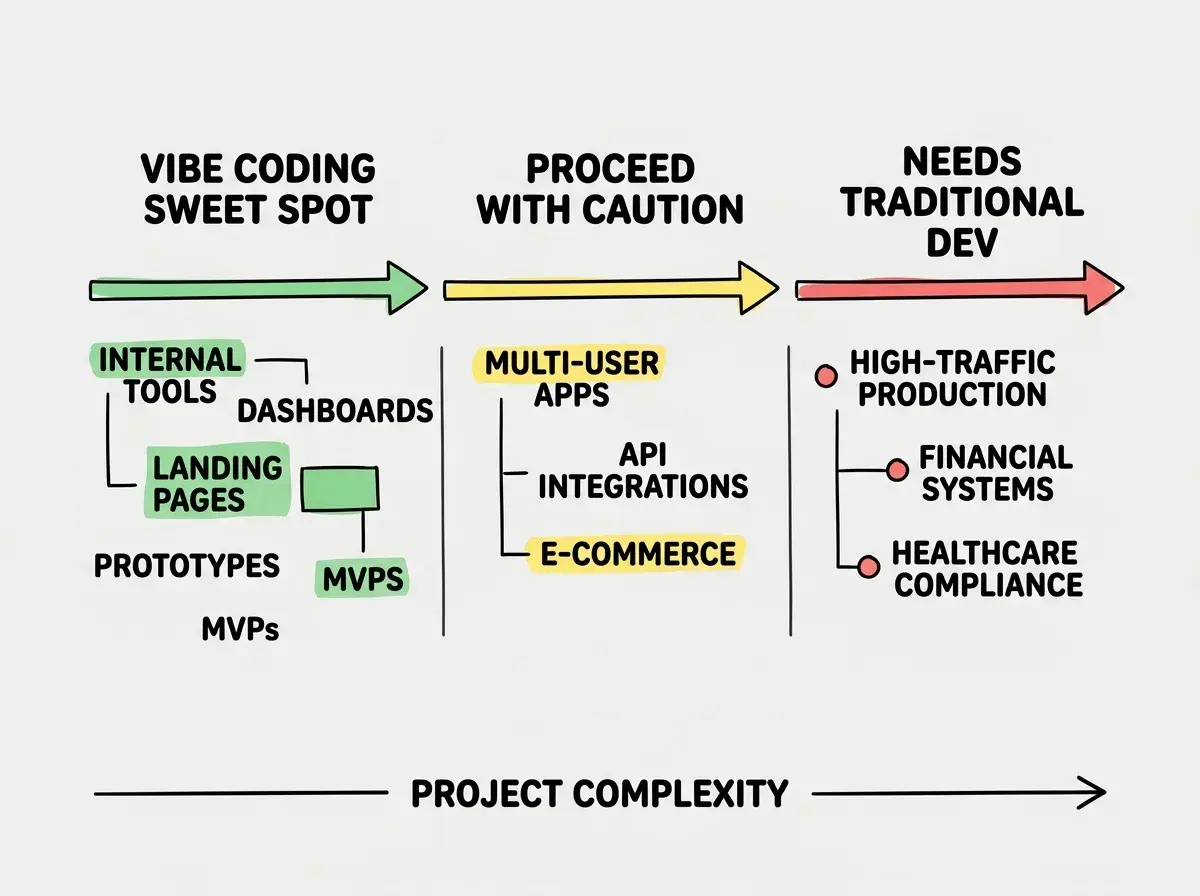
Be transparent about what vibe coding excels at: internal tools, dashboards, landing pages, prototypes, MVPs, and custom utilities. Be equally transparent about what it does not handle well: complex integrations with legacy systems, high-traffic production applications, anything involving sensitive financial transactions or medical data.
The best client conversations sound like this: "I can build you a working version of this tool in two weeks using AI development methods. It will do everything we discussed. If your team loves it and you want to scale it to handle your full user base, we will bring in a development partner to harden the codebase. That second phase is separate, and I will help you scope it." Clients respect this framing. It is honest, it sets clear boundaries, and it gets them a working product fast.
Dig deeper
A few hand-picked sources if you want to go further.
What This Means For You
Vibe coding is not asking freelancers to become developers. It is asking you to stop turning away projects that need something built. The skills that make you a good freelancer, understanding client needs, scoping work, managing expectations, delivering on time, are exactly the skills that make vibe coding effective. The AI handles the implementation. You handle everything else, which turns out to be the hard part.
- If you are a founder: Freelancers with vibe coding skills can build your MVP faster and cheaper than an agency. Look for independent professionals who understand your industry and have added AI development to their toolkit. You will get someone who cares about your project personally, moves fast, and costs a fraction of the agency alternative. Ask them to show you something they have built with AI tools, not just their traditional portfolio.
- If you are a career changer: Freelancing with vibe coding is one of the lowest-friction entry points into independent work. You do not need a development portfolio or a computer science degree. You need domain expertise in any field, the ability to describe problems clearly, and the willingness to learn how AI tools work. Start by building something for yourself, then offer to build something similar for someone you know. Your first paid project will come faster than you expect.
- If you are a student: Pay attention to the freelancers around you who are adding AI development services. The traditional career path of "get a degree, get hired, specialize" is being disrupted by independent professionals who combine multiple skills. Consider building a freelance practice alongside your studies. Even small projects (a local business website, a club's event management tool) will teach you how to scope, build, and deliver with AI tools, and that experience will be more valuable than most coursework.
Learn the vibe coding fundamentals that freelancers are using to win bigger projects.
Get started