Vibe coding for e-commerce means using AI tools to build, customize, and optimize your online store without hiring a development team for every change. With 57% of e-commerce companies already adopting AI tools in their workflows, store owners are discovering that the gap between "I wish my store could do this" and "my store does this" has never been smaller.
If you run an online store, you already know the feeling. You want a custom product comparison page. Or a dashboard that shows your real margins after shipping and returns. Or a landing page for a flash sale that needs to go live in two hours, not two weeks. Every one of these used to require a developer, a budget, and a timeline. Vibe coding collapses all three.
Your Store Is a Machine, Not a Storefront
Here is the analogy that will change how you think about your e-commerce business. Your online store is not a storefront. It is a machine with dozens of moving parts, and most store owners can only reach the parts that their platform exposes through its settings panel.
Think about a vending machine. The customer-facing side is simple: glass window, buttons, payment slot. But behind the panel, there are motors, sensors, inventory tracks, a cooling system, and a logic board that decides what happens when someone presses B7. Shopify, WooCommerce, BigCommerce, they all give you access to the glass window and the buttons. They let you change the colors, rearrange the products, and adjust the prices. But the real leverage is behind the panel. That is where you customize the logic, build internal tools, and create the operational infrastructure that separates a store doing $10K per month from one doing $100K.
Vibe coding gives you access to the machine behind the panel. Not all of it, and not at the deepest level, but enough to build things that used to require a Shopify developer charging $150 per hour.
What You Can Build With Vibe Coding for E-Commerce
This confuses everyone at first. When people hear "vibe coding for e-commerce," they picture building an entire online store from scratch. That is the least interesting use case. The store owners getting the most value from vibe coding are the ones who already have a store and are building everything around it.
Custom storefronts and landing pages. Your platform gives you templates. Templates are fine for getting started, but they are terrible for standing out. Store owners are using AI tools to build custom product pages, seasonal landing pages, and collection pages that match their exact brand vision. A landing page for a Valentine's Day promotion that loads in under two seconds, features a countdown timer, and is perfectly optimized for mobile? That used to be a $3,000 project. With vibe coding, it is an afternoon.
Internal dashboards. This is where the ROI gets serious. Every store owner lives in spreadsheets, pulling data from Shopify analytics, ad platforms, shipping providers, and accounting software, then manually calculating the numbers that actually matter. Vibe coding lets you build a single dashboard that pulls from all your data sources and shows your real numbers. Not revenue (which is vanity), but contribution margin after ad spend, shipping, returns, and COGS. Store owners report that having this visibility alone changes their decision-making speed dramatically.
Product and inventory tools. Bulk editing product descriptions. Generating SEO-optimized meta tags across hundreds of SKUs. Building a tool that alerts you when inventory for your top 20% of products drops below two weeks of supply. These are small, focused tools that each save hours per week. None of them justify hiring a developer. All of them are achievable with vibe coding.
The 57% AI adoption rate in e-commerce is not about stores built entirely by AI. It is about existing store owners using AI tools to build custom solutions around their platform, from internal dashboards to landing pages to inventory alerts. The highest-ROI applications are the operational tools nobody else sees.
Checkout and post-purchase optimization. You might think checkout optimization requires deep technical knowledge. But actually, many of the highest-impact changes are surprisingly accessible. Custom thank-you pages with upsell logic. Post-purchase survey forms that feed data into a simple dashboard. Abandoned cart recovery pages with personalized messaging. These are the kinds of focused, single-purpose tools that vibe coding handles exceptionally well.
The Revenue Math That Changes Everything
Let us talk about money, because that is what e-commerce ultimately comes down to.
A custom landing page for a product launch might cost $2,000 to $5,000 from a freelance developer. If that landing page converts 1.5% better than your template page, and you are driving 10,000 visitors to it during a launch, that is 150 additional sales. At a $50 average order value, that is $7,500 in incremental revenue from one page. The developer cost might still make sense at that scale. But what if you need twelve landing pages per year? Or what if you need to test three variations of each page to find the one that converts best?
This is where vibe coding transforms the economics. When the cost of building a landing page drops from $3,000 to your own afternoon, you stop treating landing pages as expensive investments and start treating them as cheap experiments. You build one for every product launch, every seasonal promotion, every new collection. You test variations because the cost of testing is nearly zero.
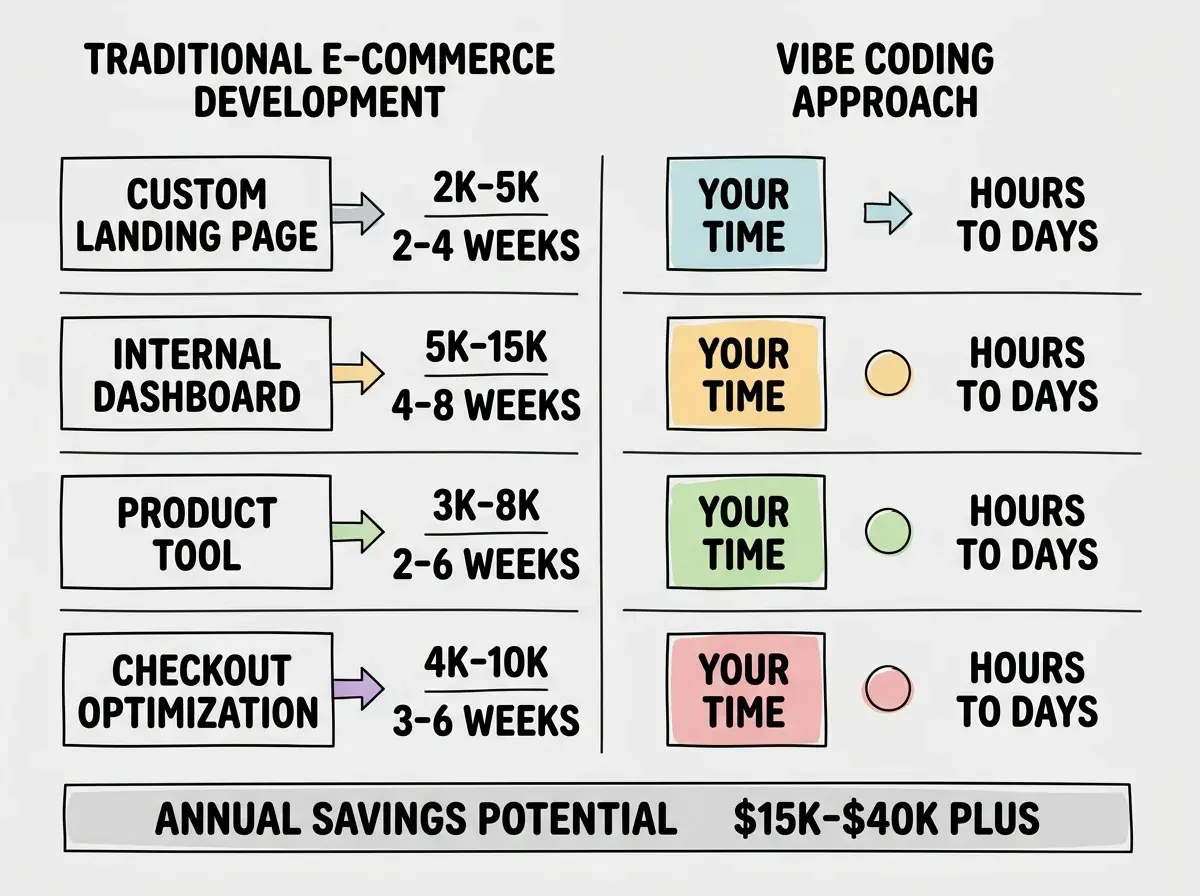
The same math applies to internal tools. An operations dashboard built by a developer costs $5,000 to $15,000. The vibe-coded version might not be as polished, but it shows you the same numbers. And because you built it, you can change it whenever your business changes. New supplier? Add a column. New ad platform? Add a data source. No tickets, no waiting.
The store owners winning with vibe coding are not building the prettiest tools. They are building the most tools, iterating based on real data, and treating every operational friction point as a focused afternoon of building.
Where Vibe Coding Hits a Wall in E-Commerce
Honesty matters, so let us talk about the limits.
Payment processing is not a vibe coding project. Anything that touches credit card data, PCI compliance, or financial transactions needs proper engineering. Your Stripe integration, your payment gateway configuration, your subscription billing logic; leave these to your platform or a qualified developer. The risk of getting payments wrong is not just a bug, it is a business-ending liability.
Inventory management at scale, meaning thousands of SKUs with complex warehouse logic and multi-channel fulfillment, is another boundary. You can build alerting and monitoring tools with vibe coding. You should not build the core inventory system itself.
Building customer-facing features before internal tools. Store owners get excited about custom storefronts and skip the operational infrastructure. Start with an internal dashboard or a product management tool first. These have immediate, measurable ROI because they save you hours every week. They also let you learn vibe coding in a low-risk environment where bugs do not affect your customers.
Security and authentication for customer accounts also fall outside the vibe coding zone. Your platform handles login, password resets, and account security for good reason. Do not try to replace or modify these systems.
The pattern is straightforward. If something going wrong could cost you money, lose customer data, or create legal liability, it is not a vibe coding project. If something going wrong just means a page looks a little off or a dashboard shows stale data for an hour, build away.
Learn the fundamentals that help you build tools for your store with confidence.
Start learningA Practical Starting Point for Store Owners
If you are reading this and running an online store, here is where to start this week. Not next month. This week.
Open a spreadsheet and list every task you do manually more than twice a month. Pulling reports. Calculating margins. Updating product descriptions. Checking competitor prices. Formatting email content. Generating social media copy from product descriptions. Every one of these is a candidate for a vibe-coded tool.
Pick the one that annoys you the most and takes the least data to solve. Usually this is a margin calculator or a product description generator. Build that first. It will take a few hours, and the result will not be pretty, but it will work. And the next morning, when you use it instead of doing the task manually, you will understand viscerally why 57% of e-commerce companies have already adopted these tools.
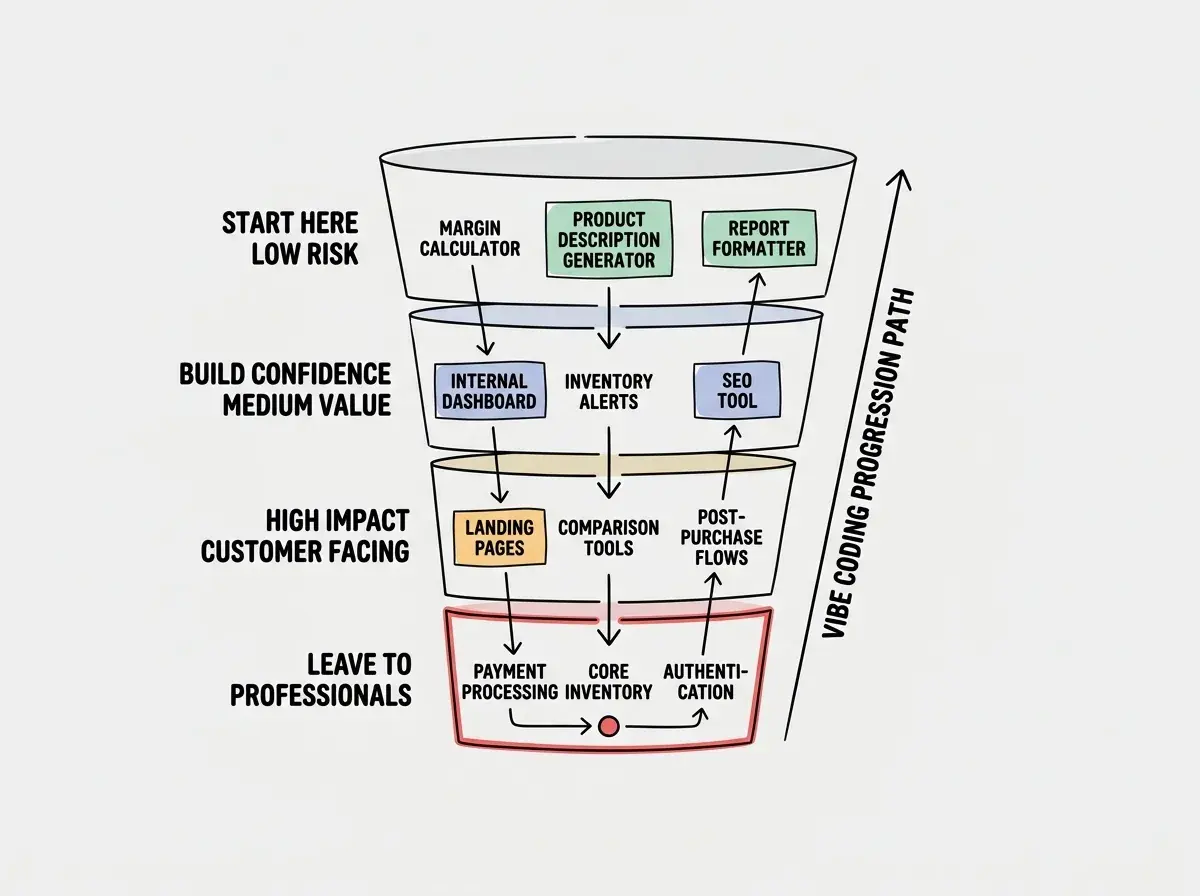
Then pick the next one. And the next one. Each small tool compounds. Your margin calculator feeds into your dashboard. Your product description generator connects to your landing page builder. Your inventory alerts inform your purchasing decisions. Over six months, you are not just a store owner who knows vibe coding. You are a store owner with a custom operational infrastructure that none of your competitors have.
Dig deeper
A few hand-picked sources if you want to go further.
What This Means For You
Vibe coding does not replace your e-commerce platform. It fills the gaps your platform was never designed to cover, the custom tools, dashboards, and pages that make your specific business run better.
- If you are a founder running a store: Start with internal tools that save you time every week. A margin calculator, an inventory alert system, or a unified dashboard will pay for itself in hours saved within the first month. The customer-facing applications (custom landing pages, optimized product pages) come next, once you are comfortable with the workflow and can iterate quickly.
- If you are a career changer entering e-commerce: Combining e-commerce knowledge with vibe coding skills makes you extraordinarily valuable. Brands need people who understand both the business logic and the tools to build custom solutions. Positioning yourself as someone who can diagnose an operational bottleneck and then build the tool to fix it puts you in a category with very little competition.
- If you are a student studying business or marketing: Building a small e-commerce project with vibe-coded tools is one of the best portfolio pieces you can create. It demonstrates business thinking (why this tool matters for revenue), technical capability (you built it), and initiative (you did not wait to be assigned the project). Interviewers notice when candidates have built real things that solve real problems.
Explore the vibe coding fundamentals that power custom e-commerce tools.
Explore more