The AI code review habit is the most important skill in vibe coding, and it is the first one to disappear. The compulsive accept trap is what happens when you stop reviewing AI-generated code and start hitting "accept" on everything, a behavioral pattern so common that 41% of AI-generated code ends up being reverted within two weeks.
That statistic should stop you cold. Nearly half of the code you accept without reviewing will need to be undone. But knowing this fact is not enough to change the behavior, because the trap is not about knowledge. It is about psychology.
How the Trap Takes Hold
The compulsive accept trap does not happen all at once. It creeps in gradually, like falling asleep at the wheel. One developer described the experience with painful clarity: "I reward-hacked myself. I would set up strict rules but slid into compulsive accept mode." That phrase, "reward-hacked myself," captures the mechanism perfectly.
Think of it like auto-pilot in a car. The first time you engage auto-pilot, you watch the road intensely. Your hands hover over the wheel. You check every lane change, every speed adjustment. But after an hour, your attention drifts. After two hours, you are checking your phone. After a week of daily use, you barely watch the road at all. Nothing went wrong to make you stop paying attention. The absence of problems became the reason you stopped looking.
AI coding tools follow the same pattern. Your first day with Copilot or Cursor, you read every suggestion carefully. You compare it to what you would have written. You catch a few errors and feel good about your diligence. By the second week, the suggestions keep being mostly right, so you start accepting faster. By the third week, you are accepting without reading. By the fourth week, you have lost the habit entirely.
AI output is, as one researcher described it, "a system totally optimized to make you say yes." The code looks clean, uses proper formatting, includes comments, and appears to handle edge cases. It is engineered to pass visual inspection, which makes compulsive acceptance feel rational even when it is not.
The optimization is not intentional in the way advertising is intentional. Nobody at OpenAI or Anthropic designed their tools to trick you into accepting bad code. But the training process, which rewards generating code that looks like high-quality human code, produces output that is visually indistinguishable from well-written code. The superficial signals of quality, clean formatting, consistent naming, appropriate comments, are all present even when the logic is wrong.
Auto-Pilot and the Attention Cliff
The auto-pilot analogy extends further than you might expect. In aviation, there is a well-documented phenomenon called automation complacency, where pilots who rely on auto-pilot for extended periods lose the ability to respond quickly when something goes wrong. The longer the auto-pilot runs without incident, the worse the human's reaction time becomes when an incident finally occurs.
Software development has its own version of this. A developer with twenty years of experience described investing 400 hours into an AI-assisted project: "I turned into QA testing work of a bad engineer and became exhausted." The project grew to nearly a million lines of code. By that point, restarting was impossible and reviewing was overwhelming. The auto-pilot had been running for so long that taking manual control felt hopeless.
This is the cruel twist of the compulsive accept trap. The longer you stay in it, the harder it is to escape. Each accepted suggestion makes the codebase larger and harder to review. Each unreview ed line of code adds to the technical debt you cannot see. The project grows beyond your ability to understand it, and you become dependent on the AI not just for writing code but for understanding code the AI already wrote.
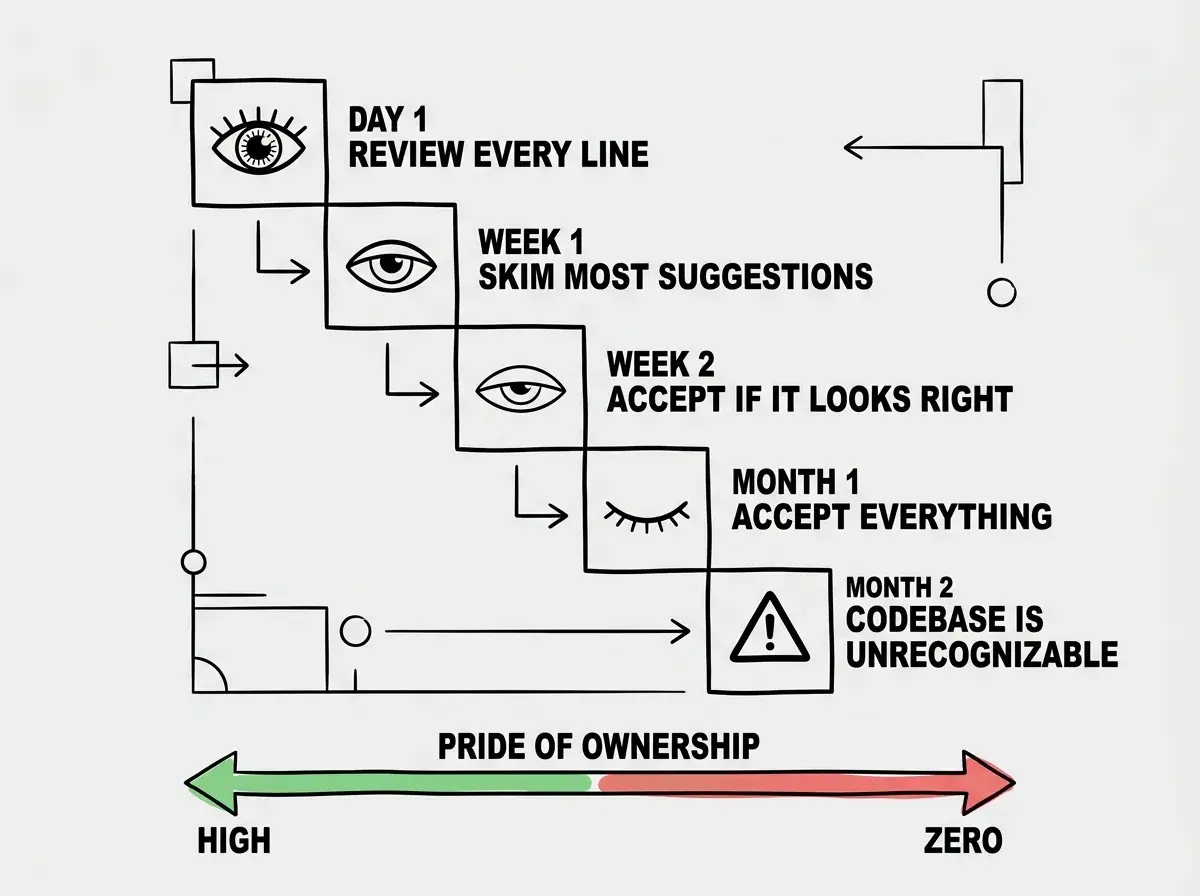
The attention cliff also affects your emotional relationship with your project. As one developer noted, "pride of ownership diminishes, patience drops to zero." When you stop reviewing code, you stop understanding your own project. When you stop understanding your project, you stop caring about its quality. This is not laziness. It is the predictable result of being disconnected from what you are building.
The Three-Second Rule and Other Escape Strategies
This confuses everyone at first because the solution seems obvious: just review the code. But willpower alone does not work against a behavioral trap this strong. You need structural changes that make compulsive acceptance harder and deliberate review easier.
The three-second rule. Before accepting any AI suggestion, pause for three seconds and read the first and last lines of the generated code. This is not a thorough review. It is a circuit breaker that prevents you from accepting on autopilot. Three seconds is short enough that it does not destroy your flow and long enough that it forces you to actually look at what you are accepting. If anything looks unfamiliar, that is your signal to read the whole thing.
Defensive commits. Commit your code before every AI interaction. Every single time. This means that if the AI breaks something, you can instantly revert to a known-good state. More importantly, it creates a psychological safety net. You are more willing to reject AI output when you know you can get back to where you were. Without that safety net, the fear of losing progress makes you accept things you should reject.
Small changes to your workflow prevent the biggest mistakes.
Learn the basicsRead diffs, not files. After the AI generates code, do not try to read the entire file. Read the diff, the specific lines that changed. Most AI tools and code editors show diffs by default, but many developers skip past them because the green-and-red display feels less important than the final result. Train yourself to read the diff first. It is a fraction of the code but it contains 100% of the risk.
Why 41% Revert Rate Matters More Than You Think
You might think a 41% revert rate is not that bad. After all, 59% of the code sticks. But actually, the cost of reverted code is not symmetrical with the benefit of kept code. Writing code takes minutes. Debugging code that should have been caught in review, finding the subtle bug that slipped through, tracing the regression that broke a feature three days later, that takes hours.
The 41% revert rate is also an average. For developers deep in the compulsive accept trap, the rate is almost certainly higher. For developers who maintain strong review habits, it is lower. The revert rate is not a fixed property of AI tools. It is a measurement of how much human attention the code received before merging.
The security dimension makes this even more consequential. Veracode's 2025 study found that 45% of AI-generated code introduces security vulnerabilities. When you compulsively accept code, you are not just accepting logic bugs that cause errors. You are accepting security flaws that expose your users. The Lovable platform discovered this when CVE-2025-48757 revealed missing Row Level Security across 170 production applications, code that had been accepted without adequate review.
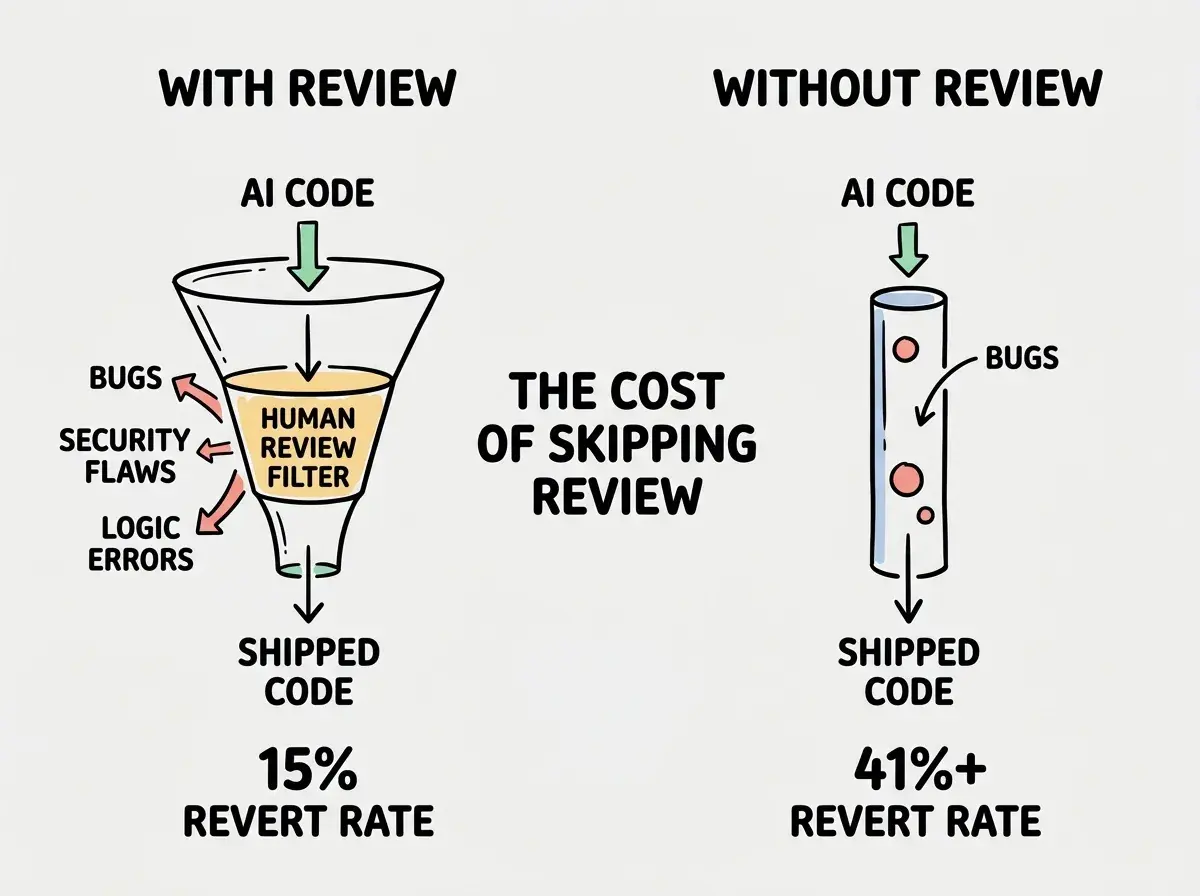
The compulsive accept trap is particularly dangerous for founders and indie hackers building products alone. Without a team to catch errors, without code review from colleagues, the only quality gate is your own attention. When that attention fails, nothing stands between AI-generated vulnerabilities and your users.
Believing that you will "go back and review later" after you finish building. You will not. The codebase will be too large, the context will be lost, and the pressure to ship will only increase. Review now or accept the debt forever. There is no "later" in the compulsive accept trap.
Breaking free from the compulsive accept trap is not about being a better developer. It is about recognizing that AI tools are optimized to make you say yes, and building workflows that force you to actually look before you do.
What This Means For You
The compulsive accept trap is the most common behavioral failure in vibe coding, and it affects experienced developers just as much as beginners. The 400-hour cautionary tale came from someone with twenty years of experience. Seniority does not protect you. Only habits do.
- If you are a founder, the compulsive accept trap is your biggest risk. You are building fast, alone, under pressure. Every incentive pushes you toward accepting without reviewing. Institute the three-second rule and defensive commits today, before the codebase grows beyond your ability to audit it.
- If you are changing careers, build the review habit before you build the acceptance habit. The order matters. If your first experience with AI tools includes careful review, that behavior becomes your baseline. If you start by accepting everything, you have to unlearn a habit before you can learn the right one.
- If you are an indie hacker, you are the most vulnerable persona because you have no teammates to catch what you miss. Consider using AI-powered code review tools as a second layer of defense. They are not perfect, but they catch the obvious issues that slip past compulsive acceptance.
- If you are a student, practice reading AI-generated code critically before you ever use it in a real project. Take a suggestion, read it line by line, and try to find the bug before running it. This is the single most valuable exercise for building the review muscle that protects you from the trap.
The difference between shipping quality code and reverting it is three seconds of attention.
Keep reading