To build the business case for AI-assisted development in enterprise in 2026, frame value across four pillars that resonate with enterprise decision makers (developer productivity gains with measurable hours saved, faster time-to-market for product features, improved code quality through AI-assisted review, and reduced operational costs through automation), provide specific metrics rather than abstract claims, and address the predictable objections about security, governance, and ROI before they derail the conversation. Enterprise adoption requires different framing than startup adoption; understanding the difference is the work.
This piece walks through the four value pillars, the metrics that move enterprise decisions, the objections you must address, and the four mistakes presenters make when pitching AI tools to enterprise audiences.
Why Enterprise Cases Need Different Framing
Startups adopt AI tools because they need speed; enterprises adopt them because they need defensible business cases. The same tool requires different framing for each audience; what wins startup adoption fails in enterprise pitches and vice versa.
The 2026 reality is that enterprise AI adoption has accelerated but remains gated by formal procurement processes. Successful proposals address the formal evaluation criteria; unsuccessful proposals assume enterprise buyers think like individual developers.
A 2025 Gartner enterprise AI adoption survey of 800 IT leaders found that AI coding tools with strong business cases (specific metrics, clear ROI, addressed objections) achieved adoption in 67 percent of pitched organizations, while pitches lacking these elements achieved adoption in only 18 percent. The framing matters more than the underlying tool capability; the same tool wins or loses based on how the case is built.
The pattern to copy is the way enterprise software has always been sold. Salesforce, Workday, ServiceNow each built business cases around specific value pillars that mattered to enterprise buyers. AI coding tools follow the same pattern; the capability is real, but the case must be built specifically for enterprise audiences.
The Four Pillars of Enterprise Value
Four pillars consistently work for enterprise AI tool business cases.
Pillar 1, developer productivity gains with measurable hours saved. Concrete time saved per developer per week. Multiplied across team size, the number becomes substantial enough to justify the tool investment many times over.
Pillar 2, faster time-to-market for product features. Features ship faster; revenue from features arrives sooner. Time-to-market improvements have direct revenue implications enterprise buyers respect because they connect to top-line growth.
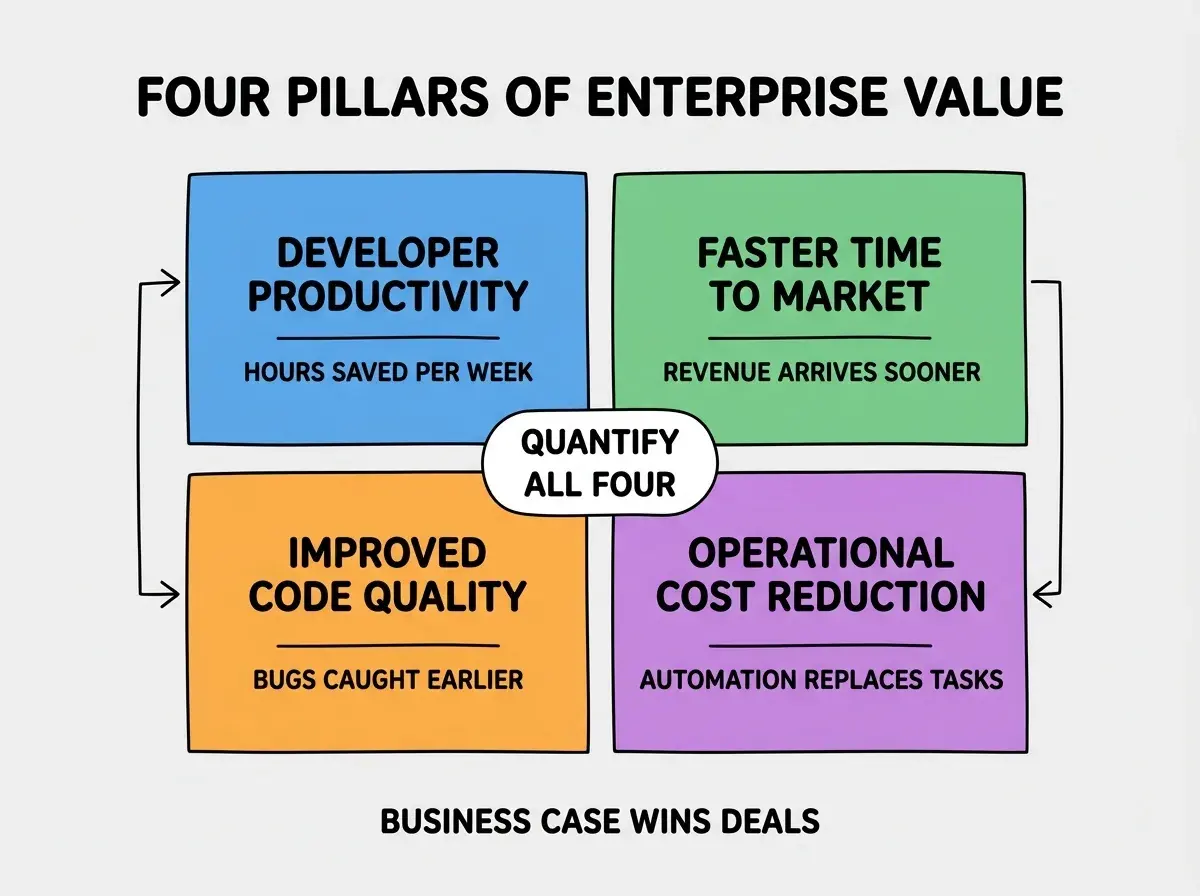
Pillar 3, improved code quality through AI-assisted review. Bugs caught earlier cost less; fewer production incidents save real money. Quality improvements have measurable financial impact in enterprise contexts where production incidents carry substantial business cost.
Pillar 4, reduced operational costs through automation. Tasks previously requiring expensive engineer time become AI-handled. Operational savings compound across team and time, producing the multi-year ROI that enterprise CFOs want to see.
The Metrics That Move Enterprise Decisions
Three metric types consistently appear in winning enterprise business cases.
Metric 1, total cost of ownership over 3 years. Enterprise buyers think in 3-year horizons. Calculate licensing, training, integration, support, and benefits over 3 years; the long view often wins where short view does not.
Browse more enterprise adoption guides
Read more foundations articlesMetric 2, payback period in months. Months until savings exceed investment. Payback periods under 12 months get fast approval; longer paybacks need stronger justification.
Metric 3, risk-adjusted ROI with conservative assumptions. Enterprise buyers apply risk discounts to optimistic projections. Conservative assumptions that still produce attractive returns win more deals than aggressive assumptions that look impressive but feel inflated.
The Objections You Must Address
Three objections appear in nearly every enterprise AI tool conversation.
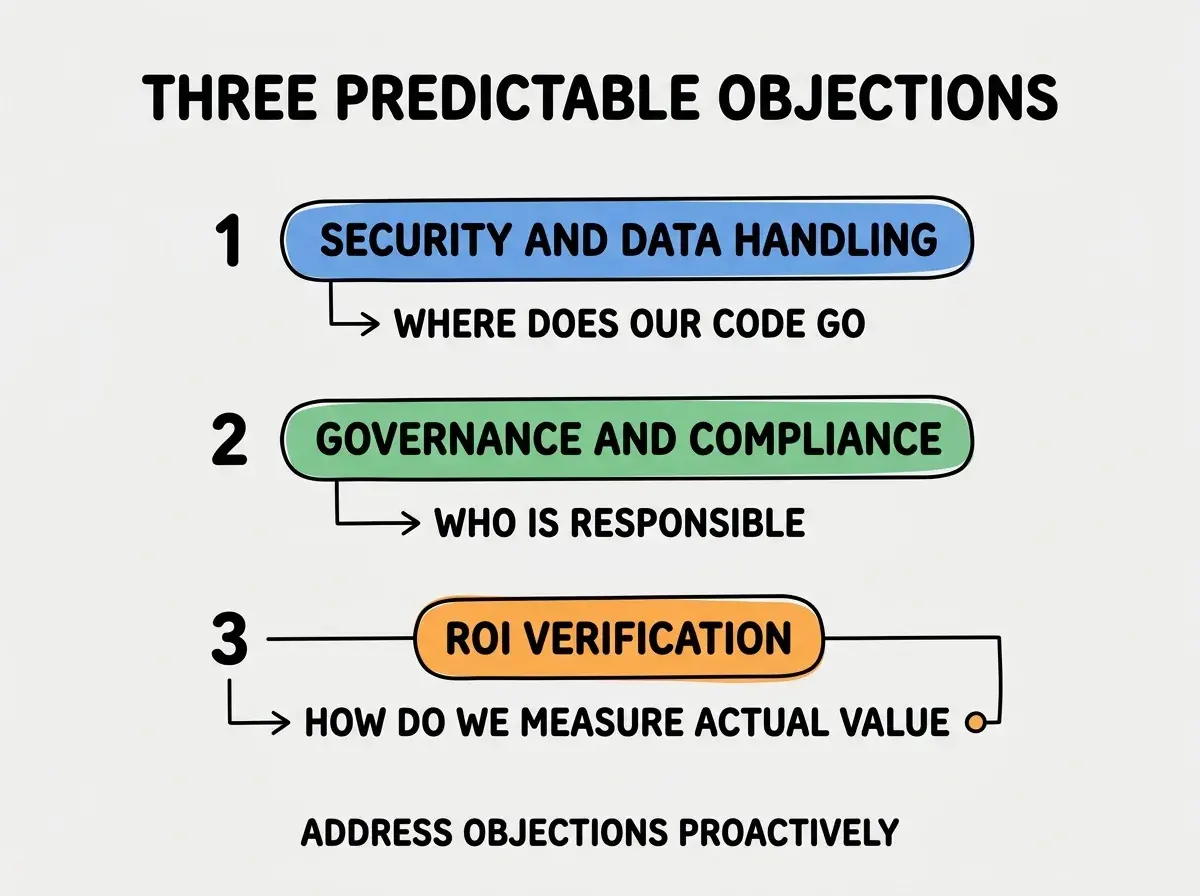
Objection 1, security and data handling. "Where does our code go? Who sees it? How is it stored?" Address with specific vendor data handling policies, enterprise tier features, and customer references in similar contexts.
Objection 2, governance and compliance. "Who is responsible if AI-generated code causes problems? How do we audit AI usage?" Address with vendor liability terms, audit logs, and specific compliance certifications.
Objection 3, ROI verification. "How do we measure actual value once deployed?" Address with measurement frameworks, pilot program structures, and reporting capabilities built into the tool.
How to Run a Successful Pilot Program
Three pilot patterns produce results that win full deployment approval.
Pattern 1, define success criteria upfront with stakeholders. Specific metrics, specific thresholds, specific timeline. Without upfront agreement, post-pilot debates about success kill many otherwise successful pilots.
Pattern 2, choose pilot team that represents broader use. Not the most technical team; not the least technical. A team that resembles the broader population produces results that generalize.
Pattern 3, document everything during pilot for post-pilot decision. Time savings, quality changes, adoption patterns, friction points. The documentation supports the broader rollout case; without it, the pilot produces only impressions.
The combination produces pilots that move forward decisively. Without these patterns, pilots often produce ambiguous results that stall rollout indefinitely.
How to Structure the Pitch
Three structural patterns produce successful enterprise pitches.
Pattern A, lead with executive summary including all four pillars. Decision makers often read only the first page. Make the four-pillar value visible immediately; details come later.
Pattern B, include detailed pilot program proposal. Enterprises rarely commit to full deployment without pilot. Propose specific pilot scope, success criteria, and decision gates upfront.
Pattern C, provide reference customers similar to the audience. Same industry, same size, same regulatory environment. Generic references convince less than specific peer references.
The combination produces pitches that win enterprise approvals. Without structure, pitches default to feature lists that fail to motivate enterprise decision makers.
The most damaging enterprise pitch mistake is copying startup pitch energy. Startup pitches lead with disruption, speed, and visionary outcomes; enterprise pitches lead with risk reduction, measurable value, and integration with existing systems. The fix is to translate the same underlying capability into the appropriate framing for the audience. The tool that "moves fast and breaks things" for startups becomes the tool that "improves productivity within existing controls" for enterprise; the framing changes the conversation.
The other mistake is underselling the change management requirement. AI tool adoption requires real workflow changes, training investment, and culture adaptation. Pitches that minimize the change management often fail because enterprise buyers know change management costs and distrust pitches that ignore them. The fix is to address change management explicitly and budget for it in the business case.
A third mistake is failing to involve the right stakeholders early. Enterprise procurement typically includes IT, security, finance, legal, and end-user teams. The fix is to map stakeholders early and engage each appropriately; pitches that miss key stakeholders get blocked late in the process.
A fourth mistake is treating procurement timeline as the same as decision timeline. Enterprise decisions can happen quickly; procurement to live deployment often takes months. The fix is to set expectations on both timelines distinctly and plan accordingly.
What This Means For You
Building enterprise business cases for AI tools is real skill in 2026. The four pillars, metrics, and objection handling produce successful enterprise adoption.
- If you're a founder: Even if you do not sell to enterprise yourself, understanding enterprise framing helps when your customers face internal AI procurement processes. Help them succeed internally.
- If you're changing careers into enterprise sales: AI tool sales is high-leverage opportunity. The skills transfer across enterprise software more broadly.
- If you're a student: Study how enterprise procurement actually works. The business case construction skill is increasingly valuable across many roles.
Browse more enterprise adoption guides
Read more foundations articles